
Your Partner Doesn’t Suck as Bad as You Think

The one about expectations in romantic relationships.
At one point, your romantic partner was a stranger. Consequently, you expected little from them. In the early days of dating, you’re mostly just happy to spend time with this new person. If that stranger were to help you out around the house or drive you to the airport, you would be appreciative. Maybe even blown away: “Wow, they didn’t need to do that! I’m so grateful!”
It’s nice the first few times your partner does a chore for you; you’re glad to have some support. This feeling doesn’t last long. Over time, what was once viewed as a favor becomes an expectation. What was once novel and exciting becomes banal and uninteresting. Your partner’s efforts become like that couch you were once ecstatic to buy—comfortable furniture that has faded into the background of your attention. You become entitled to its comfort. This doesn’t make you a butthole; it makes you normal. Our brains are designed to lose interest in things that are commonplace and to keep moving the goalpost for what constitutes “impressive.”
It’s Normal for Expectations to Increase Over Time


Hedonic adaptation is the fancy way of saying that we eventually get used to anything—good or bad. And as we become accustomed to the nice things our partner does for us, acts that used to feel extraordinary begin to feel just plain ordinary. Our expectations adapt. We can feel entitled to any level of effort, big or small, from our partners. Why else is it that one person might feel over the moon that their partner actually remembered their anniversary while another is grumpy because they didn’t receive the expensive trip they were hoping for?
I have single friends who say things like, “I just want to find someone I can come home to and watch Netflix with.”

That’s how it starts out. But I’ve yet to meet anyone able to hold onto the extremely low bar of “able to watch Netflix” past the third date. Our list goes from “able to watch Netflix” to “buys nice presents, is charming at dinner parties, impresses my mom, apologizes appropriately, cleans the bathroom correctly, shares my parenting philosophy, and yada yada yada” in no time flat.

It reminds me of that scene in the movie The Jerk, where Steve Martin’s character loses everything and gets dumped. As he leaves, he starts out saying he doesn’t need anything, but then keeps adding more and more things that he “needs”.
He doesn’t need any of this! (Except the ashtray, oh and the paddle game, and the remote control, the lamp, the chair, the matches, and a magazine.)
We start out with good intentions. We start out so easy to please. We don’t need any of this. We’re just delighted that they like us, they text us, they spend time with us. And then something starts to shift, and we become jerks like Steve Martin’s character did:

Slowly but surely, our expectations creep up. It starts with the small things: who plans the dates, who drives, who cooks, who orders the food, who books the travel, how to clean properly. You start to care about your partner’s ability to contribute to your shared responsibilities. You don’t want to bear an unfair share of the grunt work. So you start keeping score—noticing who is contributing what and when. You start to care quite a lot about your partner’s ability to do things other than watch Netflix with you, like how often they empty the dishwasher or replace the toilet paper. It turns out maybe you do need the ashtray, paddle game, remote control, lamp, magazine, matches, and chair.

Happiness = Expectations Minus Reality
Our expectations tend to go up up up, higher higher higher over time, making it harder and harder to satisfy us. This is as true for the endeavor of choosing a mate as it is for setting the bar for our partner’s contributions. When I was in 8th grade, I thought it was so cool that my 10th grade boyfriend worked at the fast-food chain Wendy’s. Eventually, guys I dated also needed to have their own car, their own apartment, and have a modicum of ambition. Then I realized they also needed to eat healthy, read books, and enjoy intellectual conversations. Left to your brain’s devices, the bar keeps rising and rising. The more boxes that need checking, the more opportunities there are to feel disappointed. In other words, expectations are a bitch.
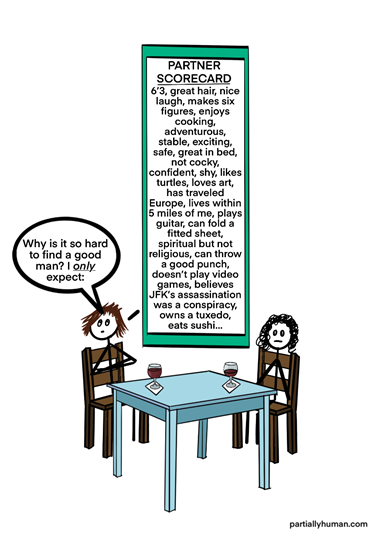
This nitpicky tendency reminds me of a time when I was standing in line at a fancy, expensive food and wine festival waiting to get in after collecting my complimentary tote bag and wine glass. Behind me in line, a lady said with disappointment, “Ugh. This wine glass isn’t REAL crystal. Last year it was real crystal.” This is a classic human response to attending an amazing event full of fine food, wine, and entertainment on a beautiful, sunny day—noticing the one thing that isn’t perfect.
Expectations Start Choking the Life Out of the Relationship
Left unchecked, we become practically unpleasable. We develop more and more requirements, preferences, hopes, desires, and specifications for our partner to meet, chore-related and otherwise. What changed? Why is it that they used to be able to make your day with one sweet text message? And now you don’t bat an eyelash at them making dinner or taking out the trash? Whereas at one point you would have been over the moon that they handled buying some plane tickets, now you’re livid that they booked you a window seat when they should know you prefer the aisle. Previously impressive feats—like grocery shopping to your exact specifications—become underwhelming.
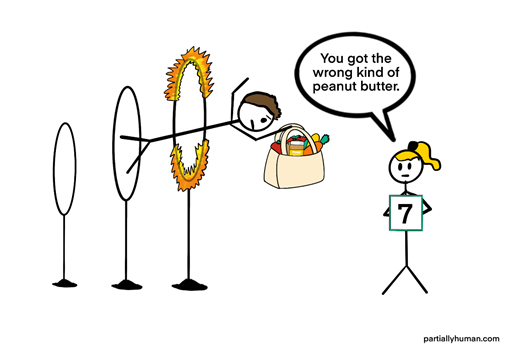
This tendency rears its ugly head saliently when it comes to household chores. We have standards for how we want to live, and we want our partner to partake in meeting those standards. But did you start dating your partner because what was missing from your life was someone who loads the dishwasher to your exact specifications? Of course not. But at some point, their role—and value—insidiously shifts and comes to be measured by their ability to check things off a to-do list. Is that the most important part of having a romantic partner? Or is it just that the ability to manage household affairs is what becomes most noticeable in the realm of domestic life? It’s all very silly when you think about it. But in another, very real sense, these practical things matter.
We Want Things to Be Fair
I’m not saying that your partner shouldn’t have to do anything around the house because you should just be happy enough that you get to spend time with them. Not at all! Not even close! What I’m saying is that it’s common for people to obsess about their partner doing their “fair” share, and, in the process, they make their partner and themselves miserable. Yes, you both need to get stuff done. Yes, you both need to contribute. No, it doesn’t need to be 50/50. No, your partner doesn’t have to do things to your exact specifications. No, your partner’s value can’t be measured on a chore chart. They are not your employee. They are not your housekeeper. The sum total of their worth is not made up of the things they do for you.
As most people in their 20s do, I had to learn these lessons the hard way. I regularly fixated on making sure past boyfriends did their “fair” share. Spoiler Alert: this morphs your relationship into something that feels more akin to a sibling rivalry than a romantic, mutually satisfying partnership. As it turns out, people have different definitions of what’s fair. And they have different opinions on what constitutes “clean” and “good enough.” They have different views on what things even need to be done in the first place. More importantly, they have different capacities for staying on top of life’s to-do list. A rigid adherence to making sure things are 50/50 turns out to be impossible to execute and really quite silly!
Eventually, I lived with someone who was terrible at staying on top of chores. He was the nicest, funniest, most caring guy you could imagine, but he was much less productive than I was. While I cut through our to-do list like a buzzsaw, he barely accomplished half of the things he was supposed to do. This was hard for me. And the issue was compounded by the fact that I worked from home two days per week—allowing me to complete some tasks in lieu of a commute or between meetings—while he worked long, exhausting hours, with less time and energy to get things done. This allowed me to do EVEN MORE around the house, putting his chore debt deeper and deeper in the red. Every weekend, I would silently take note of any time he spent not catching up on his chores. When he inevitably didn’t accomplish everything, I would point out all the time he spent playing video games and scrolling through his phone, irritated that—once again—he dropped the ball. (I was a real peach, huh?)
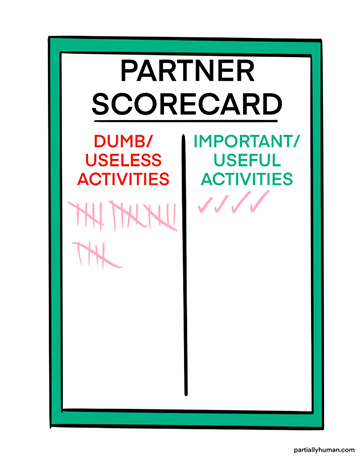
This is a thought pattern that develops at a young age for many. Siblings fight about getting the EXACT same number of Christmas presents, the EXACT same privileges and punishments, PERFECTLY EQUAL treatment. You know who else measures fairness this way? Monkeys, as demonstrated in this 3-minute video:
This instinct runs deep in us. And once we feel victimized by the burden of doing more than someone else or getting less than we “deserve,” we become spiteful, exacting revenge in petty ways that make us feel like we are merely restoring justice.
Of course, no one wants to get the short end of the stick or to be taken advantage of. But these tit-for-tat thought patterns become mental habits that no longer make sense as adults. One time, while on vacation in my 30s, I was eating lunch, and I remember looking around at everyone else’s brownie to make sure no one had a bigger, better piece than I did. This made no sense; it was a self-serve buffet. All-you-can-eat. I could have grabbed 10 brownies if I wanted. And I’m an adult; I can buy or make myself brownies anytime I want. And furthermore, so what if someone got a bigger brownie? I still got to have a brownie. Couldn’t I just enjoy the treat?

This tit-for-tat mindset is especially silly because humans are EPIC FAILURES at accurately counting the contributions of others. We tend to give ourselves more credit for what we do and discount others’ efforts. When you ask people what percentage of the work they are doing in their marriage or on a work team, and then add up everyone’s answers, it always comes out to more than 100%. So even if you and your partner somehow magically manage to divide tasks up 50/50, you lack the ability to mentally measure that fact fairly or accurately. You are hyper aware of your own contributions—awarding yourself full-credit for everything you do—and dimly aware of other’s contributions—awarding them partial credit.
Chores Without Scores
I can’t say I’m proud of my boyfriend’s and my solution, but it did break me out of this task-obsessed mindset: He started paying me to do his chores. And POOF, I stopped keeping score. Just like that, I no longer cared what he did around the house; I was more than happy to do everything. Better yet, things were now done exactly to my standards, on my exact timetable! Hallelujah! (This must be what heaven feels like.)
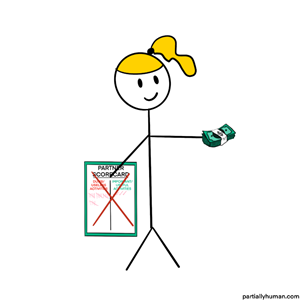
We eventually broke up. (I know—shocker. Hard to imagine why anyone would let a prize like this go.) I got my own place. Then, with the chores truly all my responsibility, I found a happy rhythm to getting things done. But it wasn’t long until I thought, “Gee, it would be nice if I just had someone who would take out the trash occasionally and maybe split the internet bill with me.” Funny how that works. And then I met my future husband. And let’s just say… how do I put this nicely… we had different cleanliness standards.
He nearly pooped his pants when he saw my house for the first time; it was immaculate. As a lifelong Clutter Pirate, he knew the nagging that was in store for him if he dated me. Not one to give up easily; he proposed. Since we both brandished battle scars from past conflicts over domestic life, we handled our discussions about moving in together like European Union negotiations. We had spreadsheets, charts, budgets, lists, and Google Docs that laid out the minutia of our roles and responsibilities, household maintenance, cleaning preferences and schedules—all the day-to-day things cohabitors must navigate.
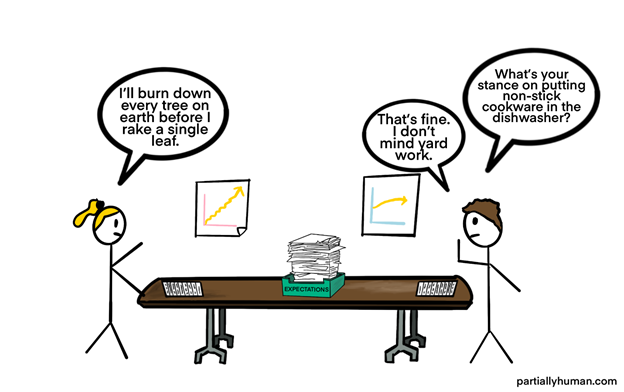
I know this sounds litigious and exactly like the type of thing I’ve been saying we need to move away from, but hear me out.
Yes, we still wanted things to be “fair.” This time though, we had a new definition of fair. It wasn’t about splitting chores 50/50. It was about understanding each other’s preferences, habits, and strengths so we could figure out systems and routines that worked for both of us. It was about setting realistic expectations that we could both be happy with. It was about finding out what we each bring to the table and offering up what we have available to give. We tossed out the scorecard and aimed at just trying to do the best that two flawed fancy monkeys could do.

What does it even look like to just love someone without all the baggage?
Love Without Scores
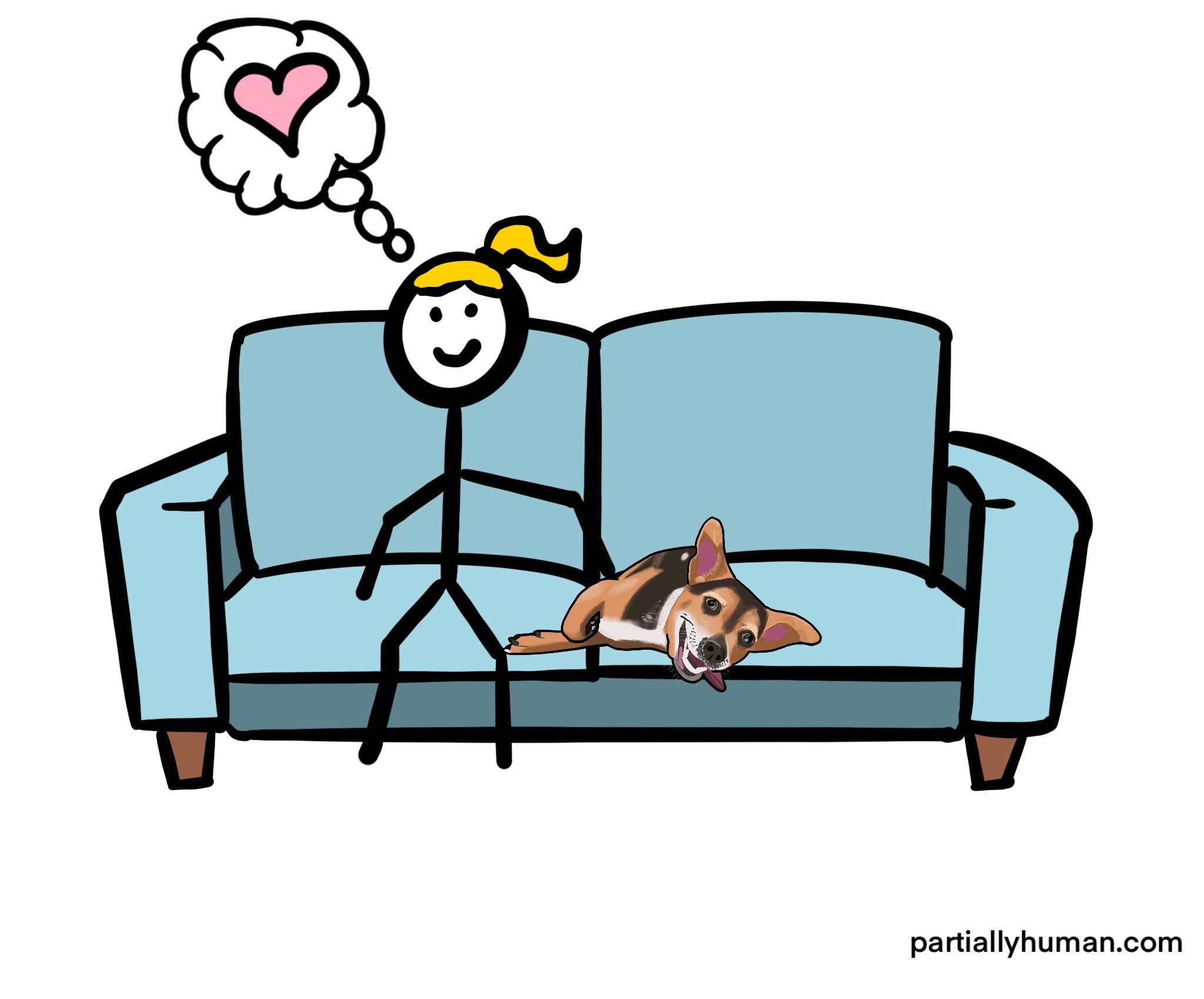
Most people already know what it’s like to love someone with all their heart despite how little the object of said love contributes, thanks to pets and babies. Arguably the most useless creatures on the planet, with nary a chore completed between the lot of them, people are still obsessed with their pets and babies. This is the purest love there is: loving another for just being, no strings, no standards, and no scores. You give to them freely, expecting nothing in return. This way of loving something—not focused on what it can do for you—is the most satisfying type of love there is. Babies and pets can’t do much more than sit with you while you watch Netflix, yet somehow that is more than enough.
Rewriting the Scorecard
I’m happy to report I’m now 4 years in recovery from keeping score. Come to think of it, I’ve gotten really good at not keeping score. I’m probably like a 9 out of 10 at it. (Lol just kidding, but also slightly serious. Old habits die hard.) But in all seriousness, I now notice all the ways my husband contributes and feel grateful. When I see something that needs to be done, I do it without adding it to my scoresheet. If I want help, I ask for it. If I want things a certain way, my husband and I discuss options that work for both of us. I now know I can’t measure the value either of us brings to the relationship by counting crumbs left behind on the counter.
We can override our tendency to discount the other’s efforts and tune out all the wonderful things about them. Our monkey brains love to fixate on problems and gloss over things that are going well, so we have to deploy fancy mental tricks to rewire those thought patterns . The techniques mostly boil down to shifting your attention away from where your partner lacks to noticing what they do right, and to keeping your expectations in check.

Maintain lofty ambitions and low expectations: With an expectation, you—by definition—expect to get the thing you want. Full stop. You view it as a failure when you don’t. With an ambition, you recognize the aspirational nature of the goal and know that humans are imperfect, so you can live with things being a work in-progress. Keep trying to shoot high, knowing that sometimes you’ll both fall short.
Practice counterfactual thinking: This is essentially practicing the Stoic technique of negative visualization. Imagine the highly probable ways your life could have turned out worse than having to deal with your partner’s dishes in the sink. What if you ended up with someone who developed a heroin or gambling addiction? What if your partner died suddenly, making them not only (still) unable to remember to take out the recycling, but also severely limited in their ability to complete any chores at all? What if you never found love at all and always had to do everything yourself for your entire life? As a woman, I often think of how women used to be basically a hybrid between a slave and a pet to their husbands, and am glad I was born in a time and place that women have rights. I know this is dark, but accounting for all the ways things could have been worse puts things in perspective.
Notice all the ways you benefit from them being in your life: We tend to weight categories of contributions differently, conveniently overweighting the areas where we do the most. If your partner doesn’t shine in the to-do list department, how else do they contribute? Do they carry the burden of making small talk with people at dinner parties? Do they infuse fun and spontaneity into your life? Do they make you laugh? Are they a good listener? What are all the unglamorous ways your life is better off by being with them?
Count the little things as if a stranger were doing them: If a casual acquaintance did the dishes for you and folded some laundry, would you be appreciative? Yes, of course. Why does your partner deserve less credit than some random person you don’t even love? “Oh, well a stranger doesn’t have to. There’s no expectation.” Since when do expectations have to be inversely related to appreciation? Feeling like you don’t need to be appreciative of your partner’s contributions, big and small, is the definition of entitlement. Does it hurt you in some way to be grateful that your partner bothered to put their socks in the hamper like you asked them to? Even if you “do more” than your partner, can’t you be happy about the things they manage to do? Give them credit generously. Not just for their sake, but also so you get to feel more warm and fuzzy.
Do things out of the spirit of generosity, expecting nothing in return: The 80/80 Marriage: A New Model for a Happier, Stronger Relationship is a helpful book that shows you how to nurture love and connection and move away from the tit-for-tat power struggles. The premise is that both partners should strive for fairness using the mindset of radical generosity, while also maintaining realistic expectations.
Build an appreciation habit: Say “thank you” for everything. Every day. All day long. Acknowledge the big things, the small things, the silly things—all the things. Point out when they are good at something. Even if all they did was find a good movie for you to watch, say “Hey, I’m so glad you picked out this movie. Great find.” Many people feel like others only notice when they do something wrong, like they don’t get credit for anything. Isn’t that so sad? A little praise goes a long way.
I already know the objections I’ll get to these suggestions.
But Your Suggestions Suck
Right now, some readers are mentally giving my article a score, and they’re awarding it a 0 out of 10. They’re thinking:
- But I do SO MUCH MORE than my partner! It’s really-super-duper unfair!
- But why should I appreciate my partner when they don’t appreciate me?
- But, OF COURSE, I should expect my partner to do X, Y, Z chores! It’s called a relationship. They are a gosh dang grown-up who just needs to take responsibility.
- But I deserve better! Are you telling me to settle for life with a useless bum who contributes nothing more than stinky farts to my life?
- But that’s not fair! Are you telling me to let my partner do whatever the heck they want while I do all the hard work?
- But I would be happy if my partner just __________ (fill in the blank).
Fair enough. It’s reasonable to have some minimum standard of what you’re willing to put up with. It’s fair to have a price of admission people must pay to be with you. Maybe your current partner can’t meet your expectations. We all have to do the cost/benefit analysis ourselves of whether someone is worth the trouble or not. I don’t have any answers for you there.
But I will say this: our brains tend to find problems and fixate on them, and maybe that’s more of a problem than our partner is. I came across a quote by Jiddu Krishnamurti recently that says it beautifully:
“It seems to me that the real problem is the mind itself, and not the problem which the mind has created and tries to solve. If the mind is petty, small, narrow, limited, however great and complex the problem may be, the mind approaches that problem in terms of its own pettiness.”
Before throwing away my advice, or throwing your partner’s shortcomings in their face, make sure you aren’t overlooking all the wonderful things they contribute. And maybe the next time you watch Netflix with your partner, just relish how nice it is.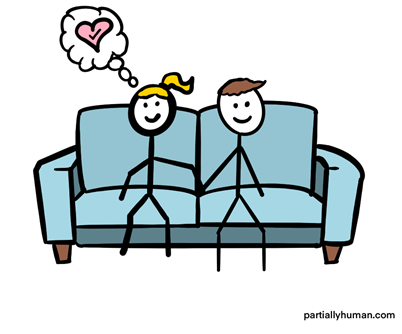
How are your expectations working for you?
EXPERIMENT: Noticing the Good Stuff

STEP 1: PAY ATTENTION
- What do you tend to notice about your partner?
- What actions of theirs register for you throughout the day?
- Are you keeping score?
- What do you expect from your partner?
STEP 2: GET CURIOUS
- Are you noticing their flaws more often than the good stuff?
- What actions of theirs are you not even registering?
- Are there things they do that you used to be happy about that now feel unremarkable?
- Are your expectations reasonable?
- If you’re keeping score, are you overvaluing your contributions and undervaluing your partner’s?
- What contributions of theirs do you take for granted?
STEP 3: GET CREATIVE
- How can you notice more of the good stuff?
- How can you be more appreciative of the things that are working well?
- What techniques from this article might you experiment with?
- How might you move away from keeping score?
STEP 4: TAKE ACTION
It’s usually easier to act your way into a different way of thinking, rather than think your way into a different way of acting. You don’t need to wait for the spirit to move you in order to be more generous and loving toward your partner. Start with small things, like looking for opportunities to say, “thank you.” Act out what a generous, grateful person would do, and eventually your thoughts will catch up. And if a part of you still wants to get points, I’m more than happy to give you a 10 out of 10 for your effort.

This is my favorite article to date. A practice of gratitude can really change perspective (and relieve stress.) And I hope that poor monkey eventually was rewarded with a grape.
Thanks for your blog, nice to read. Do not stop.