
Declaring War on Collective Nouns
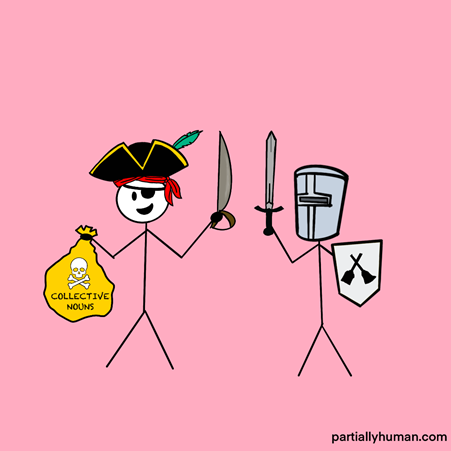
The one about stopping our collective noun chaos.
Some of us are drawn toward order, toward minimalism and efficiency. Let’s call those types: Tidiness Crusaders. And some of us are drawn toward chaos, toward (as far as I can tell) living like looting and pillaging pirates that accumulate junk and upend civility. Let’s call those types: Clutter Pirates. All joking aside, I’m clearly a Tidiness Crusader with an affinity for simplicity. It’s not only unnecessary physical knick-knacks, like souvenir shot glasses and excessive amounts of garden gnomes, that rub me the wrong way. I disdain ALL forms of clutter: unnecessary steps in a process, unnecessary graphics on a PowerPoint slide, unnecessary mental worries, and—the topic of today’s post—unnecessary words. This post is about the battle between the Clutter Pirates and the Tidiness Crusaders over a group of pointless words: animal-related collective nouns—the epitome of language clutter.
Collective Nouns Are Unnecessary


Collective nouns are like single-purpose kitchen tools cluttering the cabinets of our minds, describing only one hyper-specific group of things at a time: a gaggle of geese, a colony of penguins, a school of fish, a smack of jellyfish, a pod of porpoises, and on and on the list of highly specialized words for “group” goes. Collective nouns are the banana slicers of the English language. Most animal-related collective nouns—wisdom of wombats, parliament of owls, murder of crows—mostly collect dust, taking up precious mental storage space while waiting to be pulled out during a trivia game or an opportunity to sound smart.
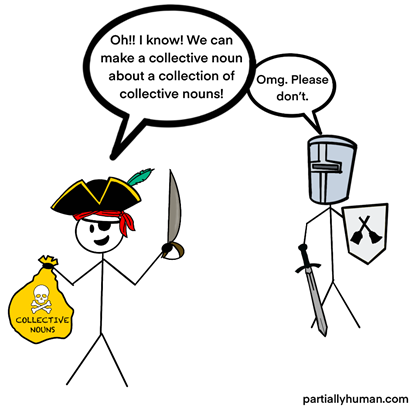
All of these things are just groups. All of them! Groups of geese, groups of penguins, groups of fish. Why are we overcomplicating things?
Clutter Pirates Love Creating Silly New Words
Since languages develop and evolve in a dynamic, essentially crowdsourced, fashion, it’s inevitable that some idiosyncrasies and inefficient elements will squirm their way in. There is no central committee culling the silly nonsense from the English language, (unlike in France—Tidiness Crusaders like none other!). This is the beauty and the curse of language—it’s all made up and anyone has the power to influence it. The Clutter Pirates love this. This lack of boundaries allows them to run wild, creating new permutations of any word that suits their fancy. They just willy-nilly decide it would be fun for there to be a different word for every single type of baby animal: fawn, colt, cub, joey, pup, calf, hatchling.
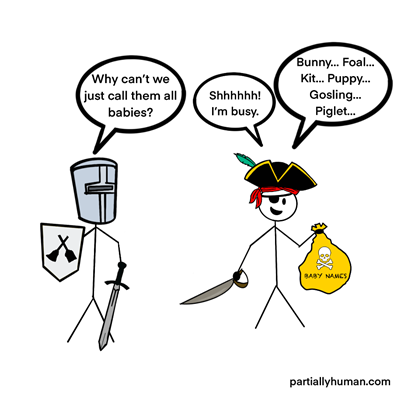
Dictionary writers merely document, post-hoc, what the masses are already using in everyday speech, so we can’t count on them to guard against language clutter. That’s why the Tidiness Crusaders must unite to clean up our collective nouns! But what will we lose if we ruthlessly purge language gems such as “cackle” of hyenas and “pride” of peacocks?
The Clutter Pirates’ Case
As far as Google can tell, there are 3 primary reasons Clutter Pirates give to justify hyper-specific collective nouns:
- They’re fun
- They’re fancy
- They’re functional
Let’s see whether any of these arguments justify the chaos collective nouns wreak on our ability to quickly and confidently remember the correct word to describe a group of things.
Collective Nouns Are Fun
Clearly, most collective nouns were made up by people trying to be cute and whimsical. In doing research for this post, the most common argument I found in favor of collective nouns was: “But they’re fun!”

Classic Clutter Pirate responses to calls for order. “Fun” is the exact same reason people give for all manner of clutter: figurine collections, decorations for every conceivable (also made-up) holiday, different types of cups for different types of drinks, Civil War memorabilia, seashells, rock collections, movie posters—you get the point. They love stuff! The more, the merrier!

But just because decluttering isn’t fun (for some), that doesn’t mean we shouldn’t do it. Sure, I’ll concede that there is more to life than efficiency, and that not everything has to be rational to be worth something. But the Clutter Pirates have already created lots of superfluous things that are waaaayyy more fun than distinct names for collections of things. For example, the ever-expanding list of silly holidays: Marzipan Day (January 12), Zipper Day (April 29), Wiggle Your Toes Day (August 6).
Behold: a mere snippet of Clutter Pirate holidays.
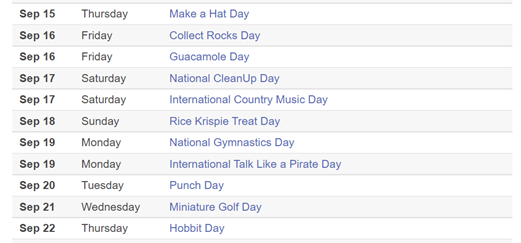
Which is more fun: a specialized word for a group of guinea pigs or International Talk Like a Pirate Day?
People who like clutter know that they don’t have a rational justification for their excess things, but they have an intuitive sense that there is more to life than order, reason, and efficiency. They know we can’t pummel every inch of life into a neat, clean cost/benefit analysis, stripping away anything that is “unnecessary” just because it doesn’t make sense. Most fun stuff doesn’t make sense. So I’ll concede that a “tower” of giraffes is fun. But my counterpoint is that there are already other avenues for Clutter Pirates to have their fun.
Collective Nouns Are Fancy
Slang words have always been important cultural aspects of language. Using these fad terms shows how fancy you are. And, apparently, in the 14th and 15th centuries it was fashionable to make up cheeky collective nouns. Upper-class nobility (the cool kids of that time) loved them some hunting slang! According to this article, “Terms of venery were the linguistic equivalent of silly hats: colorful, affected, fashionable, and very popular.”
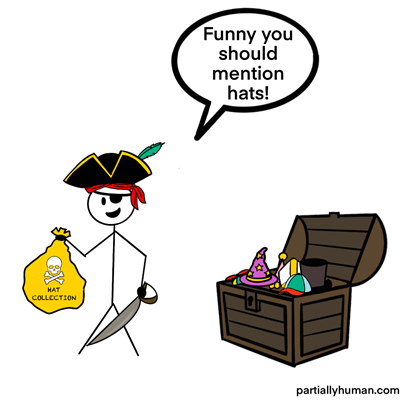
So basically, saying “bellow of bullfinches” or “murmuration of starlings” was their version of saying “bling bling,” “YOLO,” or “on fleek.”
I’m not knocking slang (although, maybe I’ll feel differently when I’m too old to “be hip” to what the kids are saying). Yes, slang is clutter. But I get it; it makes each new generation feel cool and keeps the language fresh. But here’s the thing, slang usually fades out. We don’t call things “the bee’s knees” anymore or say things are “out of sight.” Each new generation makes up their fancy cool kid words, and we let go of the old ones—a lovely linguistic spring-cleaning of sorts.
I view this as a version of not letting yourself buy a new pair of shoes unless you also get rid of an old pair. You can keep changing and replacing things, but limit the proliferation. It’s a great compromise: let the Clutter Pirates have their fun, but set some boundaries. How we’ve structured introducing and ousting slang words works for both sides; but for some reason, we never managed to purge the collective nouns cluttering up the attic. I think it’s time for a deep clean.
Collective Nouns Are Functional
There is a subset of collective nouns called “terms of venery” that stem from English hunting traditions. In an article that agrees with me about how silly these words are, a gentleman objected to the idea that they are useless in the comments section (shortened to 3 of his 6 points, for brevity):
“It’s clear that you’re way out of your depth here when it comes to language and linguistics.
Second, these aren’t just collective nouns, they are a subset of collective nouns called terms of venery, which means “hunting” in archaic French. When you’re tracking and trying to murder animals, understanding their behavior is key, which is why it does make sense to refer to a “nest” of mice and a “watch” of nightingales.
Third, many of these terms that don’t refer to hunting also make sense. A “drove” of oxen is very descriptive, but there’s different shades of meaning when you choose to say a “team” or “yoke” of oxen instead. Likewise, a “bed” of oysters is extremely accurate. And who would dispute a “pride” of peacocks?
Fourth, if you’ve ever seen two or three owls congregate, terms like “parliament” make a lot more sense. Same for “bouquets” of pheasants and “bevies” of quail.”
I smell a Clutter Pirate in our midst. He is claiming that collective nouns give you some additional insight into animals, other than that they are assembled in a group. Come on, man—you’re reaching. Take “tower of giraffes,” for example—would you not know that a “group of giraffes” are tall without the hint that they tower? I’m not buying it.
Wikipedia agrees that many of these words serve no functional purpose: “The fashion of a consciously developed hunting language came to England from France. It was marked by an extensive proliferation of specialist vocabulary, applying different names to the same feature in different animals. The elements can be shown to have already been part of French and English hunting terminology by the beginning of the 14th century. In the course of the 14th century, it became a courtly fashion to extend the vocabulary, and by the 15th century, the tendency had reached exaggerated and even satirical proportions.”
But let’s say you do glean some new information about an animal by its group name, does that slight increase in knowledge justify the trade-off of us having to remember all these extra words? Compare what a “bed of oysters” tells you to common, human-related collective nouns like: choir, gang, team, panel, or class. Those words tell you the exact functional purpose of the broader group—they sing, commit crimes, play games, share expertise, or learn together. Those words shed light on WHY the humans are in a group. So how about this? If a group of animals is singing, thieving, competing, opining, or studying, we can henceforth use the corresponding collective noun to describe them. Deal?
Let’s Stop the Collective Insanity of Collective Nouns
A word is only a real word if enough of us agree it is and then use it accordingly. But here’s the thing: most collective nouns are not actually in common use (because who the heck can remember them?). Yet we cautiously treat them like real, correct words. They’re not. Let’s stop pandering to the Clutter Pirates and clean up our collective nouns. Let’s treat them like the silly nonsense they are and refuse to recognize their legitimacy. Don’t marvel when someone pulls one of these esoteric antiques out of their butt. Instead, confidently proclaim any collection of animals you see to be a group, herd, or flock—words in the common lexicon. It’s time to wish this ancient slang farewell, “See ya later, congregation of alligators.”
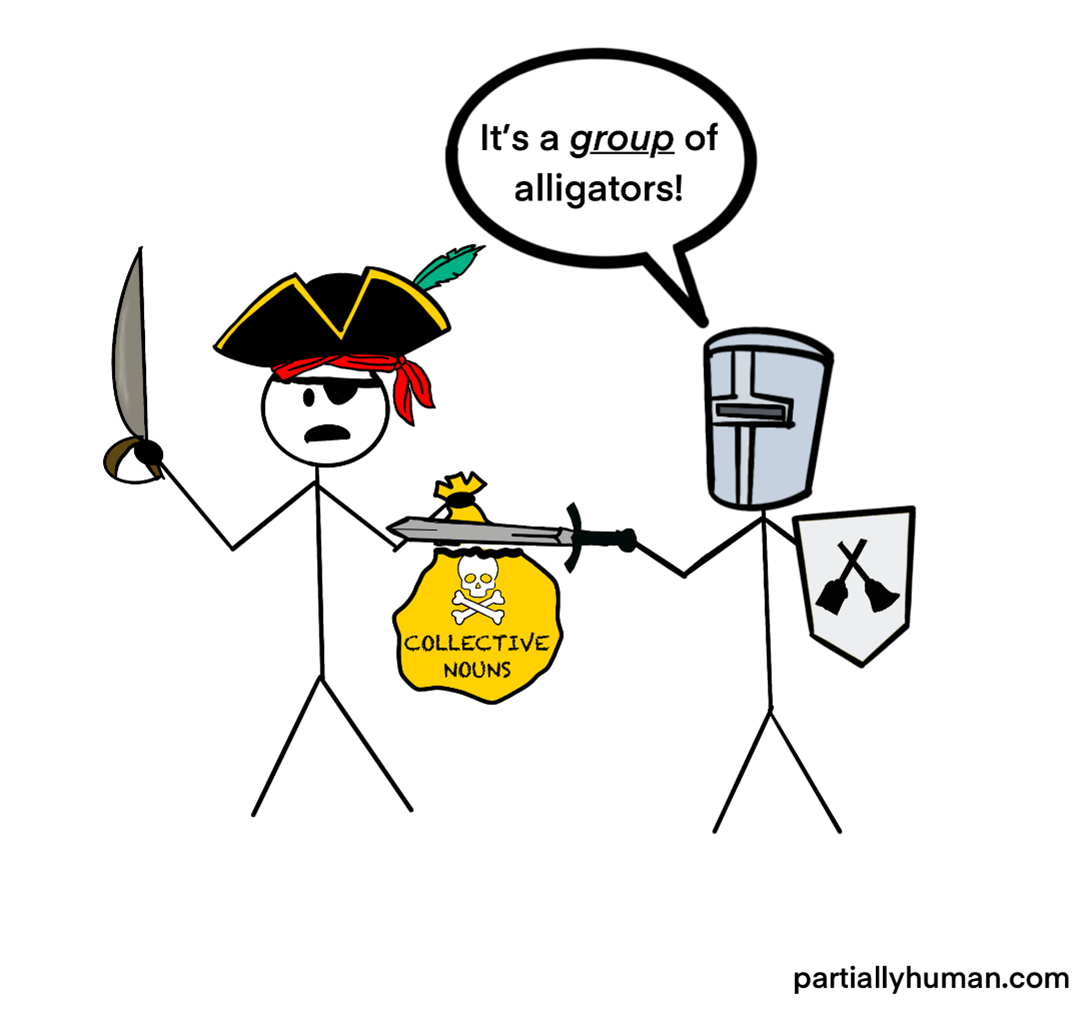
Does that feel sort of mean? If you’re worried about the Clutter Pirates’ feelings, feel free to make a peace offering.

EXPERIMENT: Stop the Clutter Pirates’ Collective Noun Chaos

EXPERIMENT: Stop the Clutter Pirates’ Collective Noun Chaos
STEP ONE: PAY ATTENTION
Notice all the silly ways we say “group.”
STEP TWO: GET CURIOUS
What collective nouns deliver meaningful information about the group’s behavior?
What collective nouns are easy and available for your brain to spit out?
STEP THREE: DECLUTTER
Use that fancy brain of yours to clean collective-nouns-house! Sweep away all the nonsense words and bask in the glory of a streamlined vocabulary.

Comments