
Why Death Feels Confusing
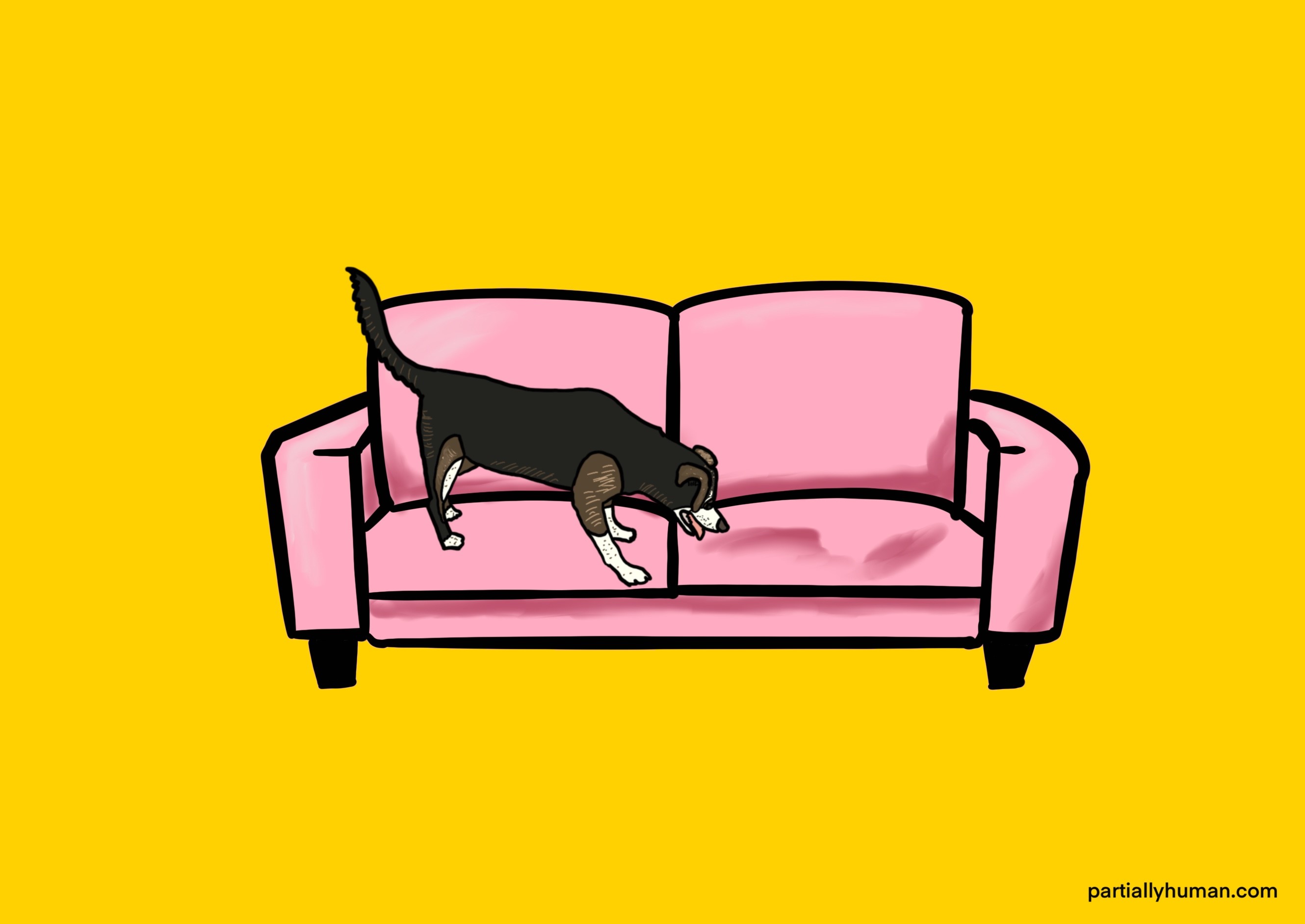
The one about how it’s hard to adjust to someone being gone.
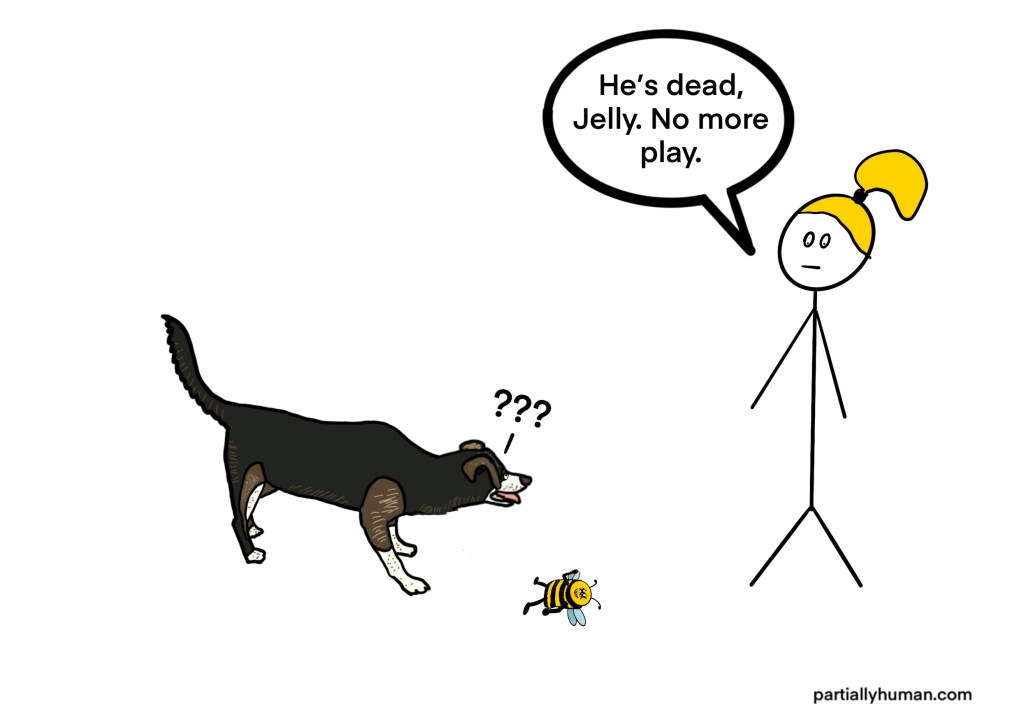
When my youngest dog Jelly kills something, a bug or mouse or small critter (not with my permission, by the way), he is disappointed when it stops moving.
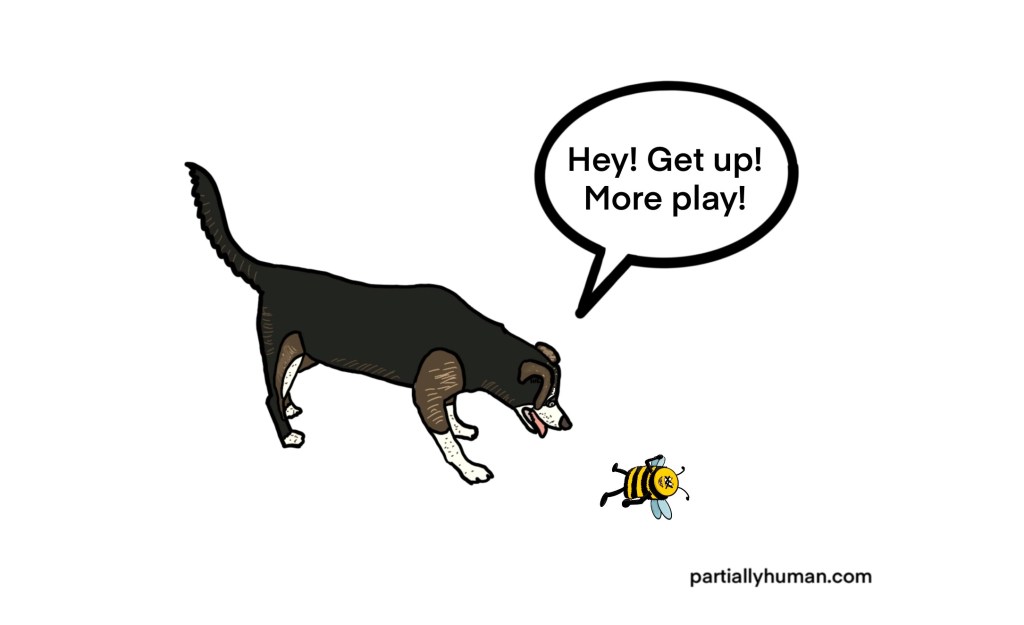
He doesn’t understand that he killed it. He doesn’t understand death. He just knows something was moving and now it’s not.
I thought I was smarter than Jelly is. Turns out I’m not. My oldest dog BamBam died and I can’t understand it. My brain fails to comprehend that he’s not here. But he’s always here, it thinks.

I keep expecting him to be in his spot on the couch, to hear him asking for dinner, to be there when I reach out to pet him. I stare at his urn, the flowers, the cards, and they don’t make sense. How is this possible? No more BamBam?
I was under no illusion that he would live forever, or even for as long as he did. He was old—16. An age I never dared imagine he’d reach. For years now I’ve thought, maybe this is his last summer, his last Christmas, his last birthday. Those thoughts felt silly though—disconnected from reality, nonsensical. I played with the idea of his death the same way I imagine one day being homeless or a refugee or a crack addict—things that will never really happen to me, identities I try on to confirm their absurdity, just as seemingly impossible as existing without BamBam.
It’s common to have trouble digesting death, to know both cognitively and viscerally that someone is definitively gone. Ed Sheeran, whose best friend died last year, talks about his struggle to process the grief in his new album, Subtract. His song “Eyes Closed” describes the incongruity of feeling like someone is still alive and being reminded that they aren’t.
Just dancin’ with my eyes closed
‘Cause everywhere I look, I still see you
…
Delusion is here again
And I think you’ll come home soon
A word brings me right back in
Then it’s only me that’s in this room
…
So I’m dancin’ with my eyes closed
‘Cause everywhere I look, I still see you
At his concert last weekend, he said he didn’t believe his friend was dead until he shoveled dirt onto his coffin. That’s odd, isn’t it? I imagine that Ed had ample data that his friend was dead well before that. Why was that insufficient evidence?
Likewise, I have evidence-galore that BamBam is dead. I held him as the life left his body. I have his ashes. He’s not here. But I simply can’t comprehend it.
While watching a movie the other day, my hand kept reaching to pet his empty spot on the couch, so I put a pillow under his blanket and tried pretending it was him, like how the guy in Memento hired prostitutes to sleep next to him so he could think his wife was still alive for a few moments when he first woke up. As if I could trick myself somehow into fully—instead of just partially—believing he was there.
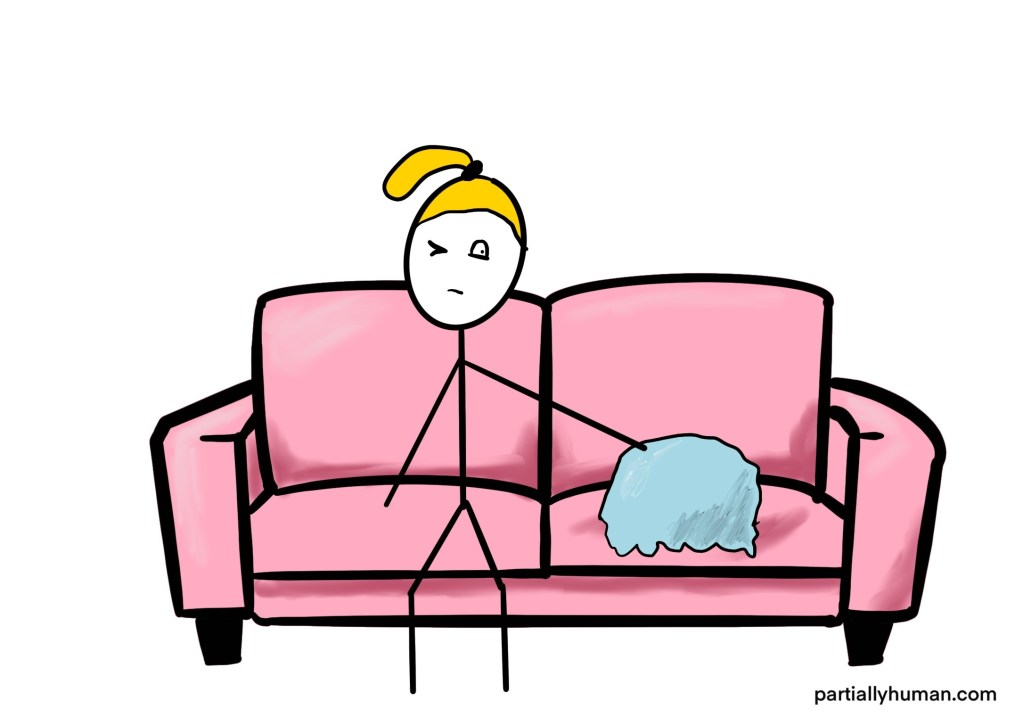
It didn’t work.
Why is death so confusing? How can we intellectually understand the reality of the situation, while simultaneously not really believing it? How come we are surprised over and over and over by their absence? Today’s post is about how the animals in our brain make us delusional in the face of death.
Wiring Your Brain to Rely on Your Loved Ones


In my post Rewiring Your Brain to Sing a Different Tune, I talk about how thought patterns are formed: Thought + Reinforcement + Repetition. To illustrate the concept, I detail a thought pattern my brain formed—making up songs about BamBam.


Grief expert Mary-Frances O’Connor would say that my BamBam songs were part of a larger virtual map my brain developed: his being was ingrained in my understanding of the world. I not only thought about him while singing, I also thought about him countless times per day in a wide variety of contexts because he was an ever-present part of my lived experience.
Our brains create mental maps of “how things are” based on experience, and this guides what we expect to happen in the future. My experience for 5,824 days was that BamBam was there. The proof of his existence was reinforced through countless repetitions of walks, cuddles, and songs. As a result, my mind’s virtual map associated him with myriad things.

I learned to rely on this map. Just as I knew that my couch would be there each morning, I knew so too would BamBam. And then he wasn’t.
Grief
When my husband is out of town, my dog Jelly (the unwitting murderer) searches the house for him every morning, as if my husband might have magically teleported to the bedroom while Jelly was sleeping. (If you knew Jelly, you’d know that this is impossible, because not only is he a light sleeper, but he fancies himself a security guard tasked with monitoring the whereabouts of everyone at all times. Right now, he is standing behind me staring at me like I’m his livestock.)
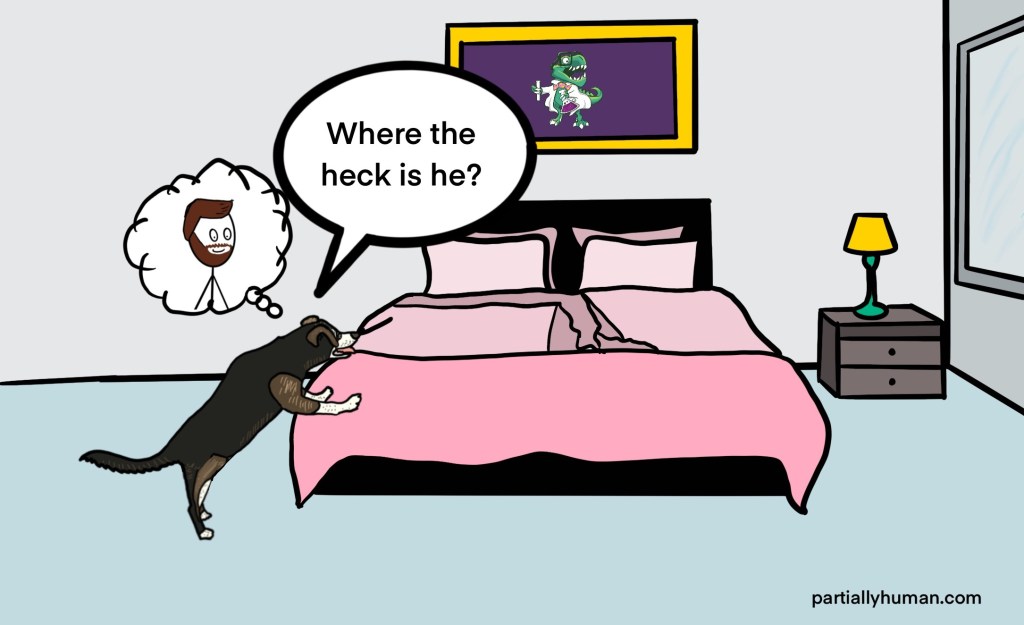
When that doesn’t work, he insists on checking the basement.

Only after looking through the whole house does he understand that my husband is still gone. But that understanding is tenuous, disappearing each night, prompting him to start his search routine again in the morning.
When my husband is gone, Jelly is sad. But he is not grieving. Part of grief is, of course, being sad about the loss. (Similar to how people report feeling depressed after Taylor Swift’s concert is over.) When a good thing ends, it sucks, and we resist it. But as painful as sadness can be, it is not the defining feature of grief. The special suffering grief begets is the war between reality and delusion as we attempt to grasp the permanence of someone’s absence, the clash between what we know intellectually and what we know viscerally. I like how it’s put in this article:
“In trying to make sense of the absence, your brain struggles to reconcile two opposing pieces of knowledge—the conscious knowledge that they are gone, and the powerful, implicit knowledge that they are everlasting. This struggle explains some of the more bewildering and crazy-making aspects of grieving. For example:
- You can’t seem to absorb the news that they are gone. How can they be gone? They are everlasting!
- You may feel, see, or hear your loved one… and interpret common sensations, sights, and sounds as signs of their presence.
- You may feel disorientated and wonder if you’ll wake up from this bad dream because, surely, they are everlasting and you will be reunited.
Each time you confront these two opposing pieces of knowledge, it triggers painful grief and you yearn deeply.”
Each morning, BamBam’s absence hits me anew. I have to remind myself over and over again that he’s gone, causing an explosion of grief as competing realities clash. And unlike Jelly learning my husband is not home—disappointed, but hopeful he’ll return—I (partially) know the unbearable truth: that BamBam is gone forever.
Mary-Frances O’Connor says:
“Grief is a heart-wrenchingly painful problem for the brain to solve, and grieving necessitates learning to live in the world with the absence of someone you love deeply, who is ingrained in your understanding of the world. This means that for the brain, your loved one is simultaneously gone and also everlasting, and you are walking through two worlds at the same time. You are navigating your life despite the fact that [your loved one has] been stolen from you, a premise that makes no sense, and that is both confusing and upsetting.”
Why is it like this? And how do we adjust to the reality of loss? The answers to those questions lie with Jelly.
Our Animal Brain-Parts Are Confused by Death
You know how there’s a dog in your head asking for snacks?

(Regular readers are well aware of this blog’s main thesis—that there are dogs and monkeys and dinosaurs in our brains causing all sorts of drama.)
There’s also a dog keeping track of your loved ones.
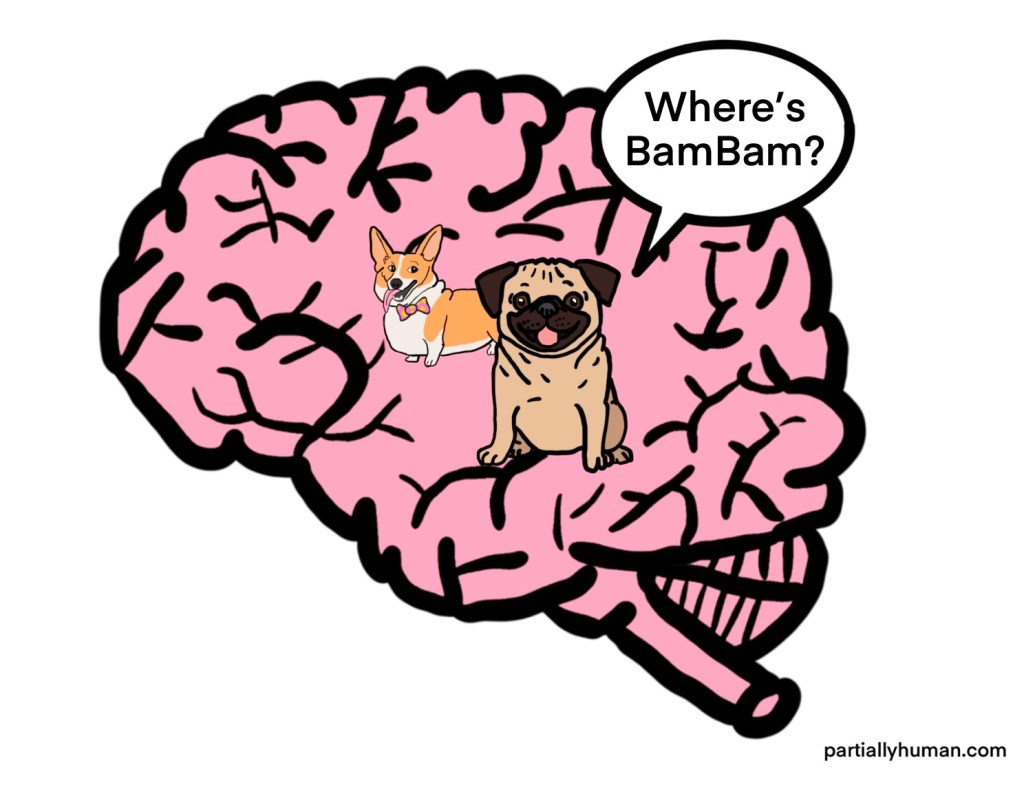
A new coworker asked me how many dogs I have. I nearly had a brain hemorrhage trying to answer that question. Here’s what happened:

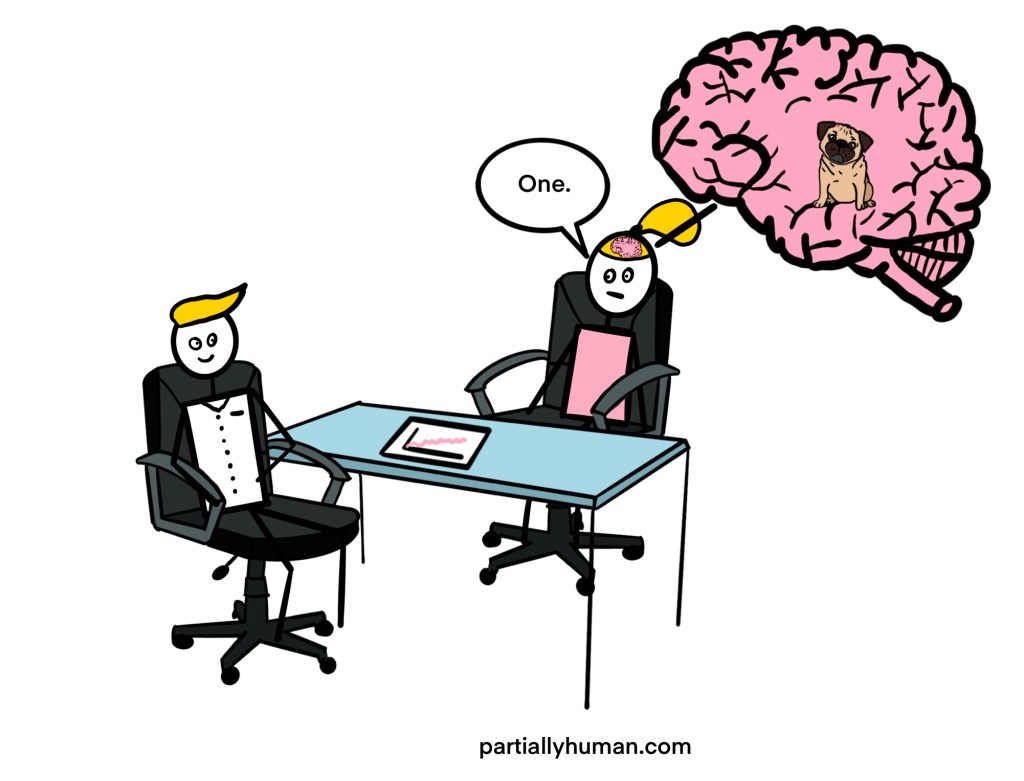

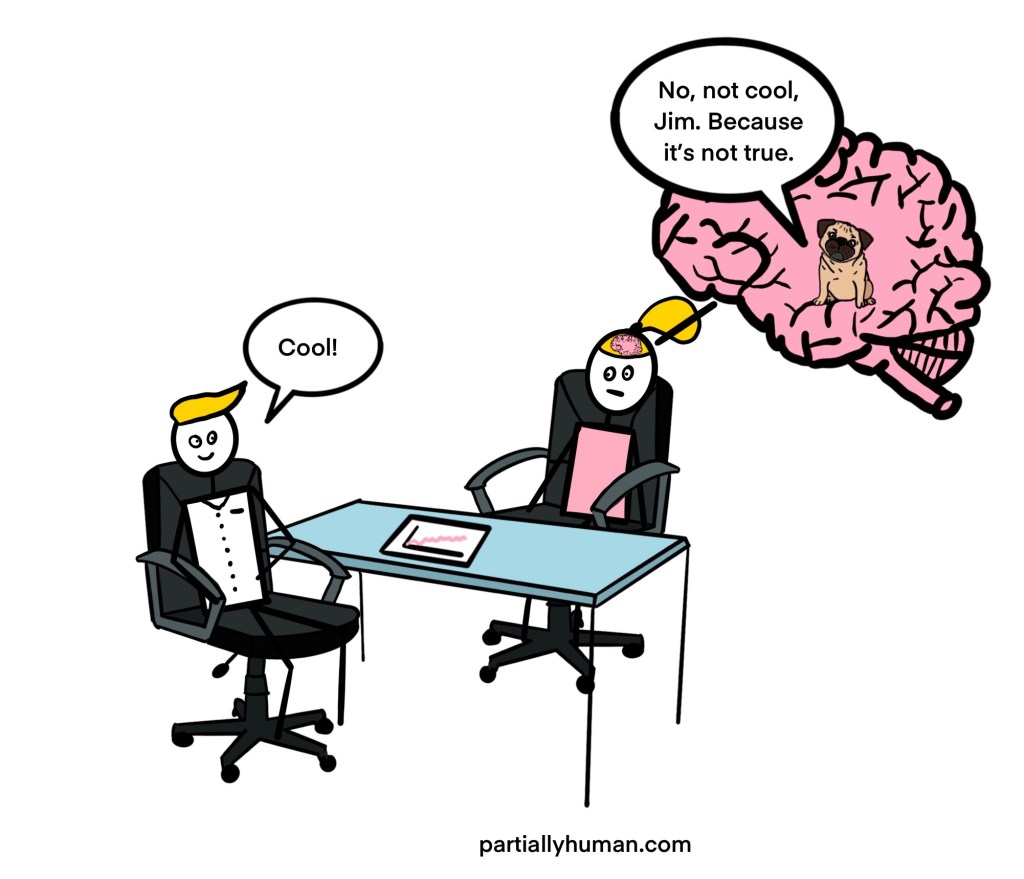
Most delusion and confusion can be chalked up to having an awkward amalgamation of animal brain parts that understand the world differently. As too with processing death. My pre-frontal cortex can describe death scientifically. It knows death can separate us permanently from those close to us. It made the well-reasoned decision to euthanize BamBam (who was suffering from Canine Cognitive Decline alongside spinal issues and arthritis). That part of my brain had anticipated for years that he would die.

But my limbic system—where instincts and emotions and brain-dogs live—relates to death differently. Like my dog Jelly, the animals in my brain lack the concept of death. For them, when they are separated from their loved ones, they “know” it’s temporary (it would be too unbearable otherwise). They’re like children: they can’t read; they don’t plan; all they know is what’s happened in the past; and all they have to make sense of the world is their lived experience. And the animals in my brain lived with BamBam for 16 years, so they know he is real, and he’ll be back.
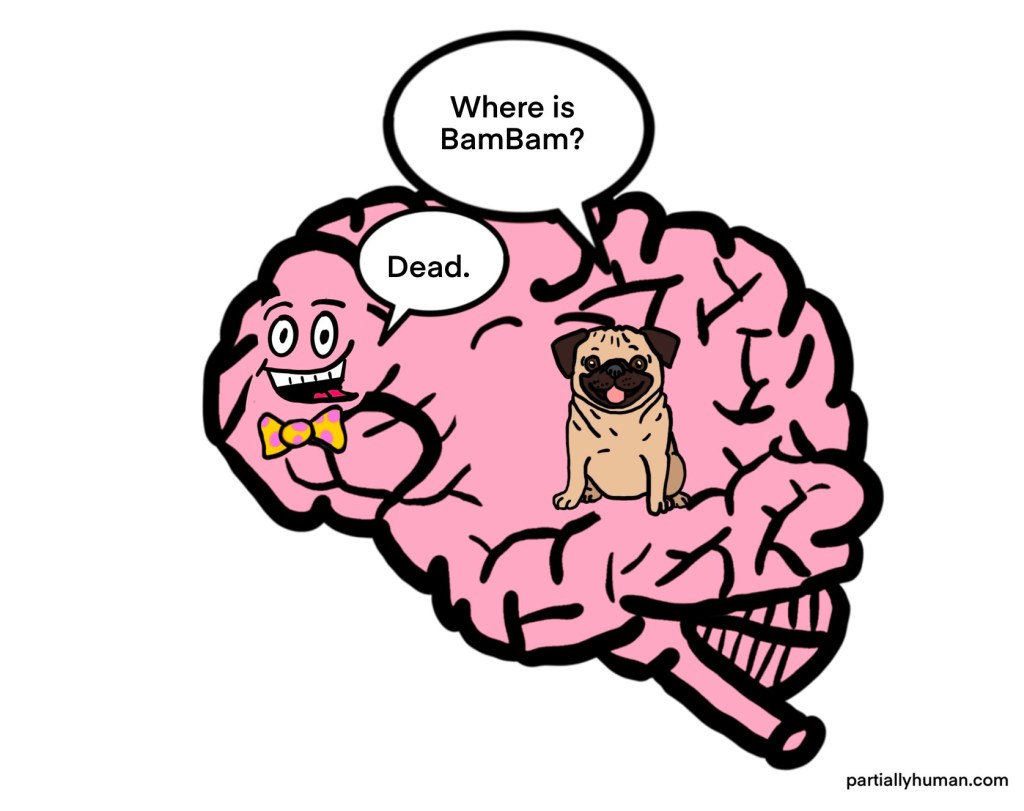

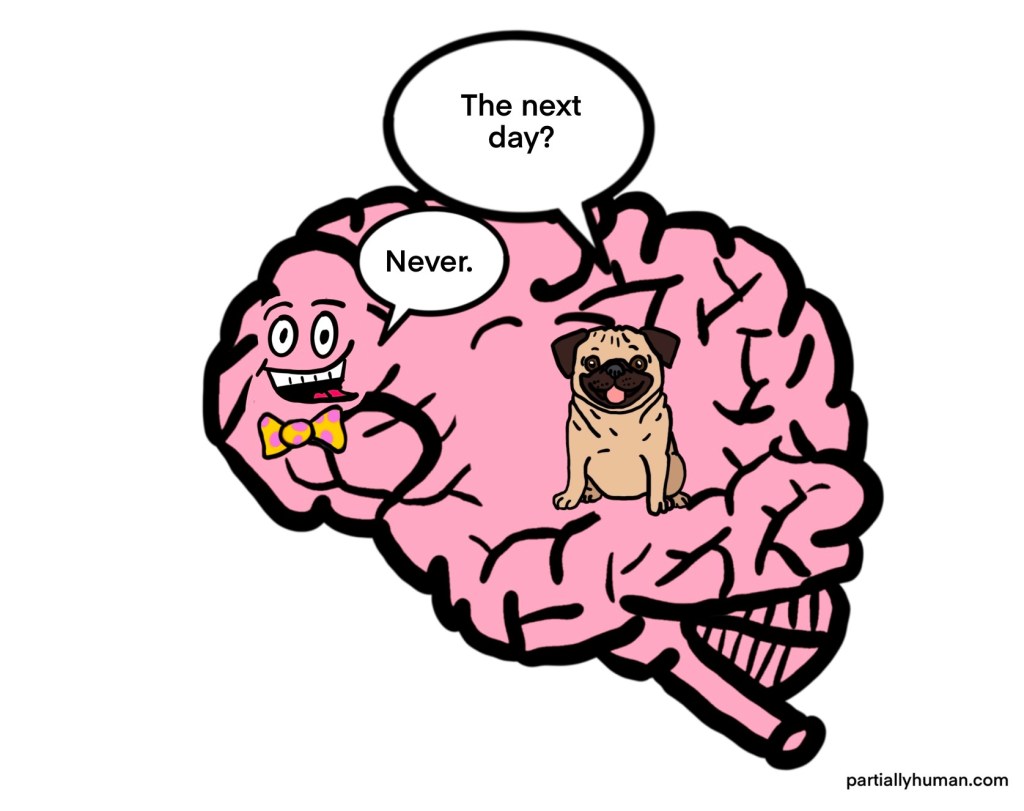
Each time our animals wrongly predict that our loved one should be there, like Jelly searching for my husband, our poor pre-frontal cortex has to remind them that they are gone. But unlike with Jelly, where it’s fine for him to anticipate my husband coming home, we have to try explaining that the deceased is gone forever—an absurd proposition. This ushers in waves of shock and pain and turmoil.
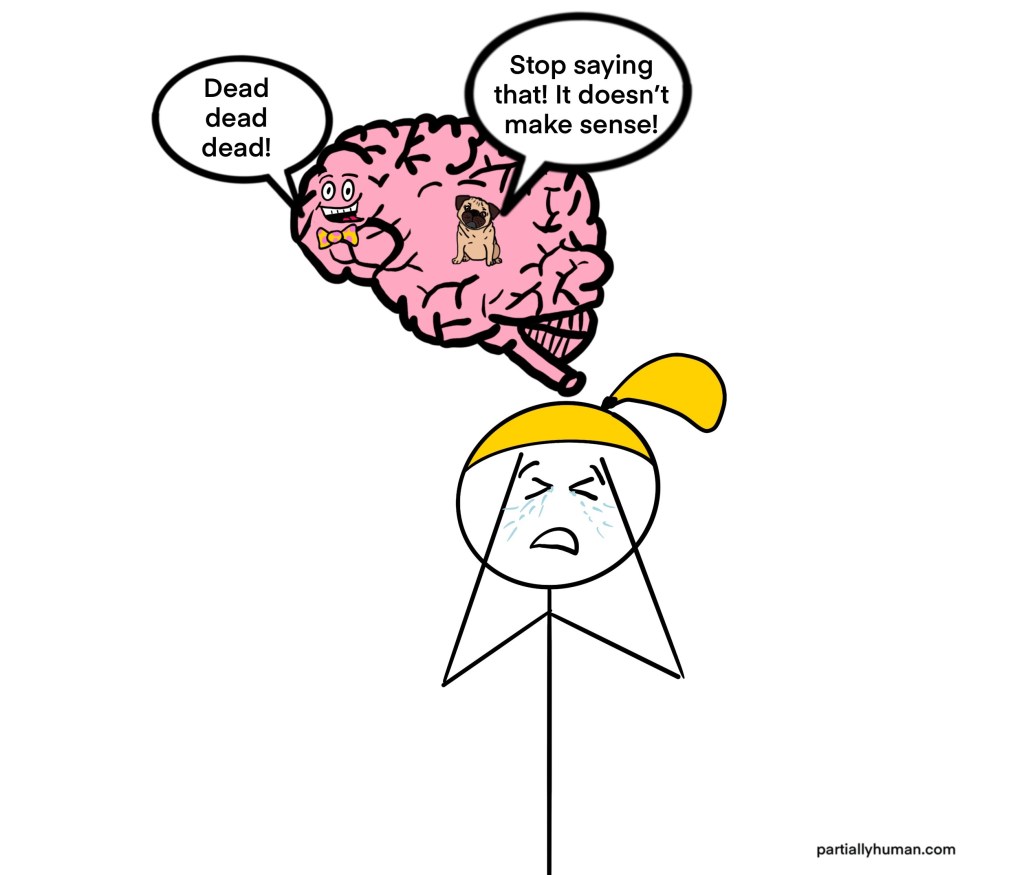
My animals (in my brain, not my real animal Jelly) also expect my husband to still be there when he is out of town. They remind me that he normally makes my coffee, walks with me, and watches tv with me. That reality clash is uncomfortable. Animals (humans included) don’t like being apart from those to whom they’re attached. But my husband being in a different city has a different emotional tenor than if he were gone forever, because my pre-frontal cortex is in agreement with my limbic system—he’ll be back.
So how do you get the animals in your brain to calm down about losing someone forever? Everyone needs to get on the same page.
Rewiring Your Brain After Loss
The exit for I-66 near me changed a few months ago, the east and west ramps flip-flopped, and now I have to take the opposite exit from what I used to. Every time I take the first exit to head west, I freak out a little bit because it feels wrong. My brain yells “Are you sure?!?!” as I triple-check the signs. After my employer switched us from Blackberries to iPhones, I continued to call my work phone a Blackberry for two embarrassing years. Six weeks after BamBam’s death I still think that I should be walking him at our normal times, saving my last bite of toast for him, and that he should be sitting on the couch next to me.
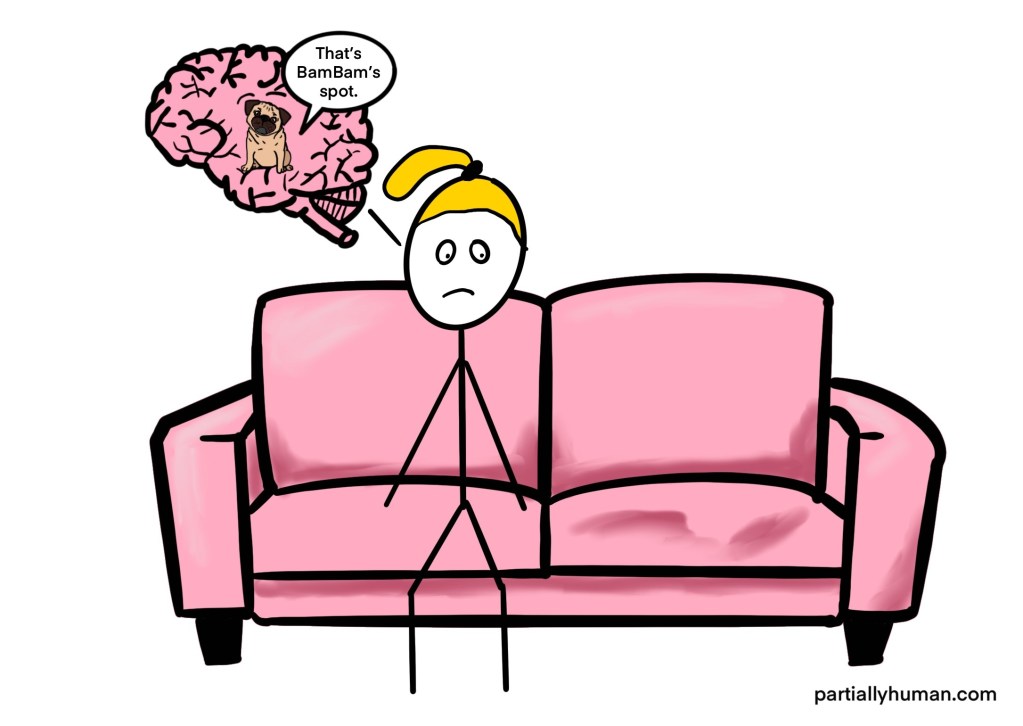
After 5,824 days of proof that BamBam exists, how many days should it take for the brain to update its expectations? One day? Two? A dozen? The brain knows better than to update its entire prediction algorithm based on a few data points; it needs a lot of proof to change a belief. Abstract knowledge—like the idea of death—is not compelling enough; it needs lived experience. Mary-Frances O’Connor says:
“When you wake up one morning and your loved one is not in the bed next to you, the idea that she has died is simply not true in terms of probability. For our brain, this is not true on day one, or day two, or for many days after her death. We need enough new lived experiences for our brain to develop new predictions, and that takes time…
[Over time] Your brain continues to note the fact that your loved one is no longer present day after day and uses that information to update its predictions about whether they will be there tomorrow. That is why we say that time heals. But actually, it has less to do with time and more to do with experience. If you were in a coma for a month, you would not learn anything about how to function without your husband after you came out of the coma. But if you go about your daily life for a month, even without doing anything someone would recognize as “grieving,” you will have learned a great many things. You will learn that he didn’t come to breakfast thirty-one times. When you had a funny story to share, you called your best friend and not your husband. When you washed the laundry, you didn’t put any socks in his drawer.”
As you repeatedly experience someone’s absence, your brain adjusts. Dr. Deborah L. Davis says:
“When your partner dies or ends your relationship, your grieving brain must learn to make sense of their absence and redraw its neural map to reflect this new reality…
As your brain laboriously redraws the neural map of this relationship and you ease into reinventing your life, you’ll gradually and naturally ease away from resisting the reality of their departure and wishing for their return.
For many months, even though you know your relationship has changed, your brain’s neural map may lag behind. Your brain favors the implicit knowledge that the partner or loved one is everlasting and won’t update the map just because they haven’t been around for a day, or even several months. It requires ample time and a ton of lived experience to absorb the absence, update the predictions, and complete this enormous redraw.
In the meantime, the still-outdated areas of your neural map make you think, feel, and act as if your loved one is here, now, and close. Your grief is triggered every time an outdated prediction fails. You ruminate endlessly on what happened and what will become of you. You feel distracted and exhausted.
This monumental rewiring job explains a lot of what you’re experiencing as you mourn. You’re not crazy; your brain is rewiring itself, and you need time to feel whole again, reinvent your life, and plan a different future without your beloved. Knowing this can grant you more patience and self-compassion.”
In other words, when someone dies, it’s like you’re suddenly living in a giant dumpster fire—a place your brain “knows” you don’t belong.

It hurts. It’s all-consuming. You resist it. It feels wrong. But, as I explain in the post Adapting to Dumpster Fires, over time, you adapt. Grief is a fire that you just learn to live with. And, eventually, it doesn’t hurt so much.

For Jelly, there was a time before my husband. Back then, I had a different partner who Jelly searched for when he was out of town. When we broke up, Jelly was sad. He eventually adapted. Now, Jelly is happier than ever (and deeply attached to my new partner). Animals bounce back.

Over time, our brain animals learn new facts. Confusion diminishes, reducing the frequency and severity of grief. And, in the meantime, if seeing the empty spot on the couch is too much to bear, there’s no shame in occasionally dancing with your eyes closed.
EXPERIMENT: Rewiring the Brain After Loss

STEP 1: PAY ATTENTION
- What reminds you of your loved one?
- What triggers grief?
- When is grief at its worst?
STEP 2: GET CURIOUS
- What does grief feel like? And how is it different than sadness?
- Can you feel the battle between the abstract knowledge of death and the intrinsic knowledge of your loved one’s existence?
- Is the intensity and frequency of the grief lessening over time?
If you are genuinely curious about grief, here are two books I found enlightening:
- The Grieving Brain: The Surprising Science of How We Learn from Love and Loss by Mary-Frances O’Connor
- It’s Okay Not to Be Okay: Moving Forward One Day at a Time by Sheila Walsh (The audio version is best because the author reads it herself; hearing her tone adds some nuance.)
Normally in each post, there is a TAKE ACTION step. Not today. While there’s lots you can do to manage grief, rewiring your brain is a more passive project: wake up, take in the new reality, repeat. In a way, it’s nice that it will adjust on its own—no action required, just new neural connections and patience. And as frustrating as it is that the animals are slow learners, being upset about their schedule doesn’t speed things along. When my husband is gone, all I can do for Jelly is comfort him—same too for your inner animals.
I will mention one thing that may help: replacing old patterns with new ones. Our routines and behaviors are triggered by cues (e.g., a specific time means it’s time to feed the dog, coming home from work sets off a slew of habitual activities like taking off your shoes and petting the dog). When a dog dies, we still have all the triggers indicating it’s time for something to happen, and then we’re confronted with the stark absence of that soft fur and waggy tail. Your environment and routine trap you in this depressing Groundhog Day. It’s generally easier when you’re places where you don’t have memories or habits related to your dog, like in the office, at a friend’s house, or on vacation. Upending your routine and environment entirely will lessen the triggers. What new routine can you build in lieu of old ones you’re missing? What new habit can follow each trigger? How can you change the cues in your environment? I rearranged the furniture in my living room and got new blankets for the couch because I could not get over the feeling that BamBam was missing—his absence was glaring in a room that was otherwise the same. Now that the room is different, his absence isn’t as notable as my brain digests the novelty.
Best of luck to you (and your animals)!

Comments