
Adapting to Dumpster Fires

The one about how after we get used to bad situations, we lose sight of the fact that there’s a problem at all, and this prevents us from fixing it.
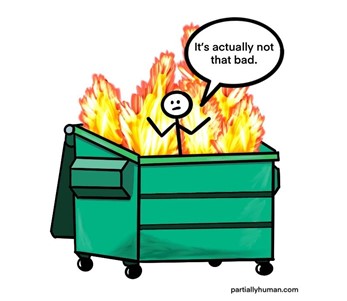
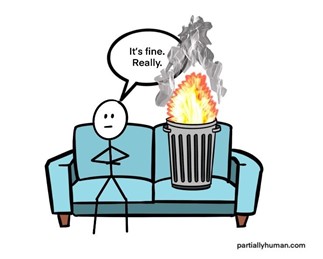
Have you noticed how the first few times it’s over 80°F/27°C in the summer it feels unbearably hot? And then as summer progresses it doesn’t feel so bad? And then when summer gets super-duper hot, 80°F/27°C feels like a luxurious break from the heat? Humans can adapt to anything—good, bad, or ugly, or hot. We can even get used to living in a dumpster fire. This adaptability shields us from having to suffer for long when thrust into suboptimal circumstances. But it also robs us of the emotional incentive to fix things. Once you’ve adjusted to living in a dumpster fire, what’s a few more days, weeks, years?
An example on the more severe end of dumpster fires is domestic violence. (Purely by coincidence, I read three books recently that featured characters in abusive relationships, so it’s on my mind.) It’s easy to shake your head at what a dodo brain you’d have to be to accept a situation like that—where your partner regularly harms you. How does a relationship become so horrendous, yet continue its tragic march forward? Why would anyone live with that? Domestic violence, like many bad situations, typically starts the same: it starts small. Imperceptibly small. The abuser slightly overreacts to their partner working late. Then they have a stronger reaction to them overspending. Then they blow up when they like an ex’s picture on social media. Eventually, they slap them in the face for making a sassy comment.
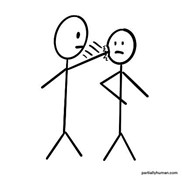
That first slap in the face feels unacceptable. Nevertheless, things continue to escalate over months and years until the frequency and severity of the abuse gets out of hand. And something interesting happens along the way: after a certain point, the person receiving the abuse is happy to get slapped in the face, relieved it wasn’t worse.
Can you imagine? I hope you can, because we all live with proverbial slaps in the face, at some point, somewhere in our lives. We adapt to bad situations. It’s an interesting phenomenon to watch—how tiny sparks, and wisps of smoke, can escalate to raging dumpster fires that we learn to live with. Our heat tolerance builds and builds until we forget that a fire is an emergency.
We All Adapt to Dumpster Fires


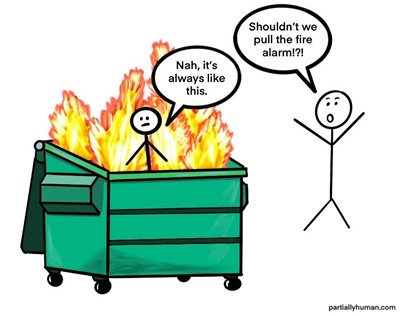
While domestic violence is a relatively extreme example of the type of dumpster fire we can get used to, its severity highlights how far our brains will go to reestablish equilibrium in the midst of new circumstances. This is hedonic adaptation. Our brains will redefine “normal” and “acceptable” in light of current conditions (especially if we don’t see an easy escape route). We ALL learn to live with undesirable circumstances—big and small—losing sight (surprisingly quickly!) of the fact that there’s a problem. We adapt to addiction, reckless spending, chronic stress, overeating, toxic cultural norms, physical aches and pains, poor health, political dysfunction, contentious relationships—you name it. The most pernicious human problems persist because when destructive patterns slap us in the face repeatedly, we eventually learn to sit back and take it.
We adapt to destructive patterns because either it would be too exhausting to do otherwise, or we don’t see another option. Sometimes there aren’t other options besides adaptation, like if you were to develop a disability or lose a loved one. But sometimes there is a way out. Sometimes we can put out the fire. But first, we have to look through the smoke clouding our vision and acknowledge that there is indeed a fire. Only then can we have the wherewithal to pull the fire alarm.
How Dumpster Fires Start
It’s important to understand how dumpster fires develop right under our nose; insight into the underlying mechanics gives us a chance to fight them.
Slow Burns
The most successful dumpster fires sneak up on us. The flames start as a slow burn. We fail to nip it in the bud because the heat isn’t too painful, it feels under control. Maybe we’ve gained a few pounds. Or we’re bickering with our spouse more often. Or our business isn’t doing well. Or we’re drinking a bit more. Or our credit card debt is accumulating. It’s just a small trashcan fire. We tell ourselves it’s not that bad.
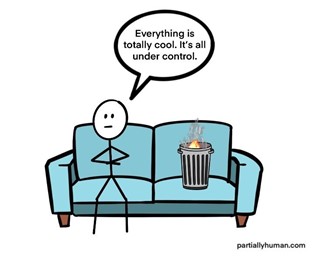
We anticipate (hope) things won’t get worse. As the problem escalates, we adjust, gradually acclimating one teensy weensy step at a time to an ever-growing container of burning garbage.
The epitome of a slow burn is Walter White’s ascent through the criminal world in Breaking Bad. Walter tries to minimize doing illegal stuff when he first starts selling drugs to provide for his family.

Then slowly moves his ethical, moral, and legal bars as his illicit activities escalate.

And by the end of the show, he’s out of control, with zero qualms about kidnapping, blackmailing, and murder.
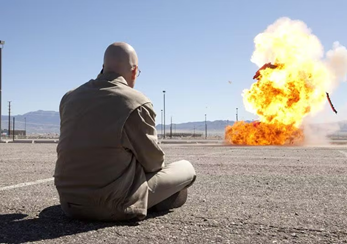
We lose our way in a similar fashion—small steps in the wrong direction that take us somewhere we never believed we’d ever end up, running our own proverbial drug cartel and taking proverbial (or literal) slaps to the face.
Big Bangs
Dumpster fires can also start with a bang—an explosion that comes out of nowhere. Things like a sudden disability, war, economic collapse, getting cancer, losing a loved one, or a pandemic.
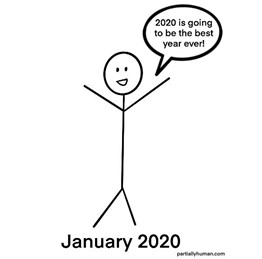
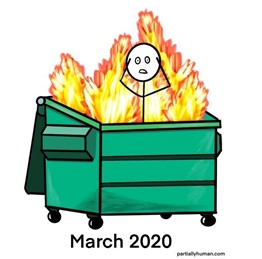
We’ll fight these unexpected fires at first, but when the flames fail to dissipate, we learn to live with them.

The good thing about big-bang-dumpster-fires is that they make it easier to retain an intellectual understanding that there’s an issue, even after we’ve adapted to it, because at least, at one point, we had the visceral experience that, yes, this is a problem. That emotional feedback is a critical signal that something is wrong. Slow burns lack that punch, that fear-fueled pizzaz that drives action. Nevertheless, despite the clear knowledge that a big bang fire is a problem, the fatigue of firefighting takes even the best of us down eventually. We’ll adapt to anything when our efforts to change things prove futile.
Listen, learning to adjust to a dumpster fire is not necessarily good or bad. It’s not a moral failure and doesn’t make you weak or lazy if you become indifferent to a bad situation. Some fires we can’t put out, so we might as well learn to live with them and make some s’mores. But some fires can be successfully fought. So why don’t we fight them?
The View from Inside the Dumpster
When you’ve been living in a dumpster fire long enough, it starts to feel cozy. Familiarity breeds comfort. The smoke clouds your vision and things don’t look that bad. The lies you’ve been telling yourself feel true enough. It’s kind of trippy actually, because if you were an objective outside observer looking at the end-state—heaps of garbage alight with towering flames—you’d be like OMG! THERE’S A FIRE, YOU NEED TO GET OUT!!! Spotting someone else’s dumpster fire is easy. But inside your own dumpster it’s not so clear. Sure, you feel some heat, but it doesn’t feel like an emergency.
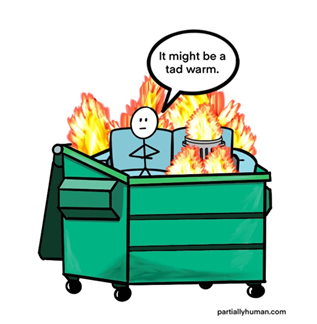
And therein lies why we don’t treat the problem with the sense of urgency it warrants: we’ve built a tolerance, so the pain needed to motivate change is absent. Our subjective feelings mislead us. This is how someone can literally get slapped in the face by their partner and then placidly sit there as if all is well. The emotional signal that an emergency is in progress is gone. The fire alarm fades into background noise.
The fact is that our fire alarms are faulty, and that’s because they are tied to our feelings.
Our Feelings Are Faulty Fire Alarms
Our feelings are blunt and often wildly inaccurate assessments of what’s important. The most terrified I’ve ever been in my life was when, as I was falling asleep, out of nowhere I felt something forcefully slam into my arm. I thought someone had broken into my house and was grabbing me and I was about to die a horrible death. It turns out that my dog BamBam (who I thought was downstairs where he sleeps) had been under my bed and crawled out and jumped on me as I was on the precipice of falling asleep. It only took me 20 seconds to figure out what was going on, but by then I was so frightened that I was shaking uncontrollably. I had so much adrenaline surging through me that it took me hours to fall asleep after. I was totally safe the entire time, but my body freaked out unnecessarily. False alarm.
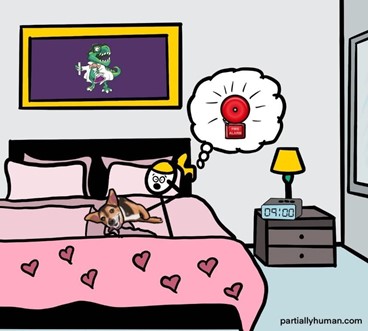
Our intuitions about what’s unsafe regularly miss the mark. Think about all the times our bodies react like we are in a full-blown crisis while we are objectively safe at that moment.
- Getting blood drawn with a needle
- When our heart rate gets super high during exercise
- Watching scary movies
- On rollercoasters
- While public speaking
- When seeing non-poisonous snakes or spiders
- In a haunted house
- When just IMAGINING bad things happening
- When just REMEMBERING bad things that happened
We are exactly like cats that get scared of cucumbers.
For all the times our alarms go off unnecessarily, you’d think we’d be covered in any emergency. But no. They regularly fail to ring, even when our lives are at stake. Of the top 10 causes of death in the U.S., at least 7 are due to (or worsened by) very boring lifestyle factors like diet, stress, smoking, and sleep. When you’ve developed the early signs of heart disease—the number 1 killer—your body does not freak out like mine did when BamBam jumped on me. High blood pressure, cholesterol, and triglyceride levels feel…unurgent. Like something you can leisurely chip away at, not an emergency. Not until after a heart attack do many people finally appreciate the seriousness of their health issues.
(A recent example of a situation that felt innocuous until it ended catastrophically—the collapse of FTX, a crypto exchange that went bankrupt and lost a lot of people’s money. In an interview, the CEO Sam Bankman-Fried shared how his reckless decisions “seemed fine.”)

Lots of bad situations fail to resonate emotionally. We may have an intellectual understanding that debt, domestic violence, and diabetes are problems, but there’s no fight-or-flight reaction getting our butts into gear. Strong emotions motivate action, and many dumpsters fires simply don’t inspire much emotion until someone hits rock bottom.
(I would like to emphasize that I’m not knocking people for getting used to bad situations. Written words on the internet can come across with a harsh tone, so I want to be clear: I’m not looking down on you or anyone for failing to fix problems. We all do it. And I think there’s value in us understanding this dynamic in hopes that sometimes we can fix things that are fixable.)
Adaptation Ain’t All Bad
Life is full of unfortunate circumstances outside our control, and there’s no sense in dwelling on those things. Thank goodness we can adapt to dumpster fires! Thank goodness children can adapt to having a parent with volatile moods. Thank goodness accident victims can adapt to being paraplegic. Thank goodness people in war torn countries can adapt to bombings and air raid sirens. Thank goodness we can adapt to pandemics, famines, loss, and countless suffering-filled situations that are an inevitable part of being alive. Should one be doomed to constant mental anguish over a situation they are stuck with? Of course not. Hedonic adaptation is a kindness Mother Nature grants us, helping us cope with being dealt a poopy hand. It’s what allows these dogs in wheelchairs (in the following video) to be so happy.
The problem with adaptation is, of course, that once something feels normal, the inertia of the status quo acts as a powerful force that keeps us stuck in harmful situations. Then we fail to douse the fires that are within our means to squelch.
Reckoning with Dumpster Fires
Grant me the serenity to accept the things I cannot change, the courage to change the things I can, and the wisdom to know the difference. The Serenity Prayer sums it up nicely—it takes wisdom to know what fires we can put out and then courage to do so. Easier said than done! There are countless barriers to making a change. Shame and denial are powerful forces that keep us stuck. Comfort with the status quo lulls us into a deluded sense of safety. Or maybe we’ve never successfully put out a fire before and just don’t think we’re up to the task. Once something feels “normal,” our brains cease to think critically about it.
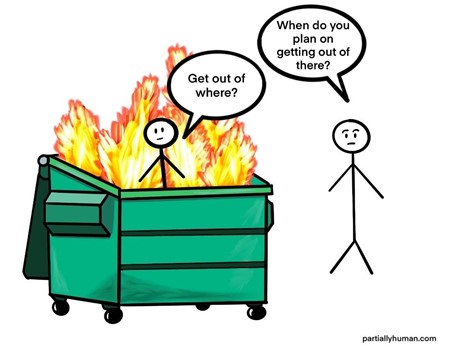
Whatever the reason we stay put, the first step to getting out is acknowledging that we are in fact living in a dumpster fire.
Acknowledging Dumpster Fires
It’s interesting listening to addicts recount hitting rock bottom. How is it that rock bottom is located at wildly different altitudes for different people? For some, the point where they determine that they have a problem is relatively benign. Jessica Simpson, the pop singer, wrote in her book that she realized her drinking was an issue when she wasn’t able to get her kids ready for Halloween. Others have to be destitute before acknowledging there’s a problem with their substance use. For DMX, being estranged from his son wasn’t enough to get him to stop using drugs. How bad we’ll let a problem get is different for each of us, but in an ideal world, rock bottom would be as high up as possible.
The first step is always admitting that there is a problem.

Do you have any dumpster fires in your life? Do you tell yourself it’s not that bad? Can you step far enough away from the flames to objectively assess the magnitude of the fire? It’s not easy to see our own fires clearly; but try mentally stepping outside yourself to view things with a fresh perspective. Imagine you didn’t witness things slowly escalate over time, but instead just saw the situation for the first time, through the eyes of a kind, objective outside observer. Seeing the truth can be jarring. And that’s a good thing—fire should be jarring. Being jarred wakes us up and imbues an appropriate sense of urgency.
Okay So I’m On Fire, Now What?
Once you’ve confirmed that there is indeed a flaming pile of trash in your life, this is where that wisdom step of the Serenity Prayer comes in: you have to honestly assess whether there’s anything you can do about it. This is no small feat. If you’re like most people, you’ll discount how much power you have to change your own circumstances while simultaneously overestimating how much you can change things outside your control.
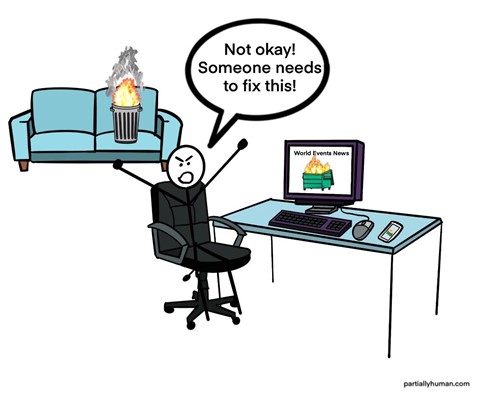
It’s much easier to throw up our hands and claim helplessness than it is to do the uncomfortable work of dousing the flames in our own dumpster (and more fun to complain about our neighbor’s fire in the meantime). Doubt and self-limiting beliefs cause us to overestimate how much stuff should go in the “things I can’t change” category. And change is hard. There’s a strong pull to maintain the status quo.
How do you grapple with being at the intersection between wanting to improve your life and choosing to accept things as they are?
I’ve noticed a societal trend towards a knee-jerk nihilistic response to self-improvement projects. If you give advice geared toward helping individuals make marginal improvements in some area, it’s fashionable to decry that you’re blaming individuals for problems that are systemic, and that we should fix institutions and broader society instead.


This is a well-meaning response that rightly recognizes we are all products of our environment, and in a perfect world our culture would make it easy to live a life where we eat right, are financially responsible, nurture healthy relationships, and contribute appropriately to our communities. But it’s a mindset that tends to disempower individuals, keeping them stuck focusing on how things outside their control should change.
Similarly, people are outraged at recommendations that feel too small to fix a problem that feels big. Like, how dare you suggest that I prioritize sleep or say “no” more often or meditate when I’m feeling stressed, when the real problem is that my job is overwhelming and I have small children to care for!?!? In reality, a big problem rarely has one big solution. Instead, it’s usually dozens of small, seemingly pointless changes that fix things. This is always the case with any systematic problem: lots of little things (good or bad), that don’t make a difference on their own, add up to a huge impact.
Another example of resistance to advice geared toward change—if you examine the unintentional role someone plays in a harmful dynamic, people are afraid you’re saying the situation is their fault, and that they are broken, deficient, or weak. That they brought it on themselves and deserve it. This is an awful line of thinking. Gavin de Becker, author of The Gift of Fear, says he caught flack for telling people that there are things they can do to avoid abusive relationships, and there are ways to get out once you’re in one. I would think this is good news! But some people are more concerned about implying that the abuse victim is partially culpable than putting forth the idea that abuse victims can get out. Put another way, they would rather have someone retain the pristine status of Innocent Victim, keeping them trapped in hell, than muddy the waters with the idea that someone has some agency, some power, some influence over their life and can possibly change things for the better (even if it is totally unfair and no one should ever have to deal with it in the first place, and you didn’t know any better when you got into the situation).
Acknowledging that someone can make changes to improve their lot in life is not victim blaming, and it’s not denying the other factors contributing to the situation. It’s empowering to recognize that there are things someone can do within their span of control to make their situation better, even if they’ve been dealt an unfair hand, even if it’s not their fault, and even if it still means things won’t be perfect. Changing your role is the thing most in your power to change, so it’s a fruitful place to explore—blame is beside the point. We’re all just doing our best.
A lot of energy is wasted fixating on whose fault the fire is, focusing on shame and blame, rather than focusing on what we can do to put it out. In adulthood, we learn to come to terms with the fact that life is not fair and it can be hard, and it’s fine to wallow in self-pity for a bit, but then we need to shift into a productive mindset and take responsibility for the things within our control. Railing against how much things suck gets us nowhere.
Alas, sometimes there’s truly nothing we can do to quell the flames. Or the effort to fight isn’t worth it. Or it’s not our priority at the moment. How do we contain the damage?
Dealing with Fires I Can’t Control
The amount of stuff we can’t change in the world is infinite. So there are plenty of opportunities to practice dealing with fires you can’t control. Grant me the serenity to accept the things I cannot change. What the heck does that even mean? So if something is unfair and awful and broken I just have to drift into indifference or pretend it’s fine or endorse it or something? Not exactly.
Acceptance is more like a different form of control—where you control your attitude, rather than the situation. Meaning, while the fire may not be in your control, your response is.
And “acceptance” probably isn’t a great word to use; it sounds too much like “agreement.” It can smack of apathy or a lack of critical thinking akin to well sexual harassment is just par for the course, boys will be boys after all, so get used to it. We don’t have a great word in English that encapsulate the essence of: I don’t think this thing is objectively right or good, I don’t like it, ideally it would be different, but there is nothing I can do about it, so I’m not going to waste energy arguing with reality.
Not accepting reality is like giving your brain a wedgie when you encounter something you don’t want to be true. It’s adding another layer of discomfort to a bad situation, without solving anything.
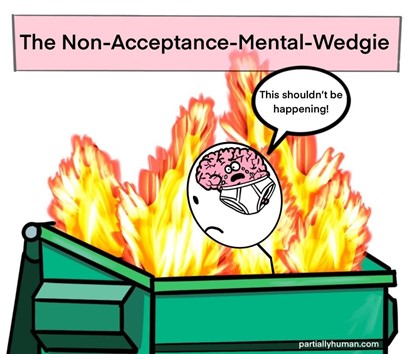
There are two flavors of acceptance, one that is true acceptance and another that masquerades as acceptance.
Sweep it Under the Rug “Acceptance”
This is where we abdicate responsibility and stick our head in the sand. It’s a cop out that mires us in self-defeating delusions, leading us to downplay the problem or ignore it. This is avoidance—acceptance’s cheap knock-off version. It’s not true acceptance, it’s artificial. It’s denial parading around with a fake smile.
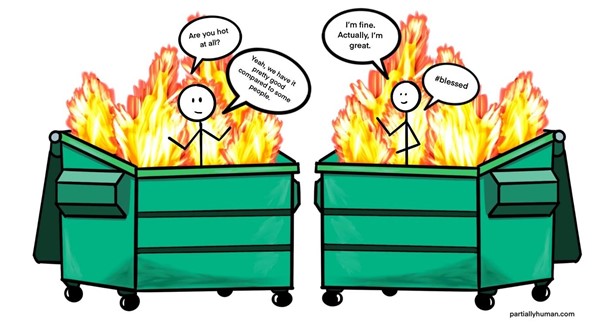
(I’m frequently guilty of the above type of “acceptance”—where I shut down my feelings and then pass myself off as intellectually enlightened for being aloof.)
Wise Acceptance
This is where we clearly see that there is an issue and clearly see what tools—if any—are available to us to fix it. It’s looking at the situation objectively, with curiosity and openness, and letting go of the mental agitation that goes hand-in-hand with resistance. It’s humbling yourself to see the limits of what you can control.
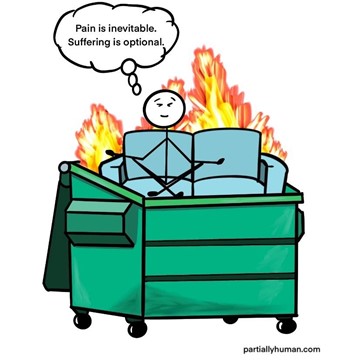
When something bad will continue to happen, regardless of what you do, the only reasonable option is to let go of the mental suffering associated with the situation. See clearly that this is how things are, see clearly how you feel about it, and see clearly that your mental agitation is not only not helping, but is actually just adding unnecessary unhappiness. I don’t mean repressing your feelings or disassociating. I mean, relating to the situation with equanimity, knowing that you’ll be fine regardless, taking in the bigger picture that life is full of ups and downs.
This can be incredibly frustrating advice. It’s frustrating to someone in truly dire circumstances. It’s frustrating to someone who isn’t sure whether they are able to change something or whether they’re fighting windmills. It’s frustrating because it takes years to develop the capacity for wise acceptance. It’s frustrating because, in the midst of suffering, acceptance feels unattainable. It’s frustrating because, sometimes, the suffering is satisfying and makes us feel righteous, and we don’t want to let it go.
And how do you even know the difference between giving up prematurely and fighting foolishly? Take someone with a chronic illness for example, when should they learn to live with it peacefully and when should they continue scouring the globe for specialists and new cures? Heck if I know. This stuff is hard! So go easy on yourself for not having all the answers.
Fighting Fires I Can Control
Once you realize that something is on fire, you have a brief opportunity to throw on that fire fighting gear. For a few shining moments, you have the clarity necessary to galvanize change. Grab onto that insight and treat the fire like an EMERGENCY.
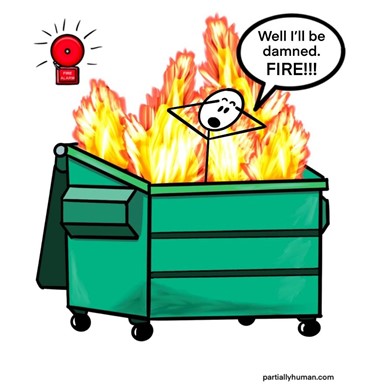
If you don’t jump on it right away, odds are that you will slip back into complacency. Remember, most dumpster fires don’t feel urgent and that is exactly why we don’t do anything about them.
The idea of treating a common, everyday problem like a no-kidding emergency was first introduced to me by Mr. Money Mustache. He says, “Your Debt is not something you ‘work on.’ It is a HUGE, FLAMING EMERGENCY!!!” He observes how nonchalant people are about carrying credit card debt, and how they continue to make unnecessary purchases instead of prioritizing paying off that debt. Instead of blithely chipping away at the debt while continuing to live with the problem long-term, he suggests the appropriate sense of urgency is akin to:
“AAAAAUUUUUUGGGHHHH!!!!
THERE IS A CLOUD OF KILLER BEES COVERING EVERY SQUARE INCH OF MY BODY AND STINGING ME CONSTANTLY!!!!
I NEED TO STOP IT BEFORE I AM KILLED!!!”
Whether it’s metaphorically a dumpster fire or killer bees, credit card debt is an urgent problem, but many people don’t treat it as such. Their instinct is to drip water on it each month by paying off a little bit at a time. All the while, this fire is damaging the foundation of their prosperity. Treating debt like an emergency, like the dumpster fire it is, would be to cease all discretionary, non-essential spending until the credit card is paid off. Firefighting debt is not casually turning on the sprinklers, clipping coupons or cutting back on Starbucks. It is a powerful fire hose stream of action; it’s selling your pick-up truck for a more economical car; it’s moving somewhere more affordable; it’s skipping fancy vacations for a year; it’s cooking at home instead of ordering takeout; it’s making major lifestyle changes to wash away the debt as fast as possible.
Is going hog wild on the fire painful? Yes, but only in the short term. It’s painful for a lot longer if you don’t put it out. Rip off the band-aid. And then it’s gone! And you can’t believe you ever lived with it!
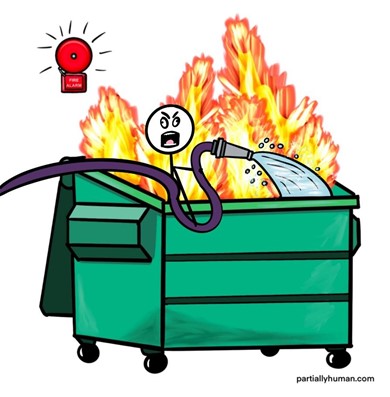
In a typical domestic violence situation, the one being abused initially tries to put out the flames with small dribbles of water. By making concessions. By avoiding doing the things they think will upset the abuser. By trying to anticipate their needs. By suggesting couple’s therapy. These things rarely make a difference. Emergency measures are required. The abusive partner needs to do serious work to address the underlying issues driving their behavior. This may involve quitting drugs and alcohol, and definitely involves talking through things in a therapeutic setting to rewire behavior patterns. If those options aren’t on the table, then leaving is the only way out. (I know that’s easier said than done. And I know leaving can be dangerous. If you or anyone you know is in this situation, all I can say is: I’m sorry you are dealing with this and it really sucks, and I wish you the best. Domestic violence is a hell of a dumpster fire with no easy fixes.)
If you’re living in fire, pull the fire alarm. Dial 9-1-1. Stop, drop, and roll. Go in fire-extinguisher-guns blazing. Put out the fire ASAP.
EXPERIMENT: Fighting Dumpster Fires

What dumpster fires are you living with? And is there anything you can do about them?
STEP 1: PAY ATTENTION
Is there fire?
Imagine how you would feel if your current problem were to spring up overnight. One day you don’t have this problem at all—no debt, no addiction, no health issues, no marital conflict, or whatever—and you wake up the next day to your current situation. Would you be alarmed, like, “Whoa whoa whoa. What is going on here!?!”
What would an outside observer think? If someone who wanted nothing but the best for you saw the situations, would they endorse it?
Better yet, imagine yourself as an 8-year-old. Imagine young-you seeing future-you’s problem. Would they think everything is hunky-dory? Is this what that idealistic, bright-eyed child wanted for your life? Is this what you wanted for them?
What springs to mind?
STEP 2: GET CURIOUS
How big are the flames? And can you do anything about them?
- Take a break from sugar-coating things—how bad is it? What are the long-term consequences of the fire?
- What is within your control to change?
- What is out of your hands?
STEP 3: TAKE ACTION
Grab the fire extinguisher and get to work.
- For fires within your control, find a sense of urgency and prioritize doing what’s necessary to squash the flames.
- For fires that are out of your control, practice acceptance.
Best of luck to you!

Great article, Katie! I’ve definitely seen all the reactions you note to dumpster fires — and being human, am guilty of them myself 🙂 In Bam Bam’s defense, he just wanted to cuddle.
Your article helped me a lot, is there any more related content? Thanks!