
Reflections on a Decade of Exercising

The one about how to develop a workout habit by making it easy, convenient, and enjoyable.
Ten years ago last month, I began working out and managed to build a lasting habit. I wish I could say that it was my first ever attempt at forming an exercise routine, that I simply started working out one day and never stopped; alas—that was not the case. As is common, I’d attempted to become a “real exerciser” many times before. I started freshman year of high school, randomly go running here and there. In sophomore year, I sporadically “felt the burn” using VHS tape workouts purchased through infomercials, like 8 Minute Buns and Tae Bo. In senior year, I got a gym membership I used maybe 10 times. At university, I flailed my way through random machines and thigh masters a handful of times per year. Post-college, newly purchased workout DVDs sat sadly unused next to my neglected DVD player.

If a regular exercise routine was unattainable before, why did I think this time would be different? Why did I even try? Who was I kidding?
The impetus for my new workout routine was moving state to pursue grad school and a new career field. A big life change is a great opportunity to shake things up and start a new habit. I already had to create a new schedule from scratch, so why not go hog wild?
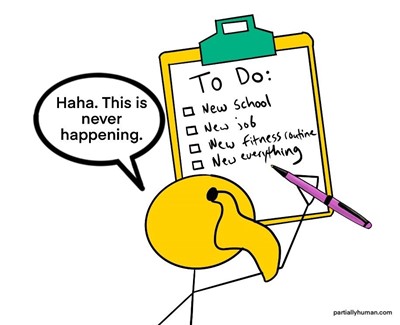
(If I’m honest, it was a bit of a quarter-life crisis.)
When I started working out, I didn’t believe in my heart that it would last, but I told myself I would go to the gym 30 days in a row, and I did. And then I told myself I would go to the gym at least 6 days a week, for the 6 months I was living in an apartment building with a gym, and I did. And then I told myself I would work out for 7 hours per week—over however many days necessary—for…some indeterminate amount of time, and I did. And then I was faced with the biggest test of all: I got a job with a hefty commute that required me to wake up SUPER early in order to work out, and I did.
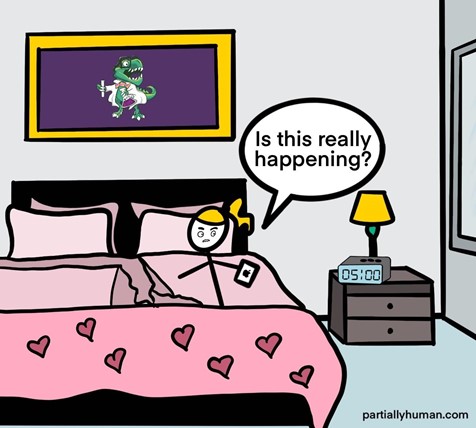
I was just as surprised as anyone that, somehow, I had started working out one day and never stopped. I just did it, and kept doing it. It took about 2 years for me to believe that I was out of the woods and that I had become a “real exerciser.” I was surprised the routine stuck.
The biggest surprise though was that I actually enjoyed my newfound habit. Historically, when “real exercisers” told me they loved working out, I figured that I must have been cut from a different cloth than them. My lot in life was to suffer through it like a responsible adult. No way would I ever look forward to it. No way would I miss it on days I skipped it. No way would I ever exercise on vacation. No way would I eventually become an indoor cycling junkie.
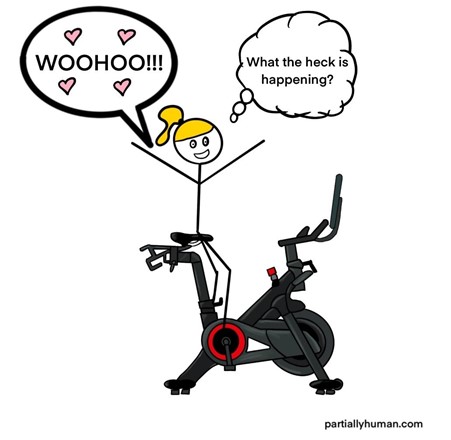
Life is full of surprises.
So why did the habit stick this time around? How did I fall in love with exercising? And what have I learned about fitness routines in the intervening decade?
Learnings from 10 Years of Exercise


Here’s what I’ve learned about exercise in the past 10 years.
Why It’s Hard for Exercise Routines to Stick
The key to making anything stick is this, it needs to be:
- Easy
- Convenient
- Enjoyable
Exercise usually isn’t any of those things at first. No wonder it’s so hard for people to stick with! I think that’s the secret though: grit your teeth long enough and form your routine thoughtfully enough that you eventually get to all three of those things (or at least 2 out of 3).
On Overrelying on Willpower and Discipline
Many people don’t ascribe to the idea that their exercise routine should be easy, convenient, and enjoyable. They think that in order for workouts to count, they need to be challenging—lots of grunting, tossing around massive weights, and running uphill in the rain while Eye of the Tiger plays in the background. Our popular conception of this go-hard-or-go-home mindset comes from the military and sports. In both of those cases, the exerciser has an external force driving them—a drill sergeant or coach. So what happens when people leave the military or a sports team? Fitness declines precipitously. Motivation falters. It turns out that being your own drill sergeant is tough.

I see too many people thinking they can bully themselves into exercising. They think it’s all about discipline, mental toughness, and just bucking up to get it done. They think if they’re not motivated then they’re simply lazy, and that they need a good dressing down in order to get off the couch. This can work occasionally, but I haven’t seen anyone sustain this level of inner-tyrant for long (the exception being people who engage in exercise in an addictive way, like many ultramarathoners do, which is a whole other issue). If even elite athletes aren’t policing themselves, why is that a fair expectation for you? And why would you want to? I personally wouldn’t want Tiger Woods’ dad or Bobby Knight or any other hard-driving tyrant overseeing my workout routine. So why would I let a voice like that in my head? Is that the only way to get yourself to exercise? Spoiler alert: no!
Forcing ourselves to do things we don’t want to do is like holding our breath, we can do it for a little bit, but eventually it becomes too much and we feel compelled to stop. And it’s not even necessary! You can be super fit without doing anything over-the-top. If all you ever do is a moderate amount of light-to-moderate intensity exercise, you’ll be in pretty good shape.
Let me share a bit more about making exercise easy, convenient, and enjoyable, along with some advice gleaned from my own and others’ personal experiences.
Make it Easy
As you work out semi-consistently, and your fitness develops, it will get easier. This is a fact. I’d say 6-8 months is enough time to see exercise get noticeably easier and a couple of years to see it get verifiably easy. That’s a long time to suffer though—way longer than most new exercisers stick with it. If the discomfort is what deters you from showing up, then make it easier. That’s not a cop out, it’s an intelligent way to keep yourself motivated long enough to crystalize a habit. You don’t have to run, you can walk. You don’t have to do plyometrics or push-ups or planks if you hate them. Start smaller. Build up gradually. Consistent small efforts add up.

Easy is not pathetic. Easy is not a bad thing. Easy is not lazy. Easy is the optimal strategy for making us less ambivalent about the endeavor. It lessens the mental battle we feel about having to do something we don’t love doing. This requires a secure ego—which is pretty badass if you ask me. And if, in your heart of hearts, you want this big, sexy, massive workout routine—great! Trust that you will evolve, and what you commit to now isn’t necessarily the endgame.
Advice on Making it Feel Easy
- Start small – Start with 10 minutes at a time and then build up gradually.
- Easy effort – Mostly work at a comfortable level of effort where you’re not suffering for more than a few minutes per workout and you aren’t too sore after.
- Easy goals – Set ridiculously small, borderline insulting goals
- Easy activities – Pick low-key activities like walking, bodyweight training, or gentle yoga.
- Easy planning – Follow a program or plan. It’s a mental burden to have to figure out what to do each workout session, and that’s not easy! It’s mentally easier for most people to do a DVD/streaming program, follow a defined routine, hire a trainer, or attend group fitness classes. I hate having to figure out what to do in a workout, so my go-to lately has been streaming Peloton workouts.
You know you’ve made it easy when you can say “Well, it’s ONLY 10 minutes” or “I have no excuse to skip this.” And then the cool thing is that what constitutes “easy” will shift over time. At first, it’s just walking that’s easy. Then power walking. Then a little jogging. Then a bit of running. Then a lot of running. Our bodies are incredibly adaptable; slowly increasing load and duration will yield increased fitness, and this adaptation continuously raises our capacity. Was there not a time when you couldn’t even hold up your own head? Babies take years to develop strength. You’ve already come so far, just go a little farther, and then a little more. Easy does it.
Make it Convenient
We can only go out of our way to do something for so long. If it doesn’t fit in your daily schedule, it’s not sticking around. If the activity is too far away or at a bad time or requires complicated logistics, you’ll feel resistance to doing it. It will grind you down.
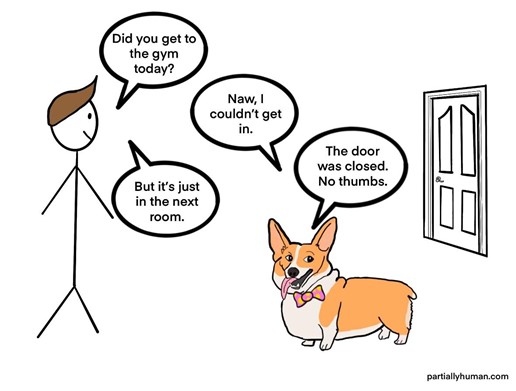
Increasing the convenience reduces the friction and ups the odds that you’ll follow through. Go to the closest gym possible. Better yet, workout at home. Walk around the block. Make it as effortless as possible to show up. When something is convenient, you can do it consistently. When you do it consistently, it becomes a habit. When it becomes a habit, you’re golden.
Advice on Making it Feel Convenient
- Create a consistent routine – When you have to figure out anew each day, or each week, when you’re going to fit in a workout, that’s a lot of mental burden and decreases the odds of it happening. This is exactly why morning exercisers are the most consistent—there’s nothing to think about, they just wake up and initiate the standard morning routine. Make it mindless: wake up, pee, drink water, make coffee, walk dog, put on workout clothes, get it done.
- Set reasonable goals that fit into the reality of your time constraints – Too many people think they need to do this big, full hour-long thing for it to count, or they need to do 5-6 days per week for it to make a difference. So they shove it in on top of their already-full life and exhaust themselves in the process. This is not convenient or sustainable. If you’re streaming a program where the workouts are normally 45-60 minutes long, just do 20 minutes and call it a day if that’s what fits in your life. If all you can do is 20 minutes 3x per week—great!
- Have an “In Case of Emergency” routine that you can do under any circumstances – Sometimes you will not have access to equipment, or you won’t have time, or you won’t have ideal circumstances; it’s handy to have in your back pocket a quick bodyweight routine you can whip out when necessary. Make it stupidly simple and quick.
- Shift priorities – Something’s gotta give. People overextend themselves left and right, but only a handful of things are actually essential. What can you give up to free up time for fitness? Where can you lower your standards or level of effort elsewhere? That feeling of convenience is inaccessible to someone with an over-packed schedule.
- Don’t be too rigid – If you bring an all-or-nothing mindset to this endeavor, what you usually end up with is nothing. It’s okay to be flexible with the frequency, duration, timing, and intensity of your workouts to make them convenient, especially if your lifestyle isn’t conducive to a set schedule. Setting a flexible goal, like working out for 4 hours per week (rather than X minutes per day or X days per week) gives you the ability to make it work in all sorts of creative ways (long workout one day, lots of short workouts other days, skip a couple of days, etc.).
- Sneak it in – I’ve seen some people come up with creative ways to slot small bursts of exercise in throughout the day. They’ll tie mini-workouts (like 10 push-ups or 20 squats or a 1-minute plank) to pre-determined triggers in their routines (like every time they go to the kitchen, right before they shower, immediately after getting out of bed, or each time they go upstairs). These small sessions add up big time!
- Spend 15 minutes per week planning to set yourself up for success – Map out your workouts, figure out what time you’ll do them, and prepare any supplies you’ll need (water bottle, clothes, gym bag, towel, etc.).
- Put on your workout clothes – This is the oldest trick in the book, and it works. Sleep in your workout clothes if you exercise in the morning or have them laid out next to your bed. Put them on as soon as you get home from work if you exercise in the evening. One less barrier to getting going!
You know you’ve made it convenient when you’re not stressed about the what/when/where/how of it all. Smooth logistics, adequate planning, and ample time lead to mindless execution, which is a prerequisite for something becoming a habit.
Make it Enjoyable
Vows, commitments, and promises don’t fuel a habit. The pleasure of the thing is what fuels a habit. No pleasure = no habit. Most people don’t find exercise pleasurable. So now what?
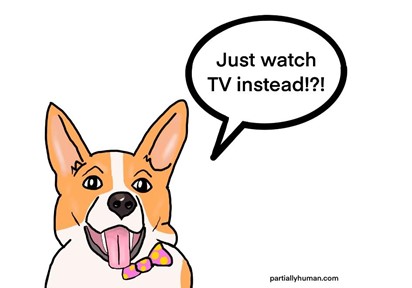
No, not that. You have to find a way to enjoy it. But how do you do that?

I know, I know—this advice is sort of annoying. I too hate the common cliché “Find an exercise you love!!!” It’s like, “Wow, thanks a lot, if only I had thought of that.” That frustrating platitude is just as unhelpful as telling someone who doesn’t know what they want to do with their lives to “follow their passion” or telling a middle schooler to “just be yourself.” What if we don’t know who we are? Don’t know what we’re passionate about? Don’t believe that there is an exercise out there that we could love?
While many people think they’ll never love exercise, I think most people can get to a place where they at least mildly enjoy it. It takes time to get there though, and I’ve observed that it’s common to have unreasonable expectations about what it’s like to fall in love with exercise. It’s usually not love at first sight. It’s more like an arranged marriage, where the warm feelings develop slowly over time. And like any marriage, you’ll have good days and bad days. But first, there are a couple hurdles you have to get past: you need to develop basic competency and a baseline level of fitness.
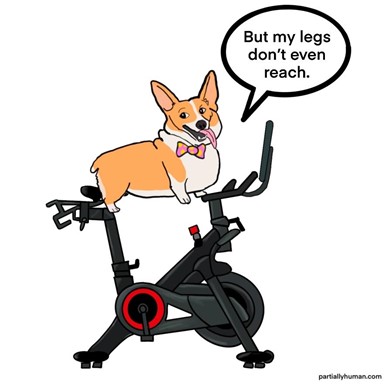
We usually don’t like things we aren’t good at. When learning to play an instrument or speak a language, most people don’t enjoy themselves much. Practicing the scales or stumbling through trying to say, “Are you a horse?” in French is tedious and awkward. It’s the same with exercise. Planks, push-ups, and Pilates are uncomfortable at first. Trying to do new moves creates this self-consciousness mental dialogue: “Am I doing this right? Am I weak? Do I look stupid?” While self-referential thoughts are a sure-fire path to mental misery, some level of self-awareness is necessary when learning to move our bodies in new ways, so this pain is unavoidable. You will eventually get better though, and then you won’t have to think about it so much. Once you’ve developed a decent fitness level, it becomes much more enjoyable. Not every single activity (I still hate running and push-ups), but a lot of them will become, at least, not unpleasant.
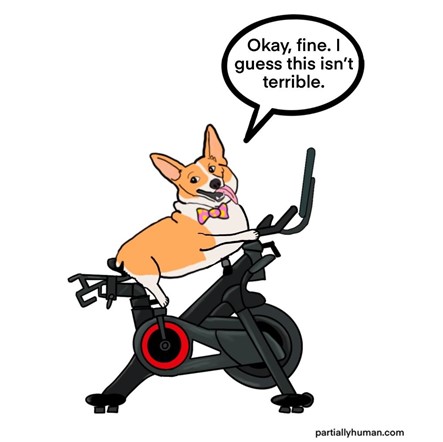
The first time I enjoyed the exercise itself (and not just the audiobooks, movies, or shows I consumed while exercising) was when I started taking indoor cycling classes. Moving in sync with the music and other people was fun, and the high heart rates finally gave me that runner’s high I had heard so much about. At that point I had already been working out for nine months. It took NINE MONTHS for me to find something I liked. (Most exercisers quit by week 6.) But guess what—no way would I have liked cycling if I started out doing it on day one. It would have been TERRIBLE in the beginning—before I already had 9 months of exercise under my belt—because I wouldn’t have had the fitness necessary to do a decent job. And guess what else—I didn’t LOVE it the first time I did it. It was more like:
- I didn’t really know what I was doing, so I was in my head a lot
- The seat was uncomfortable
- I liked the music and the energy of the other participants
- I didn’t hate it, most of the time
- I was constantly checking the clock to see when it would be over
- Sometimes I was acutely physically uncomfortable and the most out of breath I had ever been
- I liked the stuff the instructor said throughout class
- Walking out of the gym I felt AMAZING
In subsequent classes, I still felt ambivalence mixed with a few hits of enjoyment. It took about 6 months of cycling classes before I loved it. It took 3 years before I became a cycle instructor myself. Now it’s one of my favorite activities in the world.
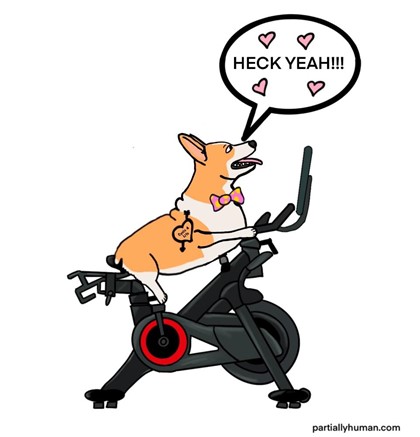
Once you’ve developed a baseline of fitness, and you know what you’re doing, it becomes easier to enjoy exercise. Eventually, the good feelings from the endorphins and adrenaline outweigh the bad feelings of lactic acid build up and oxygen depletion. That’s not to say that all you need to do is get good at something and then you’ll like it. Not at all. This is where exploration and experimentation come in. But rest assured, our biology is designed in such a way that moving our bodies is intrinsically pleasurable. Even more so when moving to music (this is why dancing is popular worldwide and has been throughout history). And even when exercise is physically uncomfortable, it can be mentally pleasurable. Few things help us be more present and in the moment.
Advice on Making it Feel Enjoyable
- Patiently build up your fitness and skills – Then it will feel better.
- Try everything until you find something you don’t hate – Try yoga, try boxing, try different fitness instructors, try sprinting, try marathons, try Zumba, try Les Mills OnDemand, try old Richard Simmons tapes, try cycling, try streaming Peloton classes, try Orangetheory, try water aerobics.
- Try everything at least 5 times – You likely won’t love something the first time. Or the second time. Stick with it long enough to at least know what you’re doing before deciding whether it’s for you. I’ve changed my mind on soooooo many things I thought I hated: yoga, planks, mountain climbers, plyometrics, and more.
- Pair exercise with something you already like – Listen to audiobooks/podcasts or watch shows while exercising. Talk on the phone or hang with a buddy while taking a walk. I used to pick audiobooks that were proverbial page turners and only let myself listen to them at the gym. This made me look forward to the gym, and sometimes I would stay longer just to keep listening to my book.
- Intentionally focus on the good parts – Our brains have a negativity bias; we tend to notice and fixate on that bad stuff that happens way more than the good stuff. This is also the case in exercise: we are acutely aware of every single moment of discomfort, confusion, or awkwardness. The moments that are pleasant or neutral fall to the wayside, ignored and forgotten by our brains. If you pay attention, you’ll notice that most of the time it’s fine, it’s not that bad, and sometimes it’s nice. (And if it really is bad the whole time, see above: make it easy.) Take in the good parts! Seek them out and relish them. For most people, it’s that feeling right after they’ve finished working out that keeps them coming back. That feeling of accomplishment, that feeling of energy buzzing through them, that feeling of being more centered and grounded.
- Find an instructor you like – There are so many amazing fitness streaming services now, featuring a plethora of fitness instructors. Finding one you connect with can be powerful. Peloton’s #1 most popular instructor (and my favorite) is Cody Rigsby, because he is hilarious. He distracts you from the workout, surprising you with the things that come out of his mouth. Hoards of his followers talk about how even when they don’t feel like working out, they’ll do one of his classes because they want to see what he’s going to say. Find a fitness instructor that resonates with you and let them distract you.
You know you’ve made it enjoyable when, more often than not, you feel good-enough while you’re doing it and great when you’re done.
General Advice for New Exercisers
After countless conversations with new exercisers, I’ve learned that there are some common missteps that throw people off. Understanding these things will help you have realistic expectations.
- No one at the gym is judging you – It’s normal to see all body sizes and fitness levels at most gyms. Everyone is mostly focused on themselves. And if one or two buttholes do notice you and think or say something unkind about you, that’s more a reflection of their petty shallowness and fragile egos than your value as a person or whether you belong there. (More on dealing with people judging you here.)
- It’s normal to be ambivalent toward exercise – Sometimes you’re motivated, sometimes you’re not. Once it’s a habit, motivation ceases to be a factor.
- Don’t press pause when life gets in the way – It takes significantly less effort to maintain your fitness than it does to build it. And when you stop working out for more than a couple of weeks, you start moving backwards, losing your progress. This is demotivating and will make it harder to get back into your routine. Instead, do an extremely bare minimum amount of exercise to maintain the routine, maintain the habit, and maintain your fitness. I’m talking like 10 minutes every other day. This will signal to your body that you still need that strength, preventing atrophy. And this will signal to your brain that exercise is an important part of your routine that you stick with no matter what.
- Make peace with diminishing returns – The progress you make in your first year of exercise is exciting. It’s intoxicating. Don’t get used to it. A new runner might knock 3 minutes off their mile run in just 3 months. Eventually, it’ll take 3 months to shave off People get disheartened when they start to struggle to increase the weight they’re lifting, run faster, or set new personal records. This is an inevitability, so don’t get too attached to the fun of beating your old metrics.
- Comparison is the thief of joy – Am I better or worse than other people? This is a question running in the background of our monkey brains when we’re around other monkeys. This is a good question to ask if you are competing in the Olympics. This is an absolutely unnecessary question to ask if you are working out for your health. How much weight and how many reps someone else is doing is neither here nor there; moving your body regularly to be healthy is the only aim. Despite knowing this intellectually, it pops up anyway. This is normal. Don’t let it torment you. Don’t get lost in pursuit of ego-validation.
- It’s 100% natural and rational to not want to be uncomfortable – Don’t feel bad if you don’t like pushing your body. Your body wants to be comfortable—it’s natural. It’s not a bad thing. The body wants the path of least resistance. That’s not a moral failing—it’s self-protective and totally understandable. Discomfort and pain are usually a signal that something’s wrong. This can be a confusing thing to grapple with when your legs and lungs are burning. Your body is literally telling you to stop, but intellectually you know that you’re doing something good for yourself. This is a tension you learn to live with.
- On waking up early to exercise – So much of this is mental. If you moved to another time zone, you would adjust. Heck, in the US, we adjust our wake-up times by an hour twice a year already. Treat your new schedule like you moved to a different country (this also means adjusting your bedtime)! Give it a few weeks, and then if you’re still really tired, then you aren’t going to bed early enough. Give it a few more weeks, and if you are still suffering, then maybe you’re someone whose circadian rhythm is best suited for nighttime activity. Or explore shifting your work schedule to start later.
I hope this was helpful. My sincere hope for everyone is that they fall in love with moving their bodies in some way, shape, or form. Feeling strong and fit elevates so many aspects of your life, and it breaks my heart when people think that that’s not in the cards for them.
What helps you make exercise easy, convenient, and enjoyable? Leave your advice in the comments.
Experiment: Making Exercise Easy, Convenient, and Enjoyable

How can you make exercise more easy, convenient and enjoyable? Play around with the suggestion in this post and find what works for you.
STEP 1: PAY ATTENTION
Tune in to how you feel before, during, and after exercise.
- What factors make it feel easy?
- What factors make it feel convenient?
- What factors make it feel enjoyable?
STEP 2: GET CURIOUS
Figure out what works and what doesn’t work for you.
- What happens when something isn’t easy, convenient, and/or enjoyable? How do you deal with it?
- What ambivalence do you have toward exercise? How does the ambivalence influence your desire to work out?
- What things increase your desire to workout? What decreases it?
- What barriers are in the way of exercising, and how can you address them?
STEP 3: GET CREATIVE
How can you make exercising more easy, convenient, and enjoyable?
Refer back to the tips in this post for suggestions and play around with your own ideas.
STEP 4: TAKE ACTION
Get moving, experiment, and try things until something works. Start small and just keep going. You got this!

Great article! So true! Starting out with just the smallest amount of exercise helps. I love working out in the mornings b/c that’s when I feel most productive & wont have an excuse @ the end of the day. My workouts have changed since leaving the gym during Covid. But I still do them. I used to never workout on vacation, now I find a way to workout. Whether it be that I bring some weights & bands b/c I won’t have access to a gym, walk/run wherever I’m staying, to stretching & keeping it easy. (Speaking of the gym, one summer I was in the OBX & looked up places to workout the week I was there. I went to the YMCA for a drop-in class & to a local gym for some of their classes. Most gyms in vacation towns offer specials for vacationers). Peloton & all the classes they offer help a lot when traveling. To be able to take a class anywhere, anytime is so nice.
Thanks for sharing your story! So cool! It’s trippy to start working out on vacation but makes you feel so much better!