
Food Won’t Make You Happy Part 1: Pleasure

The one about the difference between pleasure and happiness
There’s a commonly held belief that yummy foods make us happy. So, since food consumption has increased in most countries over the past several decades, it stands to reason that we must be happier now than ever before. Clearly, our happiness levels should expand with our waistlines, yes?
Obviously not. Missing from this equation are the negative effect on our health and the complexity of human happiness.
But what if we were able to eliminate the negative health consequences of eating, allowing us to eat whatever we wanted? Could food become a guilt-free source of unmitigated happiness? Still, no.
When Michael Phelps was eating 10,000 calories per day to support his swimming, was he the happiest man alive? By his own account, he was not. Athletes who get to eat more than everyone else without gaining weight are not demonstrably happier than those who are limited to smaller, less frequent meals. I think we can all agree that happiness doesn’t scale proportionally with calorie intake.
But eating some yummy foods some of the time makes you happier, right? You know, moderation and all that jazz?
Both modern science, ancient wisdom, and lots of smart people who write stuff on the internet emphatically agree that the pleasure food gives us does not contribute meaningfully to happiness. If you pay careful attention, you can see for yourself that the fleeting, superficial pleasure food gives us makes eating a suboptimal strategy for lifting your overall level of happiness.
That is excellent news! It means that the most effective happiness strategies aren’t at odds with our health goals. It means that there is no conflict between what is good for us and what makes us feel our best. Woohoo!
And yet, this confusion surrounding food and happiness persists. Any of this sound familiar?
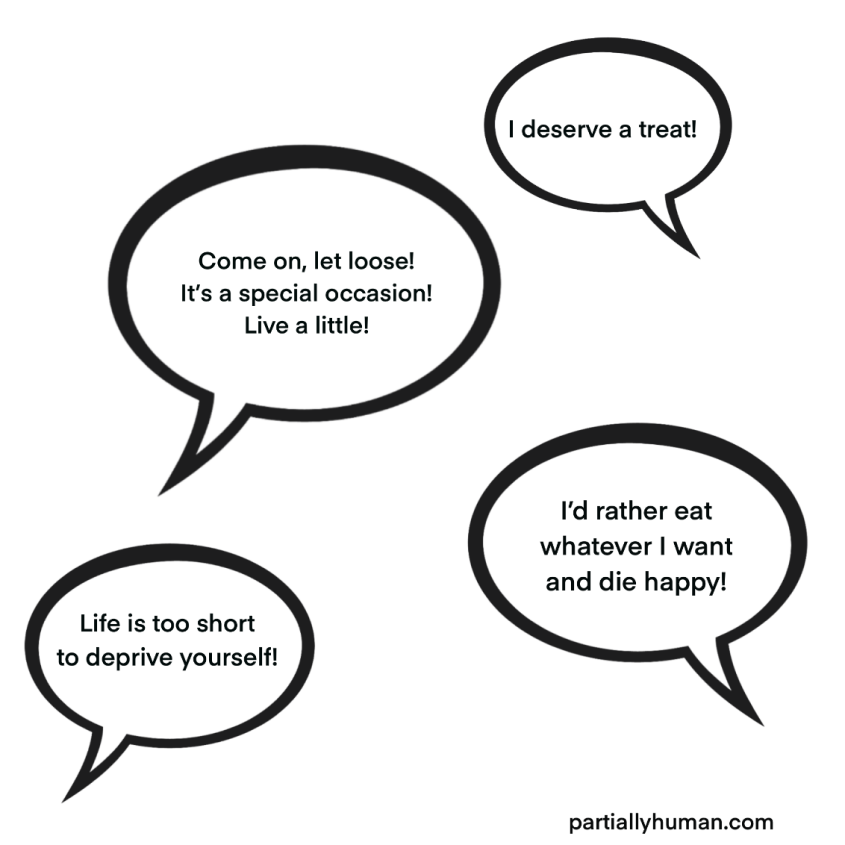
So what gives? Do certain foods make us happy? Why is the idea that food is comforting baked into our culture? Is the person writing this article some broccoli-loving-floozy that was commissioned by Big Veggie? And why is there such a discrepancy between the cultural messaging we get on food and what a bunch of old philosophers, contemplatives, psychologists, and scientists say?
To untangle these questions, we need to understand the interplay between food, mood, pleasure, and happiness, and we need to understand what things actually contribute to lasting happiness. (Thankfully, happiness is not an unsolved mystery!)
This is the first post of a series about food and happiness. Throughout the series, I’ll give you some experiments to do that will help you see for yourself that food is perfectly pleasant, but not a vital component to happiness, and you’ll test out some alternative approaches to improving your mood.
First, let’s take a look at why we think food makes us happy, with the help of my friend Chonky Corgi.
Who the Heck is Chonky Corgi?


Chonky Corgi is a very good boy with a very important job: making sure we eat.

To get his job done, he has at his disposal the two most powerful tools one can use on humans: pain and pleasure. He is a master at turning our dials, keeping us spinning on a craving-and-relief-merry-go-round that has us alternating between wanting food and feeling satiated throughout the day.
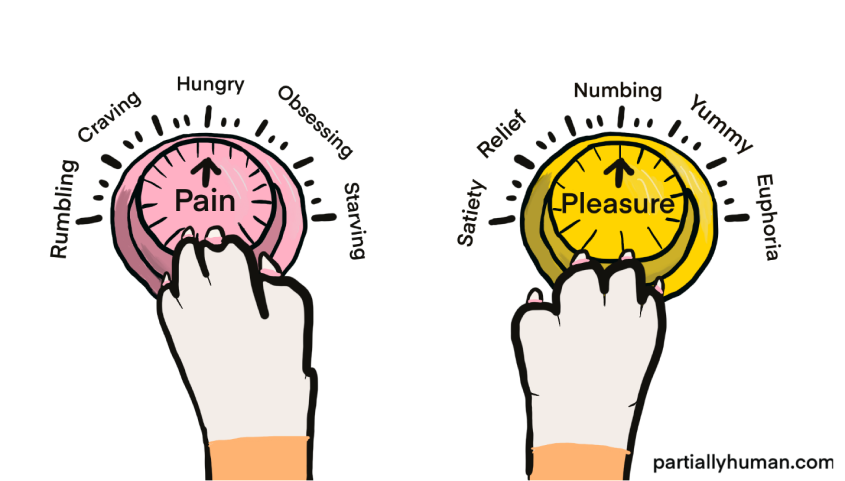
Chonk makes eating fun! (Voltaire mistakenly observed, “Nothing would be more tiresome than eating and drinking if God had not made them a pleasure as well as a necessity.” Silly Voltaire, Chonk is a DOG not a GOD.) Without Chonk, we would literally either forget to eat (especially babies – they are so dumb!) or simply lack enough motivation to muster the effort necessary to hunt and gather, resulting in our untimely death. So that wouldn’t be great. Good looking out, Chonk!
To learn more about Chonk and how he gets you to eat, read this post.
On a personal note, my personal Chonky Corgi is such an expert at his job he once got me to be 70 pounds heavier than I am now ─ now that’s hard work and persistence! He demonstrated truly superb creativity in the things he got me to eat, inventing concoctions such as the Peanut Butter Cup Sandwich (take two Reese’s Peanut Butter cups, squirt some hot fudge and peanut butter sauce between them, and top with a dollop of whipped cream) and the Mozzarella Stick Salad (lettuce, cheese, honey mustard dressing, and cut-up deep-fried mozzarella sticks).

Well done, sir! Truly spectacular work.
Why Does Chonk Live in Our Head?
You see, humans are essentially fancy monkeys wearing pants, and nature doesn’t trust us to stay on top of our basic needs unassisted. Since dumb babies can’t read, no one can hand us an instruction manual on how to survive when we are born. Instead, nature must embed instructions into all our senses to guide us. Cue emotions and physical sensations like anxiety, pleasure, hunger, thirst, sleepiness, pain, temperature, etc. to guide us toward survival and reproduction. I like to think of it as a bunch of dogs, monkeys, and dinosaurs running around in my head squirting fear and happiness chemicals and creating pleasant and unpleasant sensations to motivate me to get up and do a bunch of stuff.

What you think of as your “self” is really more like a loose coalition of different parts of the brain with different interests weighing in on things, each one competing for primacy on any given decision. Those different parts of your brain process information separately, and then need to come together to function as a whole. When you’re doing anything a dog would do – eating, drinking, having sex, fighting, hiding or running away from something scary, etc. – that means you are using your limbic system, the part of your brain responsible for basic drives and emotions. This is where Chonk does his job, controlling the knobs that drive us to eat.
Let’s take a closer look at how Chonk uses pain and pleasure to get you to do his bidding.
The Pain and Pleasure Knobs
When you eat food, Chonk rewards you with pleasure by giving you a squirt of feel-good-chemicals and pleasant sensations. When he thinks it is time to eat again, he gives you pain by creating a slew of uncomfortable feelings and sensations like craving and hunger. When he compels you to eat, he is just doing his job. Even when he persuades you to overeat and pack on weight, he is still just doing his job, because he didn’t get the memo that we are no longer living in times of food scarcity. (He’s trying to be a good boy! It’s not his fault dogs can’t read memos!)
Do you know what is NOT his job? To make you happy.
But Isn’t Pleasure a Kind of Happiness?
Hold your horses! We’ll get to that later. (But short answer: No.)
Then Where’s the Happiness Knob?
Human bodies and brains are not designed to be happy for more than brief moments. Happiness is meant to be a fleeting incentive. Lack of happiness is one way our biology motivates action, whether it be for the basics like food and safety, or for fancy monkey things like Instagram followers and car upgrades. Perfect contentment would undermine our drive to keep striving for survival and reproduction. Thankfully, this is just our basic programming, and we know how to upgrade our operating system to shift our set-point toward greater contentment. (How depressing would this post be if that weren’t the case?)
It is YOUR job to find your happiness knobs (not that one – don’t be crude). The challenge is to not get sucked into what the animals in your head mistakenly tell you will bring happiness.
We Are Wired to Chase Pleasure and Avoid Pain
The animals in our head unintentionally conspire to convince us that certain things will make us happy that absolutely will not. It’s not malicious on their part. And it’s not a moral failing or character defect on your part. The dogs, monkeys, and dinosaurs in our brains are just totally clueless about how human happiness works.
They get seduced by the idea of obtaining happiness in external things like food, money, status, or a sexy mate. They fall victim to their primitive impulses of fear, anger, anxiety, pettiness, jealousy, and greed. They don’t know what they don’t know; the only tools they have at their disposal are pain and pleasure, so they think that’s all there is to life.

They enchant us, telling us that satisfaction and contentment are just on the other side of the next pleasurable experience, only a few bites of food away. Yet we’ve all had plenty of experiences where we’ve gotten the thing we craved and felt some happiness, only to have that happiness swiftly replaced with a new desire moments later.
How is that the path to happiness?
We all have some sense that the self-destructive, short-sighted things we do aren’t ideal. But something still compels us to overspend, overeat, seek revenge, be unfaithful, lie, and participate in all manner of shenanigans and tomfoolery. What’s up with that?
The Battle Between Our Better Judgement and Our Internal Drives
Anytime there’s an internal battle going on in your head, it’s a safe bet that the animals are urging you to do things that only align with their very narrow, short-sighted interests. It doesn’t matter how smart you are, you cannot logically convince them of the error of their ways. Driven by biology, they want what they want. So even if your fancier, higher-level thinking parts understand conceptually that food won’t make you happy, there is another part of you that will never get the memo, holding fast to false beliefs.
Case in point: emotional eating. Many people feel compelled to eat foods loaded with fat, sugar, and/or salt when they are stressed, bored, or anxious. Emotional eating is a bewildering habit, because people report that WHILE they are eating their “comfort food,” they do feel a sense of relief, comfort, and numbness, but then afterwards (or sometimes in real-time), they experience shame, regret, and guilt.
So, eating in response to icky feelings is clearly not a logical solution, since it comes packaged with a whole new set of problems, yet it remains an alluring, instinctive response. This is clearly Chonk’s ham-fisted attempt to comfort you the only way he knows how.
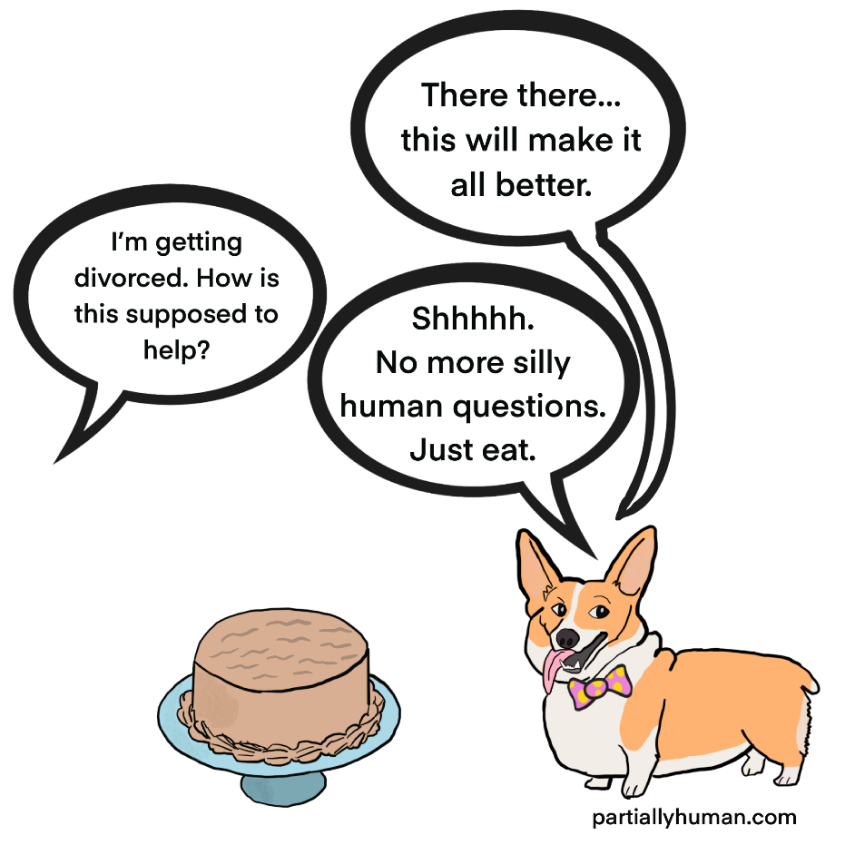
We are wired to survive, not to be happy. Our biology drives us away from pain and toward pleasure, not toward happiness. Lack of food gives us pain. Obtaining food gives us pleasure. Happiness is nowhere to be found in the equation.
But My Real Dog Seems Happy
Yeah, most mammals seem reasonably content. The way they get excited about the same things, day-after-day, year-after-year is extraordinary. They operate unabashedly in alignment with their own nature and are mostly living life in the present moment: two conditions that help you experience peace and satisfaction as long as your basic needs (food/shelter/safety) are met.
Dogs doing dog-things are probably happy, so I don’t think the dogs in our brain (i.e., the limbic system) are the primary culprits driving our unhappiness. I think, instead, that something gnarly happens when you slap a monkey brain on top of a dog brain and then add in a dash of fanciness (i.e., rationality).

This mish-mash of internal coalitions with competing desires and interests wreaks havoc on our mental health. And if there is ANYONE in our head to blame for our suffering, it is the monkeys (i.e., the cortex). Those fools actively create misery with excessive thinking, ruminating, worrying, and status seeking.
It appears that the price we pay for our fancy sophistication and fancy advanced civilization is constant inner turmoil. Is there a way out of that? Can we be happy?
What is happiness for fancy monkeys (i.e. humans)?
To answer that question, we first need to circle back and take a closer look at pleasure.
The Difference Between Pleasure and Happiness
It’s easy to confuse pleasure with happiness because they both feel good. And some would argue that all positive emotions fall under the umbrella of happiness, making pleasure a subset of happiness – but I disagree. They are different and we need to keep them in separate categories in our minds.
Pleasure
Pleasure is all the fun animal stuff we do related to emotions and fulfilling our dog/monkey needs like sex, food, cool kid points, and money.
Pleasure is:
- Fun, excitement, infatuation, euphoria, intoxication
- Short-lived, leaving you wanting more
- Dependent on external circumstances, mediated by sight, sound, touch, taste, smell, and thoughts
- Relative, adapting so you need to keep upping the ante over time to get the same exciting feeling
- Driven by dopamine, a chemical that rewards you for chasing experiences that feel good and the neurotransmitter responsible for addictive behaviors
- A nice thing to enjoy while it’s happening, nothing to get attached to or obsess about, because moods come and go
Pleasure is a double-edged sword, with pain baked into the price of obtaining and trying to hold on to it.
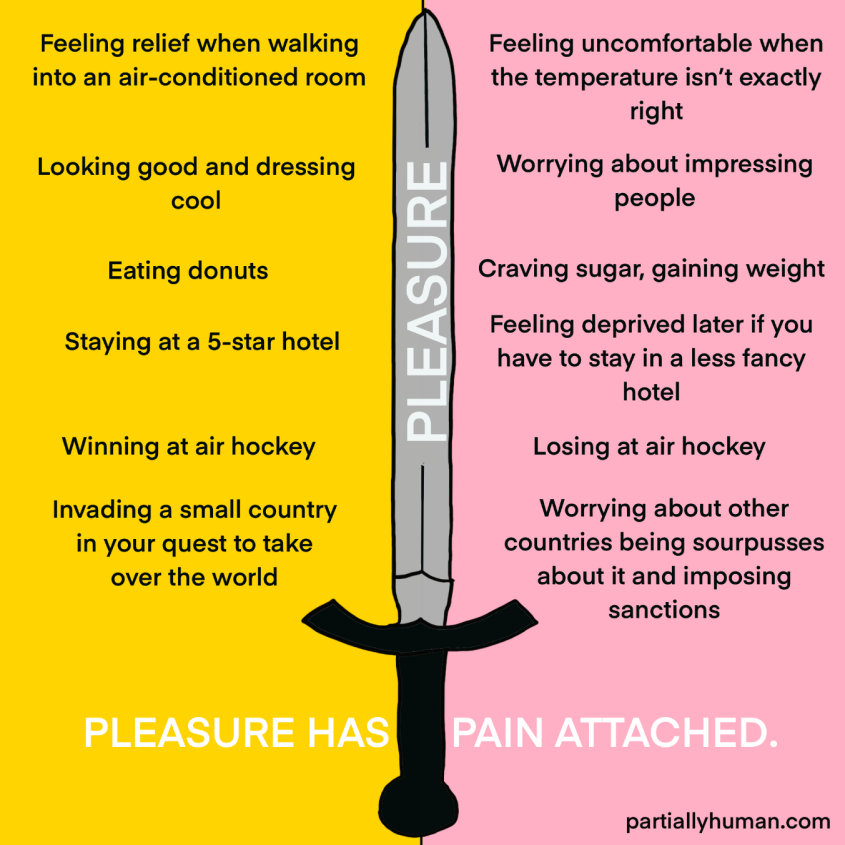
Placing your happiness in the hands of these things is one of the most tragic mistakes you can make. Having any kind of attachment to these types of temporary pleasures brings us great suffering.
Pleasure is ultimately empty and inextricably tied to pain. Seeking it is the reason why rich, attractive people who have achieved their life’s dreams can still be miserable, and tying our happiness to it leaves our mental health vulnerable to any and all circumstances outside of our control. You can’t please desires that are unlimited and insatiable. But when you see how they work, you can enjoy them for what they are, without taking them too seriously.

Happiness
Happiness, on the other hand, is a spontaneous byproduct of living a good life and cultivating mindfulness of the present moment. It is nurturing and nourishing, the opposite of suffering.
Happiness is:
- Joy, serenity, love, calm, satisfaction, gratitude
- Longer-lasting, leaving you content
- A sense of emotional well-being that is relatively impervious to life’s ups and downs, mediated by conscious awareness
- Driven by a profound sense that everything is just as it should be, not caught up in craving or aversion
- A respite from the mental suffering we inflict on ourselves by thinking, worrying, and ruminating instead of living in the present moment
- A nice thing to enjoy while it’s happening, nothing to get attached to or obsess about, because moods come and go
Doing more of the things that lead to happiness doesn’t come with the steep price that pursuing pleasure brings. That’s not to say that these things come without any suffering at all, but as you do more of these things and get better at them, the suffering should lessen. The tricky thing is that you can’t go after happiness directly; it is an offspring of things like:
- Being kind, caring, and compassionate toward yourself and others
- Good health, including sleep, diet, exercise, and stress
- Living in the present moment, instead of constantly worrying about the future or ruminating about the past
- Giving up dependence on hedonic pleasures
- Accepting that everything is temporary, freeing you from fruitless attachments and resistance
- Contributing to community
- Spending time in nature
- Cultivating satisfying relationships
- Being grateful for what you already have
- Having a sense of meaning or purpose
- Accepting life in its totality, both the good and bad, knowing that everything is all right, just as it

What is Food’s Relationship to Happiness?
Relationship Status: It’s Complicated.
In the short-term, food causes both pain and pleasure. It takes us on an emotional rollercoaster, jerking us around using mood-changing chemicals called neurotransmitters, varying our emotional state with the rise and fall of our blood sugar and hunger levels. (P.S. That’s okay! It is normal and healthy to experience a wide, ever-changing range of moods and emotions, both positive and negative. It’s normal, okay, and inevitable to feel hunger, low energy, craving, etc. Feelings are signals that we need something. Nothing to worry about or get twisted in knots over.)
In the long-term, food can contribute both positively and negatively to our sense of happiness, but in a less direct manner. Good health helps you live a good life, and healthy food provides the energy and vitality necessary for optimal emotional well-being. Doing the things that lead to fancy-monkey-grade (i.e., human) happiness requires a long-term view and a bit of wisdom, not our dog’s area of expertise.
Is Chonk Right?
So is Chonk right? Is eating the #1 best thing ever?
To find out, we need to pay very careful attention to the experience of eating and notice how our mood changes throughout.
Most people who attempt to pay careful attention to the actual experience of eating (often called mindful eating) report that something very strange happens when you slow down and notice the moment-by-moment sensations of biting and chewing food – it starts to feel… boring. And kind of weird. You realize that the actual sensory experience of food mashing between your teeth is a mediocre affair. You realize how little attention you normally pay to the tastes, textures, and smells of eating. That you are usually so distracted while eating that it’s almost like you never really eat at all. That the idea of eating is more exciting than the lived experience. You realize… that maybe eating isn’t as amazing as you thought?
When you think about it, it sort of makes sense. If eating was so fun and so great, why are people compelled to do other things, like watch tv or scroll through social media looking at pictures of disapproving Corgis, while doing it? When you are engaged in interesting and fun things, you aren’t looking for something else to do. When something is super fun and pleasurable, then you just want to do that thing.
Indeed, people who struggle with overeating often find that when they make the effort to be fully present during a meal the desire to overeat vanishes. It’s a bit of a paradox. When you slow down and actually taste your food, you get to enjoy it more, yet that desire for MORE MORE MORE lessens. When you’re in the driver’s seat, instead of Chonk, eating gives you a subtle, somewhat understated, sense of gratification, not the drug-like-frenzy of bingeing on donuts, but a calm and controlled pleasure. You feel MORE satisfied after eating LESS food. Weird, huh?
Would it be so bad to discover that eating isn’t actually all it’s cracked up to be? That Chonk might be overhyping things a bit? Since many first world health problems are due to us eating too much, too often, would realizing that eating isn’t a one-stop-shop of thrills and excitement be fabulous news?
Let’s find out.

Part 1 Experiment: Is Chonk right?
PART 1 EXPERIMENT: Does food make you happy?
Notice how it feels physically, mentally, and emotionally, before, during, and after you eat.
What is it like to eat?
- What does it feel like to want food? To get the food? To eat it? To be done eating it?
- What makes you feel compelled to eat? Thoughts? Feelings? Boredom? Stomach rumblings?
- When you’re hungry, where do you feel it? What’s that like?
- When you’re satisfied because you’ve eaten enough, where do you feel it? What’s that like?
- What sensory experiences do you notice when eating: taste, smell, texture, sight, sound?
- What colors do you see?
- What flavors do you notice?
- What does food feel like in your mouth?
- What happens to the texture of your food as you chew?
- What is happening in your mind as you eat?
- What types of thoughts do you have?
- As you’re eating do you find yourself rushing through? Distracted? Already going for the next bite before finishing this one, without really tasting what you’re eating?
- What emotions come up before, during, and after?
- Are all of these sensory experiences static and consistent, or do they vary depending on the time of day, location, social setting, stress-level, etc.?
Step 2: GET CURIOUS
Investigate the relationship between eating and your mood.
How does food play a role in your mood and/or sense of well-being?
- What is it PRECISELY that is so great about food? And EXACTLY how great is eating?
- What do you like about eating? The first few bites? The feeling of your stomach filling? The texture of food in your mouth? The act of chewing? Specific tastes? Smells?
- What’s the best part?
- What’s it like to pay careful attention to eating vs. mindlessly eating?
- What’s your mood like when you want food? When you get food? When you’re done eating?
- How much pleasure or satisfaction do you get during the first few bites? What about the next few? Is every bite equally good? Is the 20th bite just as yummy as the 2nd bite?
- How many bites until the wanting more changes to not wanting more?
- How fun or exciting is the actual moment-to-moment experience of putting food in your mouth, chewing, and swallowing?
- Is it ever boring? Do you find yourself wanting to look at your phone or watch TV?
- Do different foods give you different amounts of pleasure? How big is the difference between the positive feelings you get when eating yummier foods vs. eating boring foods? (Is there such a thing as a boring food?)
- After eating something that improved your mood, how long does that good feeling last?
- Does eating for a longer time period equate to more pleasure?
- Is eating more food better? Does three donuts give you three times the pleasure?
- Is it possible that eating isn’t very exciting? (Or at least not for very long?)
I’ll leave it there for now. We will add on to this experiment as we move through the rest of this series. In the meantime, go get curious, you gorgeous fancy monkey! And share your observations on the Partially Human Facebook page or comment below.
Up Next
In the rest of this series, we will dig deeper into how food impacts your mood and emotional well-being, what the science says about how food influences emotions, and what things happiness experts say lead to true, enduring happiness. After completing the part 1 experiment above, check out the next post: Food Won’t Make You Happy Part 2: Mood.

Im more than happy to find this page. I want to to thank you for ones time for this fantastic read!! I definitely appreciated every bit of it and i also have you saved to fav to look at new things in your web site.