
Food Won’t Make You Happy Part 2: Mood
The one about how Chonk gives you super-short-sighted advice
For the past decade, Snickers has run a cute series of ads with the slogan “You’re not you when you’re hungry,” that blames a range of grumpy moods, poor performance, and bad behaviors on hunger – conveniently recommending their candy bar as the solution.
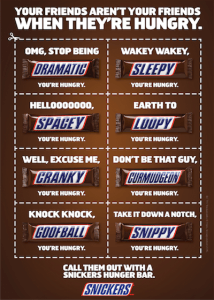
Those Snickers ads are targeted directly at Chonk the Corgi, the dog in your head in charge of getting you to eat, who HIGHLY recommends that you use food to improve your mood. Chonk recommends that you turn to comfort food to cheer you up, sugar to boost your energy, and snacks to prevent you from getting hangry. But is he right? Are those the best strategies to keep the good moods rolling?

In Part 1 of this series, we looked at the difference between pleasure and happiness and learned about how Chonk the Corgi tries to convince us that food will make us happy. As an experiment, I asked you to pay careful attention to how eating impacts your mood. Hopefully, you saw that pleasurable foods give you a temporary, shallow boost in positive feelings, and wanting them gives you the uncomfortable feeling of craving. But how does food affect our moods more broadly, outside of the immediate act of eating? Are there specific eating strategies that make our mood better or worse? Is a Snickers bar the secret to high-performance and good-moods-galore? Let’s zoom out from looking at the moment-to-moment experience of hunger and eating to the physiological underpinnings of mood.
Today we are going to dive deeper into the interplay between food and mood to crystallize in your mind how it contributes to both your ups and downs. And for our experiment we will look at how our current diet impacts our happiness.
A Disclaimer on Moods
I’m a little hesitant to do this deep dive into food and moods because I don’t want to overstate the correlation between ANY single stimuli and mood. Moods aren’t totally random, but they are so all-over-the-place and transient that it can be silly to overanalyze them. They come and go. Sometimes things that should lift our mood don’t. Sometimes things that normally make us grumpy don’t. Often (usually) we aren’t fully conscious of all the junk influencing our mood. Moods are more like weather patterns than a predictable and formulaic if X-thing happens then Y-mood happens. A sample of variables that interact to determine your mood:
-Feeling too hot or too cold
-Remembering something funny that happened
-Remembering something embarrassing that happened
-Thinking about some annoying remark your boss made in a meeting
-Watching a cheerful YouTube video
-Reading the horrible comments on the YouTube
-Being rushed
-Having a sprained ankle
-Looking forward to a special event
-Reacting to your partner or kid’s mood
-Smelling something that reminds you of childhood
-Petting a dog
-Not finishing your to-do list
-Waking up all night because of thunderstorms
-Reading lots of depressing news
-Watching a funny movie
-Doing an invigorating workout
We erroneously think that if we can decipher every little thing that impacts our mood, we might be able to control it, in a bid to always be in a good mood for the rest of our life. That’s a fool’s errand. An understandable desire, no doubt, but a futile effort. A more useful endeavor is to learn not to take moods so seriously. To let them just come and go without getting caught up in them.
Nevertheless, I think exploring the interplay between food and mood is important because there is a lot of confusion around how food makes us feel. We can often be short-sighted, valuing exciting, indulgent tastes over our long-term health. This is quite a silly happiness strategy! Hopefully taking a look at how food influences our mood through several lenses will give us a broader perspective when making daily eating decisions, allowing us to make choices that help us feel our best.
Eating Peanut Butter WITH Fancy Technology


The role food plays on your super-short-term mood is squarely Chonk’s territory, and he has high expectations for how great food will be.

While Chonk is not wrong, food can boost your mood and be all sorts of great things, his pro-eating propaganda is certainly overblown, narrowly focused, and short-sighted. He’s only concerned about maximizing pleasure today. And he wants it NOW! So he has to get you excited about putting effort into eating.
Remember, he has ONE job – getting you to eat.

What does Chonk think constitutes doing a good job?
1. Maximize calories per mouthful
2. Never risk being hungry
3. Prevent starvation by any means necessary
These goals are all SUPER-SHORT-TERM in nature, and they are the only factors Chonk considers when encouraging you to eat. Does the food prevent hunger and help you pack on fat? Then in Chonk’s view, it’s a good choice. So Chonk uses his nifty Pain and Pleasure dials to compel you to chow down on as much calorie-dense food as he can.
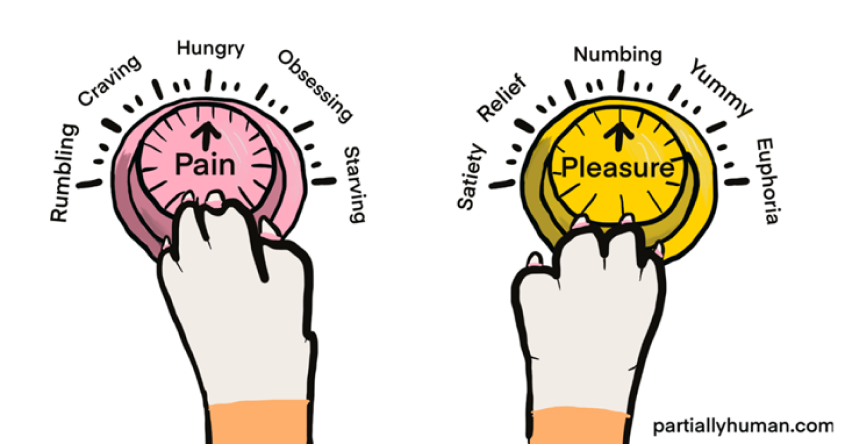
Chonk focuses on the very narrow realm of the minutes before, during, and after eating. (His attention span can’t last much longer than that.) Here are the things he dials up or down to get you to eat, with the deck stacked squarely in favor of pleasure.
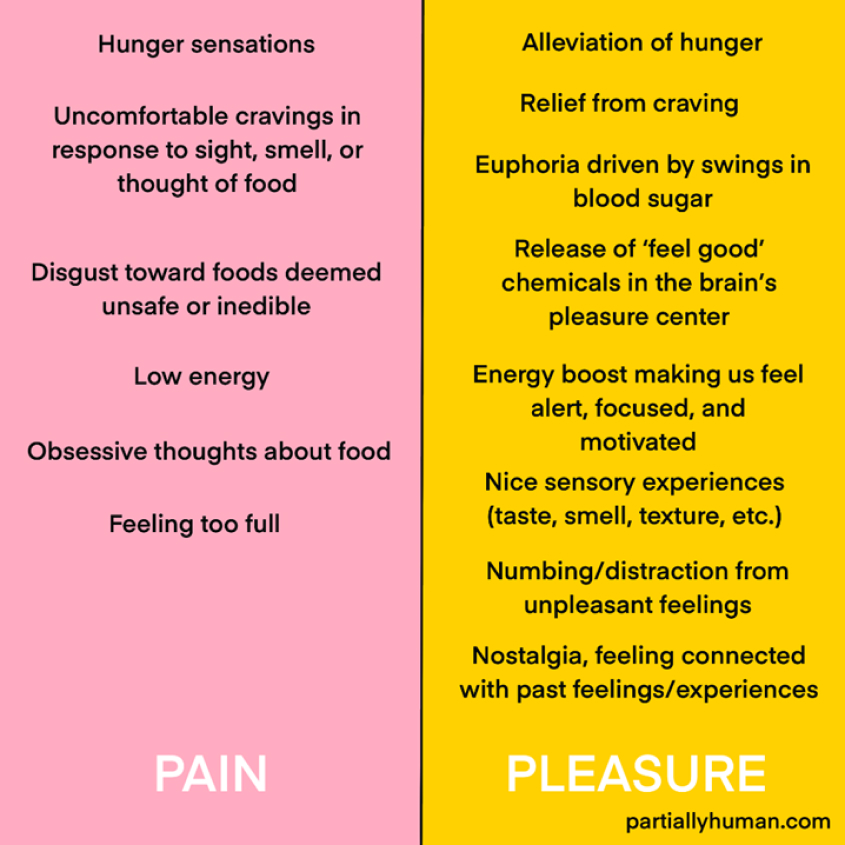
The connection between those things and eating is obvious to everyone, since there is very little distance between cause and effect. However, as you, a full-fledged fancy monkey know – these short-term effects are not the only factors to consider when making eating decisions. Let’s zoom out a little further.
The Still Somewhat-Short-Term View of Health and Mood
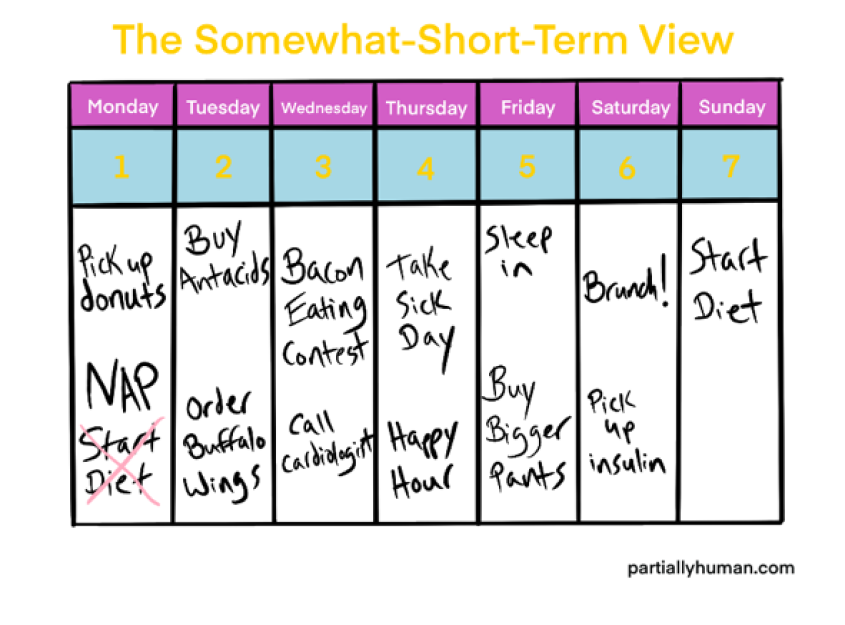
The super-short-term experience of being hungry, eating, and then feeling full is just a fraction of how food impacts us overall, but since it’s the most salient and memorable part of eating, it gets most of our attention. It’s A LOT harder to notice the precise connection between how we feel a few hours after eating and specific foods. If we are tired, cranky, or anxious – is it because we need a new mattress, or because we’re worried about something we read in the news, or is it because of our blood sugar?
What really happens when you eat a Snickers bar, other than the fleeting taste of something yummy in your mouth? Initially, you get a nice sugar rush and release of dopamine. Then your body cleans up the excess sugar, essentially fighting the nice feeling you were attempting to elicit, and drops your blood sugar. For extra sugary foods that don’t have enough fiber, like candy, the pancreas often pumps out too much insulin, causing your blood sugar to drop even lower than it was in the first place, leaving you feeling worse than you did originally ─ the famed sugar crash. Ironically, this low blood sugar post-crash is the same issue Snickers is claiming to fix in the first place. Eating a chocolate bar to support mood or performance makes no sense. Here is the reality:
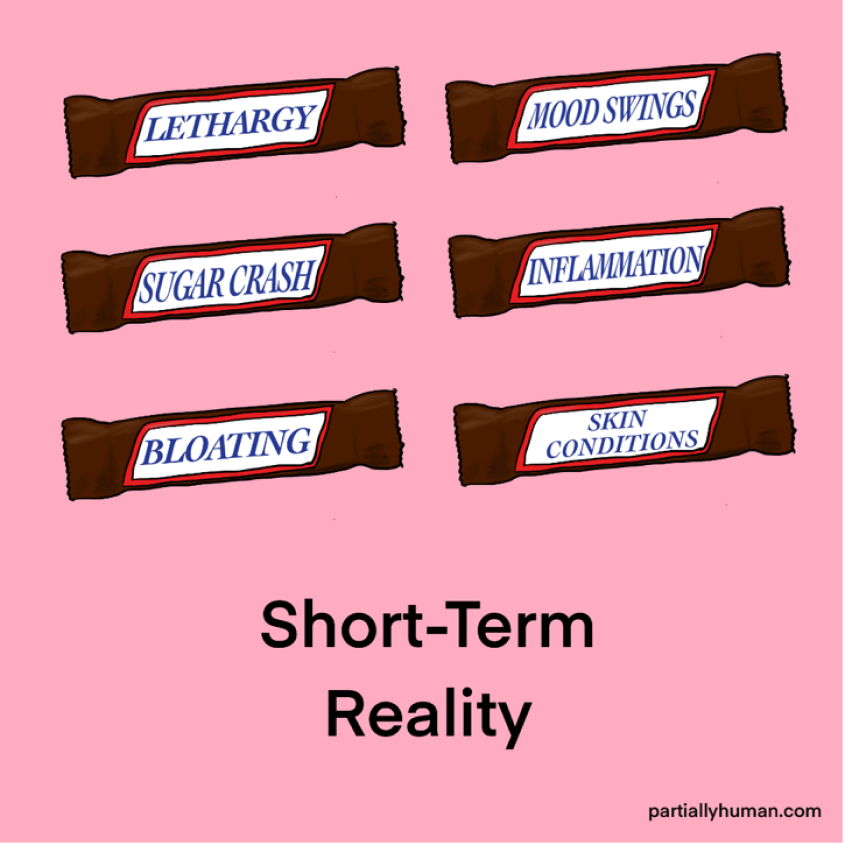
Unfortunately, Chonk is oblivious to the role food plays outside of his very narrow window of concern ─ snack time. He is totally clueless about how treats impact our broader health goals, or heck, even to how food will make us feel in an hour. Why else would people continue to eat foods that give them indigestion, heartburn, acne, bloating, stomach aches, poor sleep, and the like?

If we gotta keep reminding this dude that dairy products will create a very unpleasant situation for us in about an hour, how can we trust him to make decisions that impact our long-term health and happiness?
Why is Chonk So Confused?
Our primal intuition to pack in calorie-dense, fatty, sugary foods to stave off starvation goes array in a world where winter never comes. Chonk has trouble understanding that fun, yummy foods can come packaged with negative consequences. Chonk can only respond to immediate feedback, short-term pain or pleasure. Things in our diet that cause us pain and suffering down the road are of no concern to him; he can’t make the connection between donuts, diabetes, and depression.
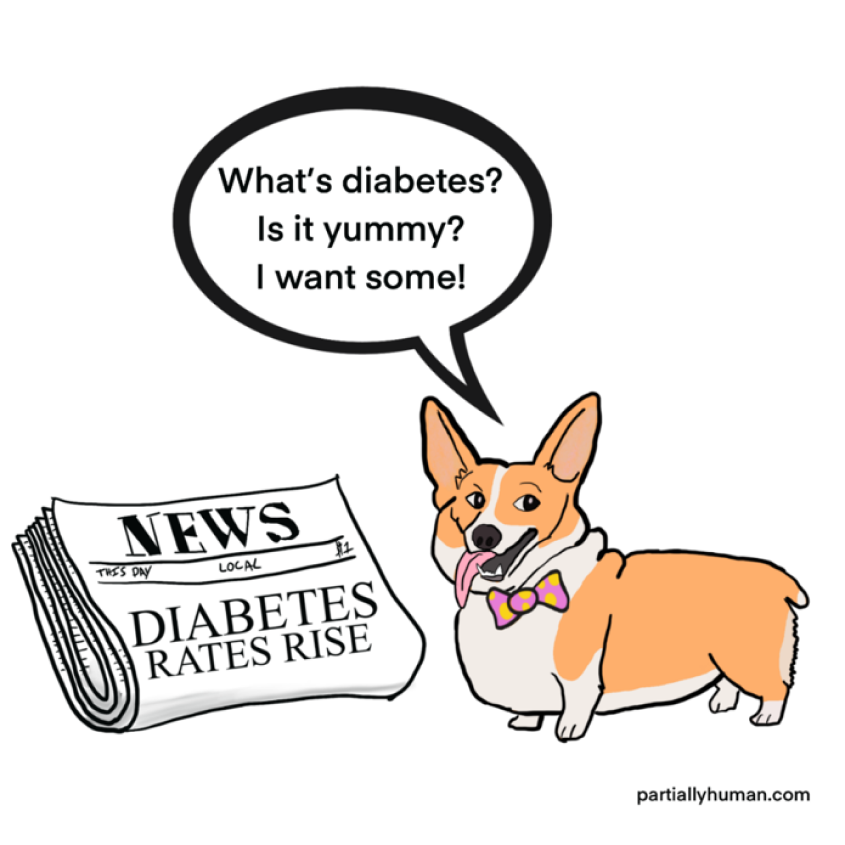
What data is Chonk overlooking when he is telling you, “Diarrhea be damned! Eat that ice cream!”?
The Long-Term View of Health and Mood

Gosh, taking the long-term view on food and health is TOUGH. There are few consequences more distant and abstract than the idea that indulging in a bunch of ice cream and wine every night will result in me having Alzheimer’s 50 years from now. It just doesn’t feel real. I don’t see any evidence that that’s what’s happening to my brain. But taking the long-term view means shifting from our direct experience of the consequences of eating to trusting medical research, which can be frustrating and confusing, especially for a live-in-the-moment guy like Chonk.
Whether Chonk realizes it or not though, your physical health directly impacts your emotional well-being, and overeating ultra-processed, calorie-dense, sugary foods lacking in fiber and nutrients does not a healthy-fancy-monkey make. Ultra-processed foods promote chronic disease and health-problems-galore. Eating these foods regularly is a recipe for depression, mood swings, and anxiety ─ cancelling out any positive mood boost you get from the temporary pleasure of indulging.
(For me, one of the worst parts of becoming an adult was reckoning with the fact that lots of yummy foods promote lots of icky health issues, forcing me to break a childhood promise I made to myself that I would regularly eat dessert for dinner when I got to make the rules.)
Consequently, Chonk is dead wrong when he tells you that eating donuts for breakfast, pizza for lunch, candy for a snack, and fried chicken for dinner is what will make you happiest. The long-term reality of a diet laden with ultra-processed foods is not a happy one.
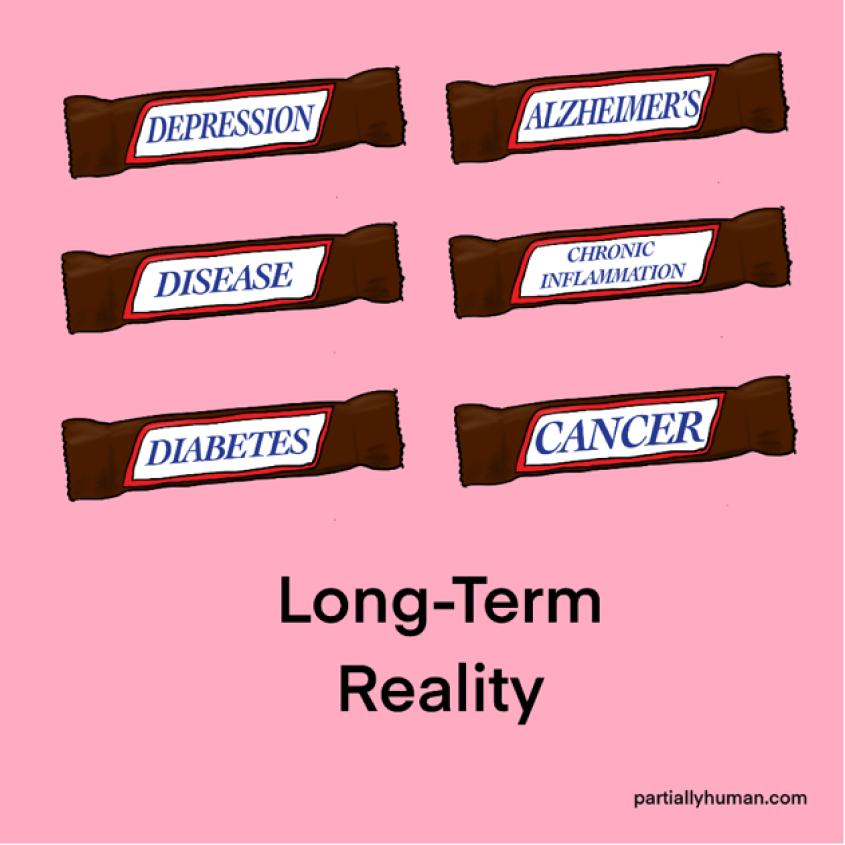
Eating poorly leads to poor health, which leads to poor moods. Here are some health issues that have been directly linked to irritability, anxiety, mood swings, and/or depression:
● Nutrient deficiencies (omega-3 fatty acids, vitamin D, B-vitamins, folate, etc.)
● Phytonutrient deficiencies (missing out on the protective antioxidant and anti-inflammatory properties of eating plants)
● Overnutrition (excessive intake of nutrients)
● Hormone imbalances (thyroid dysfunction, low testosterone, etc.)
● Insulin resistance and diabetes
● Excessive/chronic inflammation
● Chronic diseases (cardiovascular disease, autoimmune diseases, hypertension, etc.)
● Cancer
● Sleep apnea
● Alzheimer’s
Yikes!
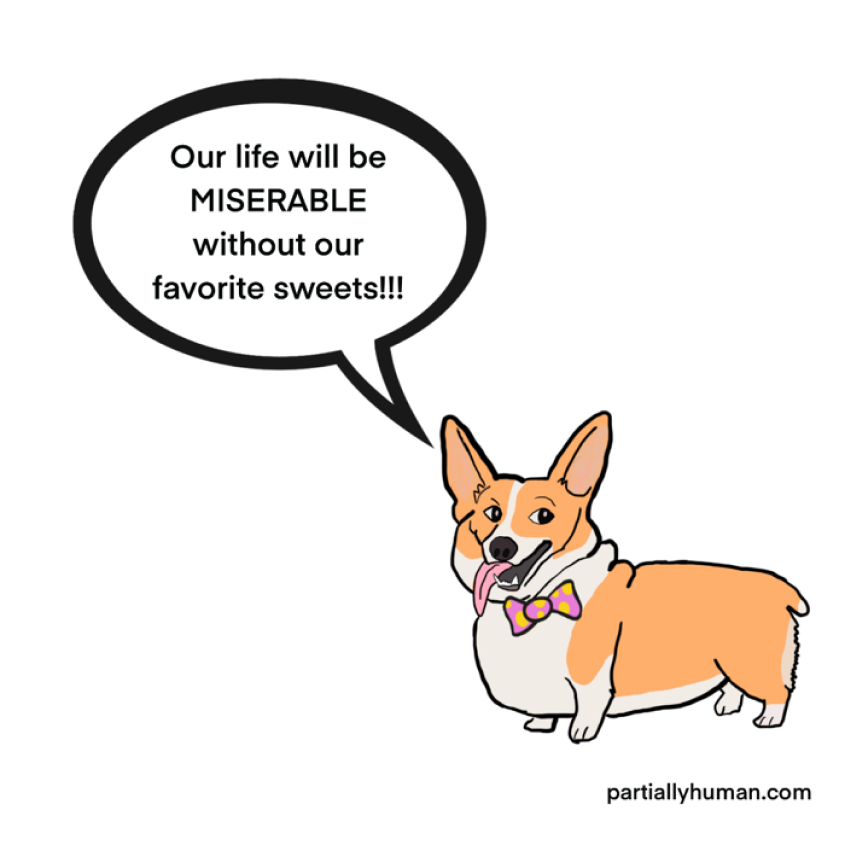
So is the choice before us: enjoy yummy snacks OR health-problems-galore? Live a long dreary lettuce-eating-life or a shorter one filled with sweet, salty, fatty goodness? Forgo Snickers for vegetables, merely trading one type of misery for another? Happiness or health? No! That is not the choice. That is the false dichotomy Chonk is whispering in your ear.
You already know from Part 1 of this series that the pleasure food gives us is temporary and doesn’t have a meaningful impact on our overall happiness. But that doesn’t mean that food doesn’t play a role in happiness at all.
Are there eating strategies that actually support having an overall happier life? For this question, we don’t turn to a dog in our head, we turn to science.
The Science on Food and Happiness
The research on how food impacts emotional well-being may be surprising to those who don’t understand how pleasure and moods work, but we fancy monkeys are smart about those things. We know there is more to happiness than fleeting moments of nice flavors and a heady boost in blood sugar. Indeed, numerous studies show that eating healthy makes you happier and that so-called “comfort foods” don’t live up to Chonk’s hype.
Meaning, there is no trade-off between happiness and health. Let me say it again: THERE IS NO TRADE-OFF BETWEEN HAPPINESS AND HEALTH!
Woohoo!
This can feel counterintuitive because we’ve all experienced the heightened emotional state of eating something incredibly yummy, and it stands to reason that doing more of that means more good feelings. But arming yourself with insights from scientific studies and zooming out to take the long-term view can help you see the holistic consequences of your eating choices more clearly. Here’s a nice sample of the current research.
Study
Findings
Conclusion
“Will Healthy Eating Make You Happier?”
This study looked at 20 research reports on the relation between nutrition and happiness.
● Strong evidence that healthy eating universally causes greater happiness
● More than three portions of fruits and vegetables per day corresponds with the most happiness
● While healthy eating leads to better health and good health increases happiness, an unexpected finding is that the effect of healthy eating on happiness is not fully mediated by better health.
Healthy eating adds to happiness, not just by protecting one’s health, but also in other unidentified ways. People should know that changing to a healthier diet will not be at the cost of their happiness but will add to it. Faulty beliefs and misleading advertisements should be counter-balanced by this established fact.
“Healthy food choices are happy food choices: Evidence from a real life sample using smartphone based assessments”
This study investigated in-the-moment eating happiness by assessing complete, real life dietary behavior across eight days using smartphones.
● Of 14 different main food categories, vegetables consumption contributed the largest share to eating happiness
● Sweets, on average, provided comparable induced eating happiness to “healthy” food choices such as fruits or vegetables
● Dinner elicited comparable eating happiness to snacking
Although many cultures convey the belief that eating certain foods has a greater hedonic and mood boosting effect, the study results suggest that this might not reflect actual in-the-moment experiences accurately. People often have a spontaneous “unhealthy = tasty” intuition, and expect a stronger happiness boost from those foods, but stereotypically “unhealthy” foods did not show the expected greater boosting effect on happiness. Taken together, “healthy choices” seem to be also “happy choices” and at least comparable to or even higher in their hedonic value as compared to stereotypical “unhealthy” food choices.
“Comfort food: A review”
This paper summarizes the current literature on comfort food.
● Negative emotions are a common trigger for consuming comfort foods
● People appear to comfort eat as a means of getting themselves into a more positive emotional state
● The emotional benefits of comfort food are more likely to be experienced amongst those for whom consumption brings back positive associations of early social interaction (e.g. of a time when a caregiver may have provided food when an individual was sick as a child)
● The “comfort” element of comfort foods comes from its affective associations with social relationships rather than anything else (e.g. the calorie count, taste, or any other nutritional properties)
● The consumption of sweet, high-calorie foods (think ice-cream, cookies, or chocolate) has been linked to the release of opiates and serotonin, which, once again, may help to elevate (or prevent a decline in) mood in certain populations
While most people believe that comfort foods elevate their mood, robust empirical findings in support of such claims are somewhat harder to come by. Many uncertainties still surround if, when, and for whom, the consumption of comfort food really does provide some sort of psychological benefit. The extent to which comfort foods work (i.e. they provide some kind of mood boost) is not so much a matter of elevating people from out of a bad mood as priming thoughts of prior positive social encounters.
“The myth of comfort food”
This study investigated whether comfort foods actually provide psychological benefits, and if so, whether they improve mood better than comparison foods or no food.
● Comfort food improved mood
● Non-comfort food improved mood
● Not eating food at all improved mood
Although people believe that comfort foods provide them with mood benefits, comfort foods do not provide comfort beyond that of other foods (or no food). Individuals may be giving comfort food “credit” for mood effects that would have occurred even in the absence of the comfort food.
“Association of Western and Traditional Diets With Depression and Anxiety in Women”
This study examined the extent to which mental disorders are related to habitual diet in 1,046 women between the ages 20–93 years, randomly selected from the population.
● A dietary pattern comprising vegetables, fruit, beef, lamb, fish, and whole-grain foods (traditional) was associated with a lower likelihood of depressive and anxiety disorders
● A dietary pattern comprising processed and “unhealthy” foods (western) was associated with a higher likelihood of psychological symptoms and disorders
● Higher diet quality was associated with lower odds for depressive disorders
There is an association between poor habitual diet quality and the high-prevalence of mental disorders.
A randomized controlled trial of dietary improvement for adults with major depression (the ‘SMILES’ trial)
This study investigated the efficacy of a dietary improvement program for the treatment of major depressive episodes.
● Significant reductions in depression symptoms as a result of the dietary improvement program
● Significant improvements were also observed on self-reported depressive and anxiety symptoms
● Improvements in depressive symptoms when eating more healthily were independent of weight change
Dietary improvement, meaning eating more whole grains, vegetables, fruits, legumes, nuts, low-fat dairy, fish, lean meat, and olive oil, while eating less sweets, refined cereals, fried food, fast-food, processed meats and sugary drinks, may provide an efficacious and accessible treatment strategy for the management of depression.
This is all very exciting news! There is no trade-off between happiness and health. Quite the opposite, in fact they support each other in a virtuous upward spiral (once you get over the awkward phase of establishing healthier habits, when you might initially feel deprived because you haven’t found a new routine that is effortless, enjoyable, and convenient yet – but that’s a topic for another day).
Optimizing Long-Term Happiness with Diet
What we put in our bodies has a profound impact on our emotions and well-being, but our animal drives and instincts get in the way of us seeing clearly the price we pay for chasing pleasure through food. What seems like a short-term sacrifice when we forgo eating indulgent foods in favor of long-term health is actually a false dichotomy.
So what’s a fancy monkey supposed to do with all of this health and mood mumbo jumbo? Well, most people don’t like to be told what to do, but since you asked.
Forgoing the short-term euphoria of ultra-processed food for the more subtle, balanced emotional well-being of eating anti-inflammatory foods rich in fiber and nutrients is the optimal approach to cultivating long-term happiness. Since the effects of eating well don’t appear immediately, and they are often subtle or seemingly disconnected from what you put in your mouth last week, you need to zoom out and look at the entire picture, including boring stuff like lab work, day-to-day energy levels, and innocuous moments of contentment. It can be hard to notice those things in comparison to the immediate surge of glee you get when eating a donut.
Check it out for yourself with the experiment at the end of this post.
Recap and Up Next
Initially in this series, we took a deep dive into the short-term effects of food on mood by exploring pleasure, and now we’ve expanded our view to include how our diet impacts us throughout the day. Both of these lenses on mood are important to understand as you pursue happiness, but they are just a small fraction of what contributes to a good life. I would hate for you to get overly focused on diet as a means to emotional well-being. So for our next and final post in the series, we will zoom out even further and look at happiness strategies more broadly.

EXPERIMENT
In the experiment from Part 1 of this series, we explored in detail what it’s like to eat and how food affects your mood and emotional well-being in the short-term window before, during, and after eating. If you didn’t do the first part, go back and do that for a week or two before adding this part.
Now we are going to zoom out and look at how you feel over a longer time horizon, taking in the bigger picture of how your diet affects you.
Step 1: PAY ATTENTION
Notice how you feel throughout the day and how your overall health and eating influence how you feel.
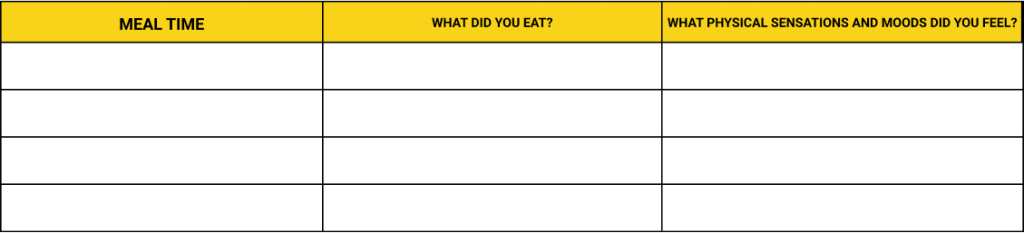
Tracking physical sensations — especially unpleasant ones — can help you uncover trigger foods, and even sensitivities or intolerances that are interfering with you feeling your best. Spend a week or two writing down what you eat and paying careful attention to how you feel throughout the day. Periodically, check in with yourself and ask, “what am I feeling physically and emotionally?”
Here are some things to be on the lookout for:
● Fatigue
● Brain fog
● Asthma symptoms
● Irritability or anxiety
● Grumpiness or feeling low
● Headaches
● Skin problems
● Joint pain
● Bloating
● Constipation
● Gas
● Diarrhea
● Stomach aches
● Heartburn
● Nausea
● Lethargy
● Trouble sleeping
Step 3: GET CREATIVE
Identify ways you can modify your diet to improve how you feel.
The research shows that the following dietary changes lead to the greatest improvements in health, how people feel physically, and their emotional well-being:
1. Eating MORE vegetables, fruits, legumes, whole grains, nuts, low-fat dairy, fish, lean meat, and olive oil
2. Eating LESS sweets, refined cereals, fried food, fast-food, trans fat, processed meats, and sugary drinks
Select a handful of changes you can experiment with.
Step 4: TAKE ACTION
Get going!
More fresh, nutrient-dense, whole foods.
Less ultra-processed foods.
Keep tracking how you feel. Give it at least a couple of weeks, because it’s common to feel withdrawal symptoms as your body adjusts to less sugar, and it takes your GI system a while to adjust too.
Step 5: GAIN INSIGHT
How do you feel? What’s working?
Do you notice a difference?
Are you more alert and energized?
Is your energy more stable?
How are you sleeping?
How’s your mood within a couple of hours of eating?
The overwhelming majority of people who switch to a less-processed diet filled with fiber-rich, nutrient-dense foods report feeling significantly better, not only physically, but also mentally and emotionally. I hope that you feel the positive effects as well. If you still feel icky though, outside of a health issue that requires medical attention, you might consider doing an elimination diet to identify whether you might have specific food intolerances to things like dairy, gluten, soy, or FODMAPS.
Please post your results in the Partially Human Facebook group!

Very nice post. I certainly appreciate this site. Keep it up!