
There’s a Dog in Your Head Asking for Snacks: Part 2
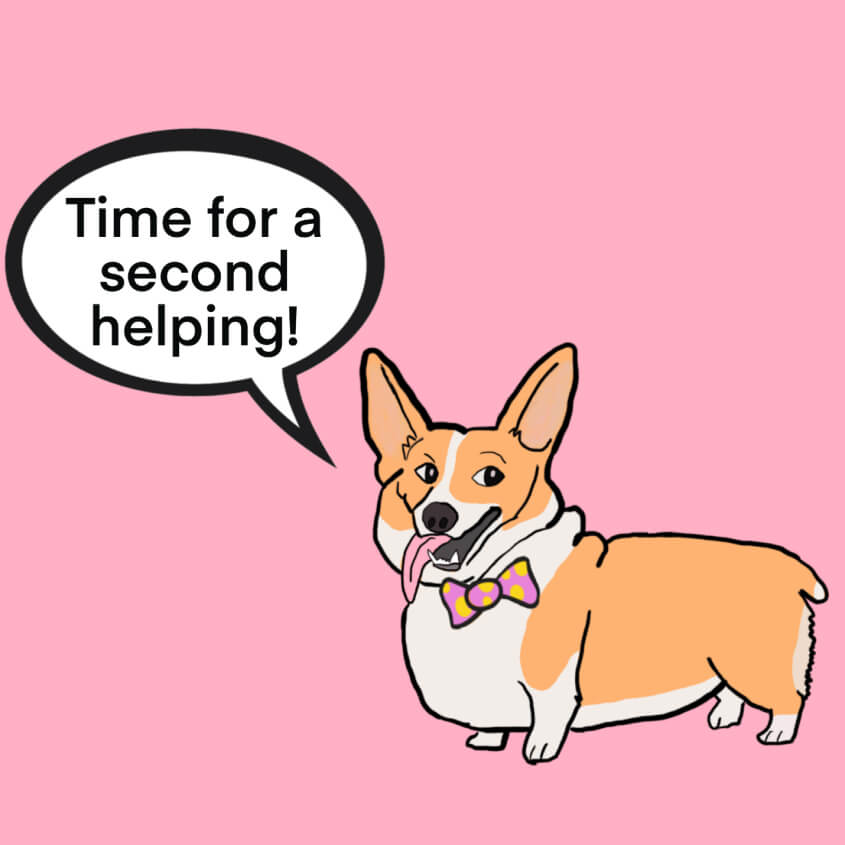
The one about Chonky Corgi chatter infiltrating your thoughts
You have experienced Chonky Corgi talking to you thousands, maybe millions, of times. We’re so accustomed to his chatter that we usually don’t give it a second thought. His input is mostly benign. Often, it’s actually quite boring and repetitive.
“I’m sleepy, something sweet sure would perk me up!”
“Only 30 more minutes until lunch!”
“I wanna eat something yummy!”
“Only 20 more minutes until lunch!”
“I should bring snacks with me, in case I get hungry while picking up the dry cleaning.”
“Only 15 more minutes until lunch!”
“Better eat some extra, so I don’t get hungry later.”
“Only 10 more minutes until lunch!”
“I should go see if there’s some leftover food in the break room!”
“Only 5 more minutes until lunch!”
“Sure, I’ll have a second slice of cake!”
Of course, we need to think about eating sometimes. But as we all know, Chonk can do his job too well. Remember his goals: 1) maximize calories per mouthful; 2) never risk being hungry; 3) prevent starvation by any means necessary. At face value, those seem reasonable. But we no longer live in times of food scarcity. We now live in a world of food abundance, which requires a different strategy to achieve optimal health.
Chonk Talks You Into Overeating


When you combine Chonk’s goals with our current food environment you get one outcome: overeating.
This stands in opposition to the more sophisticated part of your brain that knows healthy from unhealthy and knows when enough is enough. We know we don’t need to worry about starvation or undereating. We know it’s not necessary to pack in the calories with every bite. But Chonk doesn’t. So he has to amp up the persuasion in the face of our silly “logic” and “reasoning.” Chonk is having none of that “dieting” crap. He is perpetually living in the past, where famines are always possible. He wants you to just eat the dang donut!
Why doesn’t Chonk get the message that starvation is no longer a problem, and that overeating is what now causes most of our health problems? Unfortunately, when we fancy monkeys learned how to master the food chain, the inner drives, impulses, and urges that historically kept us well fed (i.e., Chonk) failed to get the message because of how our brains are built.
Our Brain’s Animal Departments
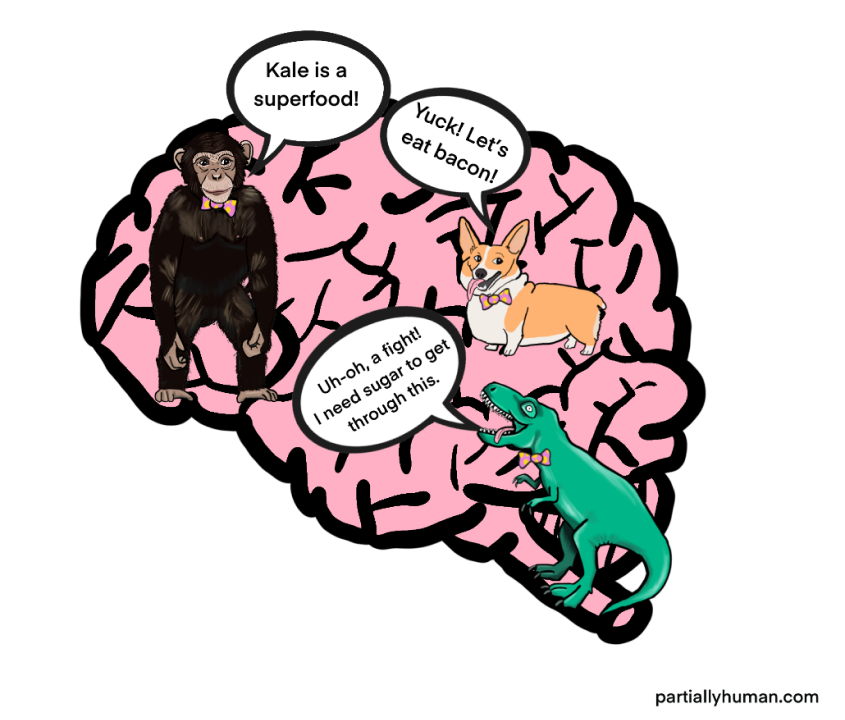
Our biology is an awkward amalgamation of ancient evolutionary programming (like fight/flight/freeze impulses) and newer, more modern features (like reasoning and creativity). There is nowhere that this is more apparent than in the brain. Our newer, more civilized functionality is controlled by the top outermost layers of the brain, and the older, more primitive functionality is buried down at the bottom. It’s very much like we have both dinosaur and dog brains with a fancy monkey upgrade slapped on top.

When new functionality gets added to the brain, it’s kind of like adding a brand-new employee with new skills. His skills now contribute to the overall organization, but the pre-existing employees don’t now magically also have his skills. So when we developed the capacity for language, reasoning, and long-term planning, the other parts of our brain, tasked with things like emotions, basic drives, and safety, did not also learn those higher-level thinking skills. Instead, the different parts of our brain process information separately, and then come together to try to function as a whole, like how a company has different departments that need to collaborate.
That means all the parts of you responsible for tasks such as eating, drinking, sex, fighting, and hiding don’t speak English, can’t read, don’t understand reasoning, and can’t think long-term – because that’s someone else’s department. Rather than having a single source of unified thoughts, instead, our monkey department (i.e., cortex) confers with the dog department (i.e., limbic system) and the dinosaur department (i.e., brain stem/basal ganglia), primarily using emotions and intuitions to figure out what to do. The different departments are constantly having meetings and sending messages to each other, trying to get on the same page. When it feels like you’re having an internal battle over something, it means the departments have different interests and are competing for primacy.
Chonk’s Advanced Persuasion Techniques
When your higher-level thinking parts try to deny Chonk his indulgences, he gets real sneaky, attempting to appeal to your rational mind to get his way. Here are some of his go-to phrases.

See how he makes his demands seem so reasonable? He appeals to your frugality. To your manners. To the idea of being prepared. To the idea of treating yourself well. Very sneaky, little buddy.
Despite how reasonable Chonk can seem, reason is not in his wheelhouse.
You Can’t Reason with Corgis
The dogs in your head never developed the language or advanced thinking skills the Fancy Monkey Department brought to the mix. So even though Chonk is highly proficient at infiltrating your thoughts, when you respond to him with long-winded explanations about vitamins, low-carb diets, and heart disease—it goes right over his head. When you try to talk to him with language, reason, and logic—he literally can’t understand you.
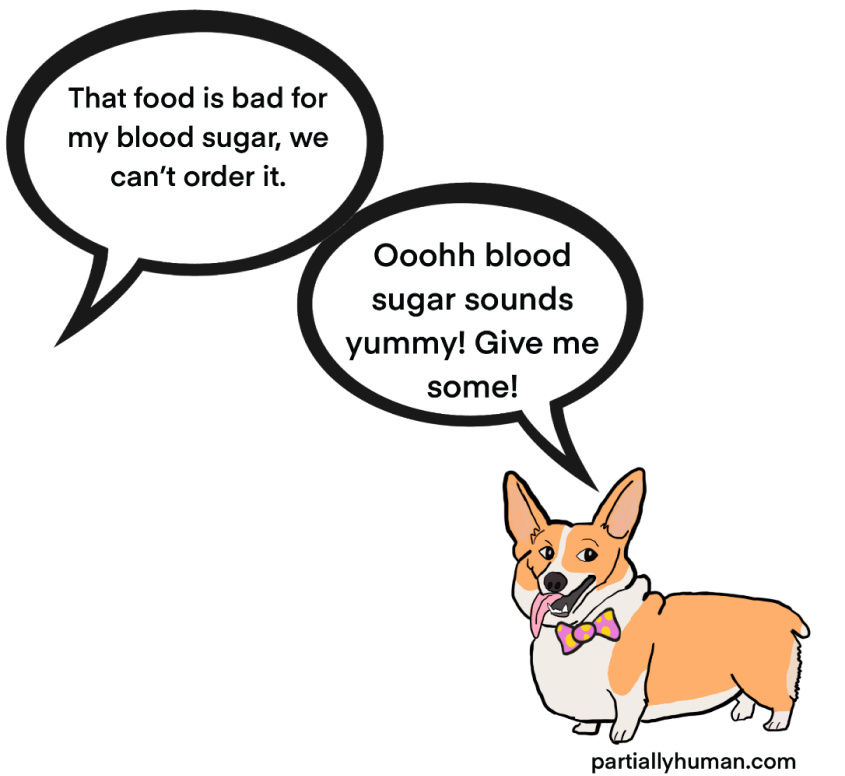
It’s no wonder there is so much internal conflict about our eating choices!
So what’s a fancy monkey to do about this state of affairs? Is there another way to relate to your inner animals besides arguing with them?
Equating Thoughts and Feelings to Animals
I don’t really think that we really truly have animals running around in our brains. But pretending that’s the case is a useful conceptual framework to help separate and organize our competing thoughts and feelings, and hopefully make them feel less personal and frustrating.
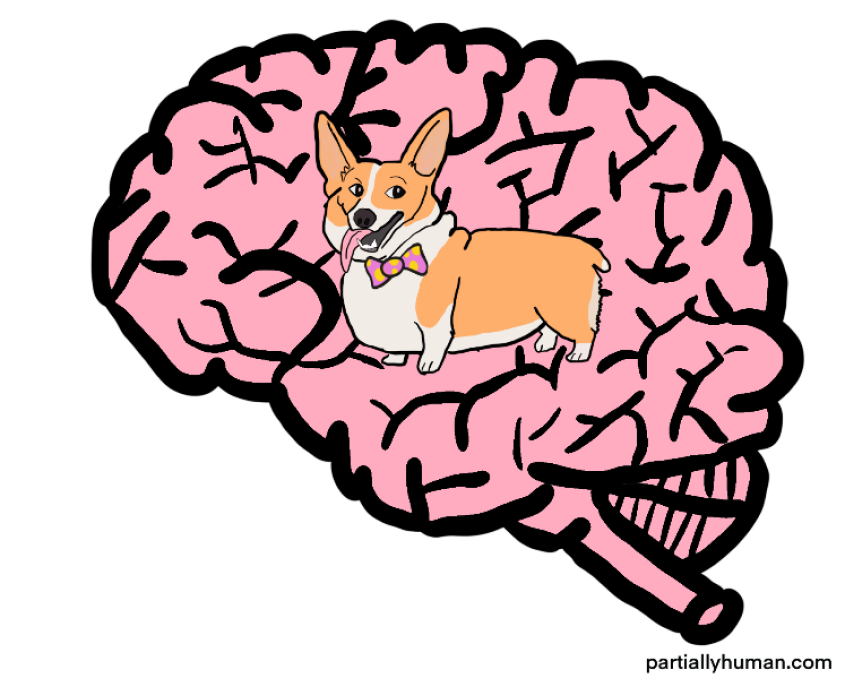
It can be painful and confusing to feel at odds with yourself. And it’s tragically common for fancy monkeys to beat themselves up for having animal urges at all. They think they “should know better”. But as you can see, this is a mistake. Part of us doesn’t/can’t/won’t know better.
Some people like to think of these wild and emotional parts of themselves as their “inner child”. Some people like to personify them as people or fictional characters that embody similar traits. People who are clearly more comfortable with emotions than I am prefer to just talk directly about feelings. (Yuck!)
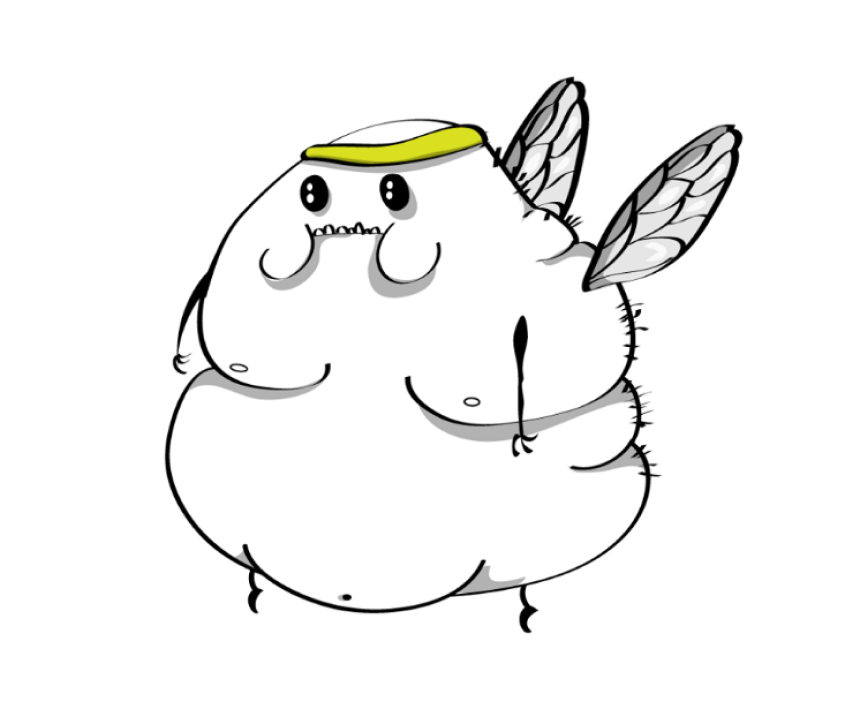
One of my favorite online comics, The Oatmeal, imagines the part of the protagonist that is gluttonous, apathetic, and indifferent as The Blerch.
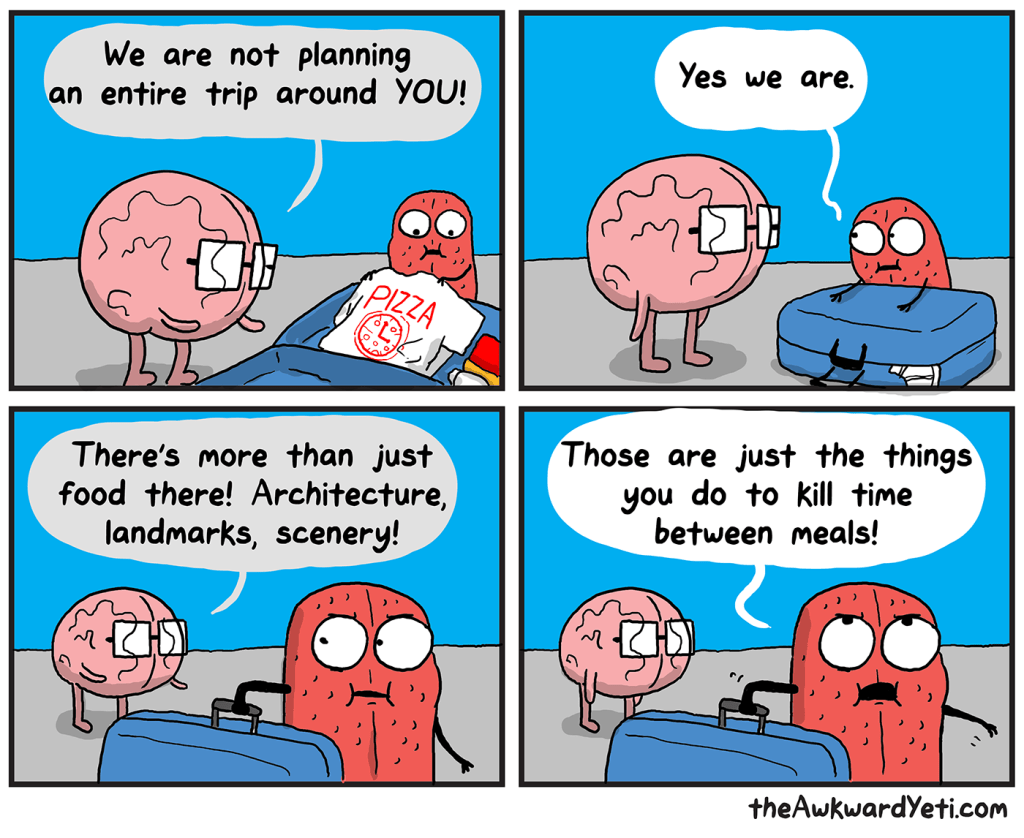
Another popular depiction of our wilder side is the Tongue, from The Awkward Yeti’s Heart and Brain comics.
The goal is to find a way of thinking about the wild and emotional parts of yourself in accepting and non-judgmental terms. I love animals and think they are perfect and amazing just as they are, so it’s easier for me to extend understanding and kindness to my urges when I liken them to dogs. My own real-life dogs ask for snacks all the time, engendering in me reactions ranging from mild amusement to slight irritation, yet I’m never tempted to feed them something harmful simply because they beg. Why should I relate to my inner dogs any differently?
What is NOT a good approach is to characterize your urges as something you hate. There is a somewhat-popular method, put forth by Glenn Livingston Ph.D., a binge-eating expert, that encourages people to develop contempt for their desire to overeat by referring to that part of themselves as a pig, or some other derogatory term. He advises people to choose something that disgusts them and relate to those urges with anger. I emphatically disagree with this approach, as it stokes our painful internal discord and forces you to essentially hate a piece of yourself—as if that is the only way to manage conflict. Not fun.
Our primitive urges are here to stay, whether we like them or not. Learning how to spot them and not take them so seriously helps us prevent unhelpful emotions and desires from clouding our better judgement.
Coming to Terms with the Animal in Your Head
Earlier (in Part 1) we looked at how Chonk convinced Andie to eat an entire chocolate cake. Listening to her describe her binge-eating episodes, I got the sense that unconscious forces were driving her behavior – as is often the case when we do anything impulsive or destructive. Thankfully, she eventually brought conscious awareness to her eating, and this allowed her to take back control from her Chonky Corgi.
“The change I’d undergone—from someone who ate to capacity to distract her mind, into someone who purposely tasted every morsel—was not unconscious. It was a transformation that had taken deliberate effort.”
“I focused my desires on reveling in moderation, and the urges to binge fell away, slowly, over time. Of course, there remained certain foods—all things sweet, in particular—that begged me to overindulge. Anything cake or pastry. These sweets required a special kind of treatment. I had to learn—painfully slowly—that two pastries never really felt better than one. That the only difference between the enjoyment of three desserts versus one is a higher cost in the dollar bills and pride. This was one of my hardest lessons. Because no matter how logically I understood my need to practice moderation, I still craved the feeling of limitlessness.”
She learned to question her automatic urges and see the underlying needs and desires she was trying to meet with food. Seeing the nature of your mind can bring clarity to your confusing and frustrating behavior patterns and open the door to change.
As always, please don’t take my word for it. In the following experiment, it’s your turn to reframe your relationship with your inner animal.

Experiment: What happens when you change the way you relate to
your inner snack-seeking-critter?
In Part 1 of this series, we practiced spotting our hungry animal in action. Now it’s time to for you to reframe your relationship.
STEP 1: GET CREATIVE
Create your own version of Chonky Corgi to characterize your inner urges to eat.
- How does your inner character look, sound, feel, act?
- Is it an animal? A person? Someone from history? A fictional character? A machine? A child?
- What’s its name?
- What’s its personality like?
- What’s its backstory?
Make it real! And make it something that you can have a lighthearted relationship with. This is not something that has power over you—it is a silly, well-meaning goofball that doesn’t understand logic or reasoning.
STEP 2: TAKE ACTION
As you go about your day, pay attention and continue to spot your critter in action. Get really curious about how you are relating to him or her. Can you relate to them with kindness? With humor? With compassion? With a sense of distance and perspective? Do your best to develop a playful and nurturing relationship with them.
STEP 3: GAIN INSIGHT
What happens when you relate to your inner critter differently? Are you able to regain a sense of control? Does the inner turmoil lessen? Does the critter’s power over you diminish? Is life more fun?
I hope you find that reframing your relationship to your inner urges and desires is both enjoyable and helpful. If the approach doesn’t land with you though, that’s okay too—we’re still friends. Until next time, keep on living, learning, and experimenting, you gorgeous fancy monkey!
Share your results on the Partially Human Facebook page or comment below.

Comments