
The Problem with Shouting “MORE BABIES!” in Response to Declining Fertility Rates (Part 1)

The one about the interests and positions of those concerned about declining birthrates.
Politicians, pundits, and the Pope worry about how many babies we are popping out these days. Why are they shouting for “MORE BABIES!” from their platforms? It’s kind of an odd thing to be concerned about if you think about it. Are we low on people? Is there some magical ideal number of people we haven’t yet reached? Should we try to fit the maximum number of people possible onto every square inch of the planet? When you dig into the MORE BABIES! movement’s concerns, you’ll find that MORE BABIES is an oversimplistic solution to a wide swath of problems—ranging from social security funding to loneliness. Why is it that we fancy monkeys latch on to One Big Solution to address complex problems that can’t be fixed so easily?

What’s happening here is a classic case of people focusing on positions instead of interests—a suboptimal way to solve problems. We fancy monkeys are attracted to this approach because it lets us pin progress to one sweeping solution (bonus: we get to ignore trade-offs too!), rather than having to deal with multiple pesky targeted interventions. Much less mentally messy! But if there is anything we hate here at Partially Human, it’s taking complex problems and stripping away all the nuance in favor of a dumbed down answer that fits on a bumper sticker.

Give us the mess! Diving into the muck of complicated systems and exploring the trade-offs of decisions with clear eyes is where meaningful progress happens. So roll up your sleeves, because today we are getting our hands dirty exploring the MORE BABIES! movement—moving beyond the tidy position of its proponents, and digging into the messy interests. And at the end, I’ll encourage you to experiment with solving problems in your own life by focusing on the deeper interests of issues.
What Are Positions?


Your position is WHAT you say you want. It is the proposed solution or action you think is needed to solve a problem or make the most of an opportunity. Here is a good rule of thumb: if it can fit on a bumper sticker, it’s a position.
Examples of Positions:
- Every Monday should be an official donut-eating holiday.
- The government should be small.
- No dinosaurs allowed in the house.
- You may not be friends with Mike Tyson, young lady.
- More cowbell.
- My boyfriend should pay for my soup.
- We should have MORE BABIES!

People approach problems by focusing on their position because they think that’s the best way to get what they want. It feels direct and to the point. It may even feel like all you’re doing is stating the obviously correct course of action.
Step 1: Spot a problem or opportunity
Step 2: Come up with a position (i.e., your solution/proposal)
Step 3: Slap a bumper sticker on your car with your position
Step 4: Advocate for that position so the bozos around you see the light and get onboard
There are a buttload of problems with this approach. For one, when you focus on your position, success is binary: you either get it or you don’t. There is only one way to win, which locks you into a rigid plan and places your ego on the line. This is silly because there are almost always multiple ways you can address a problem. Another downside to this method is that our brains usually like to land on an obvious or easy solution before doing the hard work of root cause analysis. Too often the position we lock ourselves into is not even the best one. And most importantly, focusing narrowly on your position strips away the opportunity for a meaty discussion that explores important, nuanced angles of an issue. It reduces us into simple-minded monkeys shouting slogans at each other.
Positions are only loosely tied to what matters to us. This is classically illustrated with an iceberg, where you see that positions are just the tiny, most visible piece of what we want.

Focusing on interests is a better approach to problem-solving.
What Are Interests?
Your interests are WHY you want something. They’re your underlying desires, values, fears, concerns and motivations. The ability to spot your and others’ interests is a superpower because it opens a whole new realm of possibilities for getting your needs met.

Below are some potential interests of a couple of the above positions.
POSITION: Every Monday should be an official donut-eating holiday.
Is it ever really about the donut? We fancy monkeys are amazing at contriving holidays and creating sugar-eating occasions.
POTENTIAL INTERESTS:
- Having traditions that bond the group
- Eating sugar combined with fat to get a hit of feel-good-chemicals
- Having something fun to look forward to; variety in your diet
- To feel like it’s okay to eat sugar because you’re doing it with others
- Numbing out the feeling of not liking Monday
- Timeboxing donut eating so it doesn’t get out of control
- Reliving a nostalgic time of your childhood when your dad brought home donuts on Sundays
- You’re in cahoots with Big Donut and want their stock price to go up
- You secretly want Meatless Mondays but don’t want to admit it, so you chose a fun vegetarian food to push
- Your mom never let you eat donuts and now that you’re an adult you want to eat them every week goddammit!!!
I could go on, but you get the point.

When examining these interests, it’s easy to see that there are lots of ways to meet them besides Donut Mondays: we could choose a different food for our Monday tradition, we can make Mondays a half-day for work/school so we don’t dread them so much, we could start a kickball team that meets on Mondays so we can have fun with our friends, we could resolve our mommy issues in therapy—the possibilities are endless! Let’s look one more example before circling back to MORE BABIES!.
POSITION: My boyfriend should pay for my soup.
On the I Will Teach You to Be Rich Podcast by Ramit Sethi, episodes 17 and 18, “I think he should pay for everything because he’s the man,” a romantic couple, Monique and Pablo, share the story of going out to eat when Monique—who wasn’t feeling well—wanted soup, but Pablo wasn’t hungry, so he didn’t eat. When the check came, they sat there in an awkward stand-off for half-an-hour, waiting for the other person to pay. This incident encapsulated a long-standing tension between them about who should pay for what, and what’s “fair.”
INTERESTS: You see this all the time when couples fight about money—it’s not about the money (or the soup). For Monique, Pablo paying for the soup means he loves her, and not paying for the soup signifies that he isn’t willing to take care of her. Him not paying also flies in the face of her mental model of men footing the bill. So Monique’s interests were to feel taken care of, to feel loved, and to have a partner that pays for most things. What heavy stuff soup stirs up!

How could Monique have her interests met? She could share with Pablo specific actions he could take to speak her love language (recognizing he can’t do all of them all the time), she could ask for reassurance that he loves her, she could shift her expectations about what “being taken care of” looks like in an adult romantic partnership, she could ask for what she wants directly, “Pablo, it would make me feel so loved right now if you pay for the soup.” Or she could make financial generosity the price of admission for dating her and only date people who are okay with her expectations.
The nice thing about interests is that there are almost always multiple ways to address them. Seeing the exact interests at play allows us to unlock our creative juices and home in on solving the specific things we care about, so we get to the heart of the issue. The not-so-nice thing about interests is that it can be difficult to identify what they actually are, leaving us spinning our wheels going after futile solutions.
What Lurks Beneath Our Interests
Often our interests are unknown—even to ourselves—lurking below the surface. They’re muddled up with our identity, emotions, drives, values, needs, and other such intangible, confusing things. Most of that mess isn’t rational and won’t make the cut for saying out loud to another monkey whom you’re trying to convince of something.

That’s fine though—you don’t need to spew every one of your daddy issues at someone in order to go deep enough to solve meaningful problems. You just need to keep in mind our fundamental needs (this isn’t an exhaustive list, but it touches on the major ones):
- Connection/love: Feeling accepted, a sense of belonging
- Safety/physical well-being: Food, shelter, security, sleep, etc.
- Meaning/significance: Feeling important and like you matter
- Autonomy: Freedom to avoid pain and pursue pleasure
- Balance between order and chaos: The need for some certainty/predictability and some variety/excitement
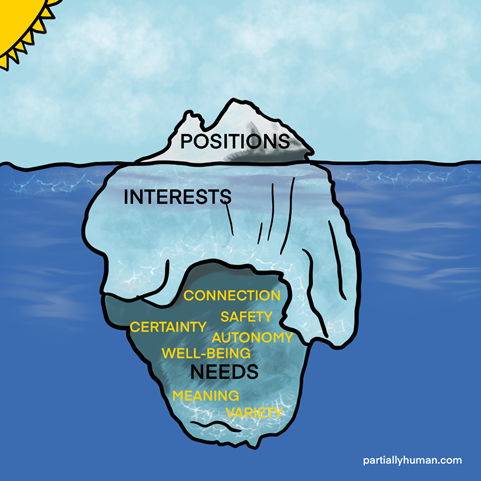
These things drive our behavior—typically, more than we realize. And despite all our running around doing fancy things and pursuing sophisticated goals, like say… making totally rad TikToks or competing in chicken breeding competitions, we can trace our actions back to the same handful of basic needs.
Give it a try: think about a cause that’s important to you. Can you tie it to one of the above fundamental needs? Try asking yourself: why do I care about this, why is this important to me? Keep asking “why” until you get way deep down below the surface.
So with that primer on interests and positions out of the way, let’s look at the MORE BABIES! crowd’s views.
The Position of MORE BABIES!
When a country doesn’t have enough babies to replace people who die, the population decreases, leaving us with more old people relative to young people. This puts a strain on social services and the economy since there are fewer workers relative to retirees. What the MORE BABIES! proponents are mostly saying is that we need the right mix of demographics to support pensions, healthcare, social security, and healthcare (given how those things are currently structured). Having too many retirees and not enough workers disrupts our systems. Maintaining a replacement fertility rate provides the predictability and stability policymakers love.
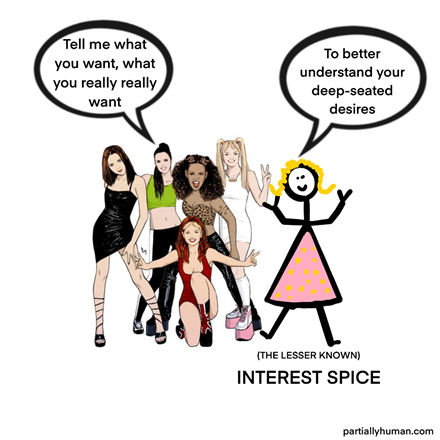
That position is fair enough. But whenever I’m trying to understand how to solve a problem—particularly a big one—I turn to the sage advice of beloved British pop stars the Spice Girls:
“So tell me what you want, what you really, really want” (Me to the MORE BABIES! people.)
“I’ll tell you what I want, what I really, really want” (MORE BABIES!)
“So tell me what you want, what you really, really want” (Me trying to dig deeper to find their interests.)
“I wanna, (ha) I wanna, (ha) I wanna, (ha) I wanna, (ha)” (They have to think hard about it.)
“I wanna really, really, really wanna zigazig ah” (Zigazig ah is shorthand for: my nuanced views don’t fit into catchy song lyrics, but maybe you can write a blog post that captures what I mean.)
Righty-oh!
The Interests of MORE BABIES!
No one is saying, “Omg, we don’t have enough babies to keep Chuck E. Cheese in business and fill up our nation’s underpopulated daycares.” In fact, only a small minority of people concerned about couples having fewer babies actually care about the baby piece (it’s mostly would-be grandparents, people with babies who want their friends to have babies, and the Catholic Church in this camp).

So what do MORE BABIES! proponents want? What do they really really want? More workers, more consumers, and a good life for older people.
INTEREST: More Workers
Why do they want more workers? So that there is enough tax revenue to fund social security, government services, pensions, and healthcare systems.
So what do they really really want? Taxes.
Why do they really really want that? To meet their obligations to retirees and government programs.
Why do they really really want that? Safety, security, and stability.
Why else do they want more workers? So our economy continues to be productive and grow.
What do they really really want? Money.
Why do they really really want that? Safety, security, and status.
Note on Status: For primates like us, status often equates to your ability to get your hands on the best resources. High status = first pass at the bodacious babes, best bed, and bug buffet. More status = more resources and safety. For that reason, it is rational to care about where you fall in the hierarchy—to a degree. But we fancy monkeys do a lot of silly things that actually hurt our wellbeing and deplete our resources as we chase a higher status: think of low-income people buying designer clothes and pick-up trucks, leaving them with less money and security—defeating the whole point of being “high status.” While the desire for status is fundamentally about the need for safety and security, it is a primitive instinct that mostly misfires in our modern life. In this day and age, our wealth and power can be totally disconnected from outward appearances, making Rolex watches a useless measure of net worth, competence, influence, or anything else that determines where you fall in the hierarchy, yet we still pursue the superficial trappings of status. We are such silly monkeys.
INTEREST: More consumers
Why do they want more consumers? So there are enough spenders to keep our businesses and economy big.
What do they really really want? Profits.
Why do they really really want that? Safety, security, stability, and status.
INTEREST: Governments want power.
Why is power tied to this? Because being a big, wealthy country makes you a powerful country that has a big military and a big market that other countries want to trade with. (Case in point: China is able to make other countries kowtow to them in order to access their 1.4 billion consumers. Hollywood has had to rewrite movies to please the Chinese government. Businesses have to play by their rules. It’s a pretty sweet position to be in. No one is lifting a finger to accommodate Liechtenstein.)
But why do they really really want to be big and powerful? Safety, security, stability, and status.
INTEREST: A good life for older people
Why do they want a good life for older people? We fancy monkeys can be sweet sometimes; we want them to feel safe, secure, important, connected, and all those good things. We also want those things for ourselves as we age. Retirees need healthcare, money, food, shelter, relationships, and meaning.
Why do they really really want that for older people? Safety, security, stability, and—call me sentimental—love. That’s the special thing about mammals, we look out for each other.

See—we are all just fancy monkeys with simple needs. The birthrate issue is just like any other—we just want to feel safe, secure, important, etc. Most of our squabbling and striving is an attempt to get those needs met. When we are disconnected from that fact, we can go down futile rabbit holes that leave us ultimately unsatisfied. It’s tough though; we get so caught up in our bright ideas that we lose sight of what matters. And when our identity attaches itself to a specific strategy, it can be hard to let go.
The MORE BABIES! supports’ interests are fair enough—admirable even. But will having more babies get them what they really really want? Are they proposing an oversimplified solution that doesn’t squarely get to the heart of their needs and interests? Are there alternatives that address the specific issues more effectively? We’ll explore all that and more in Part 2: Moving from Positions to Interests on MORE BABIES!
But first… experiment time!
EXPERIMENT: SPOTTING POSITIONS AND INTERESTS

What happens when you only share positions? What happens when you also share your underlying interests?
STEP 1: PAY ATTENTION
How often do you and others state your positions without sharing the underlying interests?
During your interactions with others, notice:
When someone shares what they want to happen or their opinion on something stated as a position, for instance:
- Buy me something special and expensive for my birthday
- We should save 20% of our income
- Let’s throw a dinosaur-themed party
- Don’t leave your dirty dishes in the sink
- Let’s move to closer to Mike Tyson
When someone also shares their underlying interests—what they really really want:
- Buy me something special and expensive for my birthday to reassure me that you still love me and are excited to be with me
- We should save 20% of our income because I hope a bigger nest egg will make me feel less anxious about our financial security
- Let’s throw a dinosaur-themed party because my mom didn’t let me throw one when Jurassic Park came out and I want to live out that childhood fantasy
- Don’t leave your dirty dishes in the sink because your mess intrudes on my quest for perfection and reminds me I’m not in control and therefore vulnerable to the whims of others
- Let’s move to closer to Mike Tyson so he lets me pet his tigers, because bonding with animals is the closest I’ll ever let myself get to intimacy
STEP 2: GET CURIOUS
- How often are you and others sharing just your positions? How often do you share interests?
- What happens to a dialogue when people are focused on their different positions?
- What effect does it have on the conversation when someone reveals their interests?
- How much awareness do you have about what’s driving your positions—what you really really want?
- Are you able to pin down your true motives, desires, fears, and needs?
This is an endlessly fascinating dimension of human interaction to explore given how tricky it is to figure out what’s driving us. It’s tough to reconcile our contradictory desires and irrational impulses with a coherent story about why we want something. So, good luck and have fun!

Comments