
The Phases of Preparing for a Move

The one about the emotional trajectory of packing when aiming for perfection.
Every time I move, my spirit and ambitions start out through the roof.

I have moved houses over 20 times. It has never gone perfectly. One time, the moving pod I rented wasn’t quite big enough and I had to leave some furniture behind. Another time, the movers charged me extortionate fees at the end because they used their own blankets and boxes for a few things. Once, a move took longer than planned because the elevators in my new building were slow, costing me several hundred extra dollars. Most moves suffer from a litany of minor stresses and damages. But with each move, I learn new tricks, leaving me hoping the next one will go better.
That thinking kicks off the first of three distinct phases of moving: Delusional Zeal.
The Delusional Zeal Phase


Several months before the big day, I have enthusiastic plans to declutter, deep clean, and start packing what I can.

I picture flawless packing, timing everything just right, and a stress-free moving day. I envision arriving at my new house with boxes full of neatly packed and labeled items that have been vetted, cleaned, and fixed up.
This delusional zeal reached a fever pitch several years ago when I had the opportunity for the perfect move. I was only moving 2 blocks away (into my now-husband’s house). Since I was already going to his house regularly, my plan was to bring 3-4 tote bags full of stuff over whenever I went there. I thought I could slowly bring everything over and then hire someone with a truck to help move the furniture in just one afternoon. What could go wrong?
We’ll get to that later…because next comes Worried Optimism.
The Worried Optimism Phase
About a month out, I usually get antsy. I want to pack more stuff, but I don’t want to disrupt my life by packing things I might need. During this phase, I have to navigate the tension between wanting to make progress and not wanting to live out of boxes.
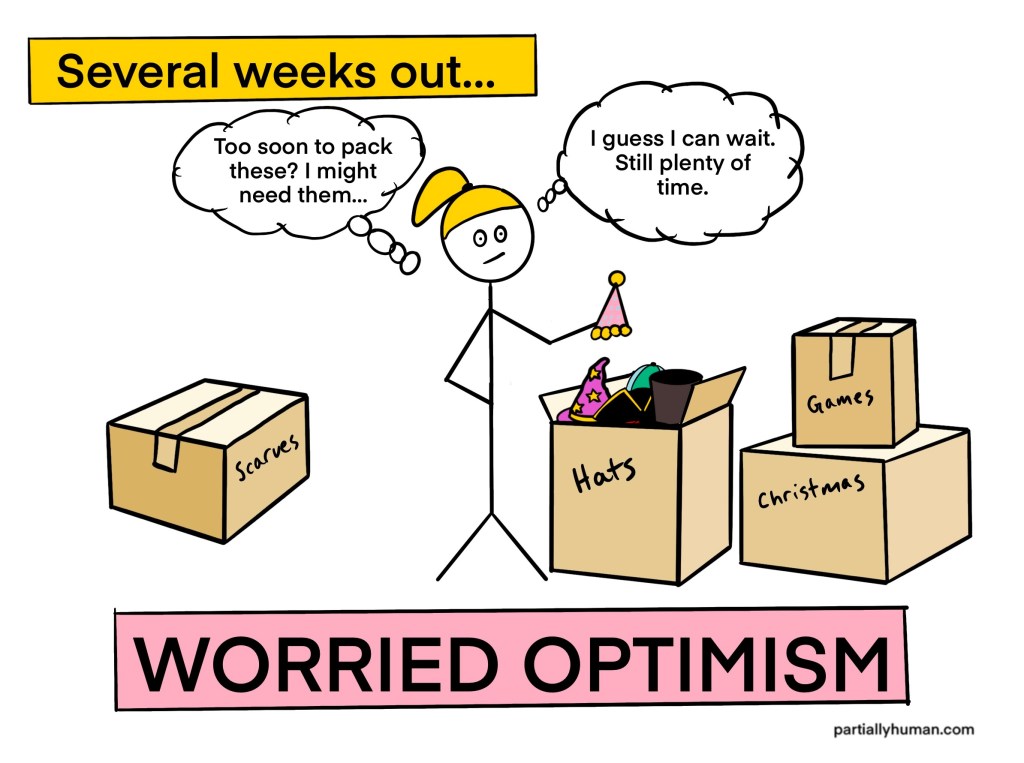
Nevertheless, I still have grand plans for a smooth, controlled, well-organized, perfectly-executed move. But doubts start creeping in as I reckon with how much stuff I use daily, and I realize that most of the packing will have to be left until later.
A few weeks before my move to my husband’s, something weird happened: my foot started hurting. My doctor and I weren’t sure of the cause, but I was supposed to rest it. This curveball slowed down the rate at which I was toting things to my new house because it hurt to carry heavy loads up and down the stairs. I didn’t know why my foot was hurting, or when it would feel better, which made me concerned about my packing plans. I hoped I would feel better soon and then make up for lost time.
But as moving day crept closer, the next phase commenced: Deranged Panic.
The Deranged Panic Phase
The hard thing about moving is that you need your stuff. Multiple days without basics like cookware and towels can be very challenging. And most people don’t move often enough to know exactly how long packing takes.
One time in college, I helped a boyfriend—a chronic procrastinator—move. When I showed up at his house, it looked like it was just any other day—he hadn’t packed a single thing. The plan was to rent a truck, just put stuff directly in it, and move it all across town in 1 day. It ended up taking 3 days. And costing 3 times more. We were all grumpy about it.
So ideally, you would pack as fast as possible at the very last minute to minimize the time spent living without basic necessities, but give yourself enough time to pack that you aren’t rushed and cutting corners. But it’s hard to time this correctly. Which leads to this:
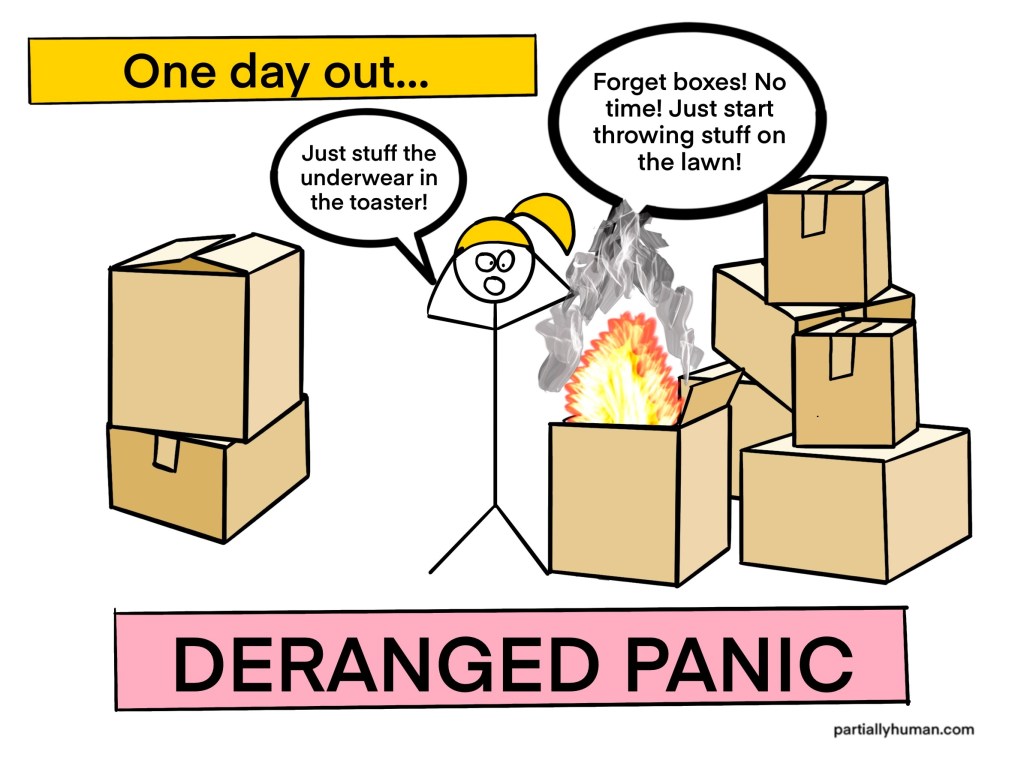
Oh how the mighty standards fall.
I don’t know how ambitious or realistic most people’s moving plans are, but it’s fairly common to be forced to cut scope or quality as a deadline approaches on a project.
By the time moving day to my husband’s arrived, my foot not only hurt MORE than it had a few weeks earlier but now my knees hurt too. I had failed to move all the stuff I had planned to move. We had to have my parents come help cart things over in their cars. I was big-time grumpy; dreams of the perfect move had been obliterated.
Dreams of Perfection
Do you remember that game Minesweeper, where you would click on little tiles in a grid that had hidden mines scattered throughout? And if you clicked just one mine you lost?

When I’m enchanted by the control-hungry perfectionist version of myself—the one who thinks that to be safe and loved, everything must go right—moving feels like playing a fresh game of Minesweeper, where I’m trying not to click the mines I’ve encountered before while also avoiding new ones. And hitting one means I lose, ushering in the sinking feeling I know all too well: shame.
I moved a lot as a kid. Moves were stressful for my parents–and for all of us. I did my best not to add to the stress. I badly wanted things to go right, for everyone to be happy. Children naively blame themselves for things that are out of their control, like a parent’s mood. And at an early age, I internalized the idea that doing everything “right” prevented bad feelings. It certainly earned me approval—a potent motivator. The stakes were high. A perfect move was a must.
What does it take to achieve perfection? With enough tinkering, you can practically perfect a process that occurs repeatedly under the same circumstances with the same inputs; Six Sigma process improvement methods can reduce mistakes to 3.4 errors per million instances. The pre-requisite to achieving this? Absolute control. You must control every aspect of the process from start to finish. Moving does not meet this pre-requisite. Very few situations do. Yet striving for perfection remains tantalizing.
Perfectionism doesn’t get us what we want though. In The Gifts of Imperfection, Brene Brown writes: “Perfectionism is a self-destructive and addictive belief system that fuels this primary thought: If I look perfect, live perfectly, and do everything perfectly, I can avoid or minimize the painful feelings of shame, judgment, and blame.” Ironically, rather than protecting us from shame, judgment, and blame, perfectionism perpetuates it. We all just want to be safe, happy, healthy, and free from suffering. Aiming for perfection sets the conditions for tremendous suffering and unhappiness.
My husband and I are thinking about selling our house this year. Grand plans are already swimming through my head for a you-know-what kind of move. However, I’ve resolved to practice more self-compassion. This means being kinder to myself and easing up on the unrealistic expectations.
The Good Enough Move
What would reasonable expectations look like for a move? All manner of ancient wisdom tells us that hardship and suffering are part of everyday life, and their solution for these “problems” isn’t to spend every waking second fighting these facts, it’s to accept reality (while, of course, still doing what’s within your control to affect positive change).
Not moving-related, but I appreciate the general sentiment – Marcus Aurelius writes in Meditations, “When you wake up in the morning, tell yourself: the people I deal with today will be meddling, ungrateful, arrogant, dishonest, jealous and surly. They are like this because they can’t tell good from evil. But I have seen the beauty of good, and the ugliness of evil, and have recognized that the wrongdoer has a nature related to my own–not of the same blood and birth, but the same mind, and possessing a share of the divine. And so none of them can hurt me. No one can implicate me in ugliness. Nor can I feel angry at my relative, or hate him. We were born to work together like feet, hands, and eyes, like the two rows of teeth, upper and lower. To obstruct each other is unnatural. To feel anger at someone, to turn your back on him: these are unnatural.”
Aurelius is advising us to mentally prepare ourselves for the bumps and bruises inherent in human interactions, instead of wishing everyone would just be nice, smart, funny, and agreeable, and then feeling grumpy that they aren’t how you want them to be. And he takes it further by offering them acceptance—he won’t be angry at them or hate them when they’re awful because he cultivates peace with the reality of human nature. Can we be at peace with the reality of moving?
What is the reality of moving? Hardship and suffering, my dear fellow fancy monkey. Don’t get me wrong, it isn’t inevitable that it will be dramatically stressful or disastrous (but those are possibilities). What is inevitable is a string of inconveniences and problems: running out of tape, things not fitting quite right in the boxes, having to live without the things you typically enjoy using each day, scuffing walls, scratching furniture, awkward interactions with movers, trying to keep the dogs out of the way, having to run to an ATM for more money because it took 2 hours longer than planned and the movers demand cash. It might feel dramatic to call these things hardship and suffering because we know other people have “real” problems. No need to be a crybaby, right? But these small things grind away at us, making us feel like we’re constantly being squeezed by life. The key to managing these mental burdens is to cultivate a healthy perspective: things will go wrong, it might hurt, and we will be fine nevertheless.
Looking back at the things that have gone wrong for me—while moving or in any other arena—most of it didn’t matter. The only things I regret involve hurting other people. Outside of that, errors that seemed like a big deal at the time have had negligible impact on my well-being today. Only an incredible disaster—like the moving truck disappearing with all of my stuff in it—would have ramifications that last beyond the time it takes to unpack. A resilient mindset is one that knows it will get punched in the face occasionally, so it prepares like Mike Tyson.
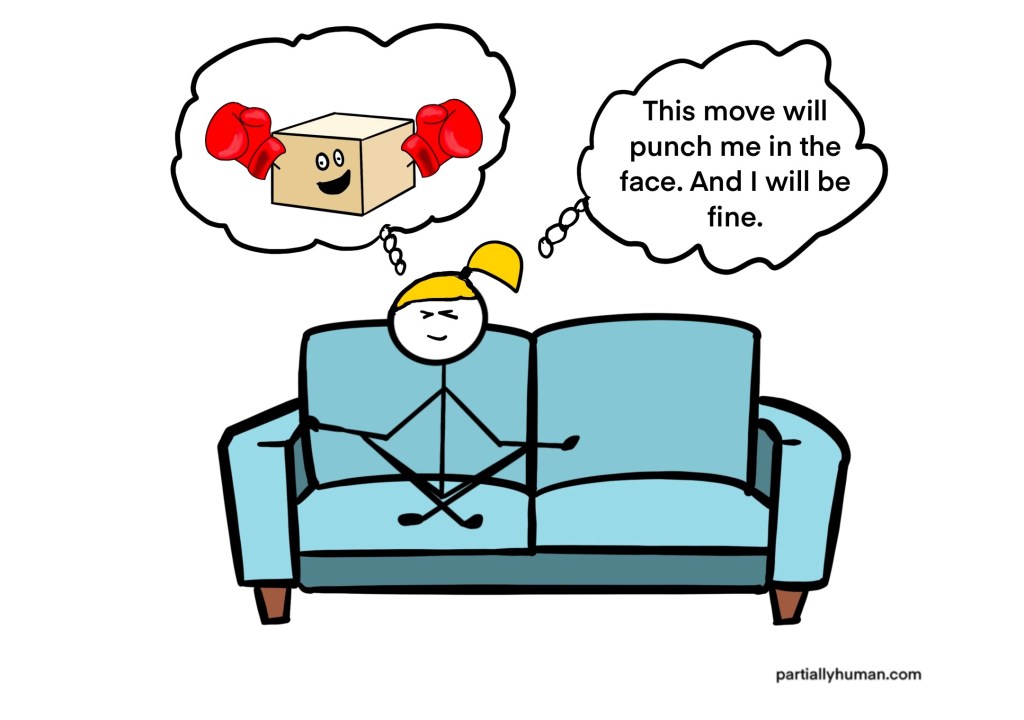
Things will go wrong, but that doesn’t mean there is anything wrong with me or that I should have prepared more thoroughly. Whatever does go wrong, I can handle it. I can be safe and happy regardless of external circumstances. I can have a good life no matter how the move goes. The stakes are not high. In fact, almost nothing important is at stake. No need to hope for perfection because hope is only fear in disguise. There is nothing to fear here; damaged furniture doesn’t damage me. So here’s to a good enough move!

EXPERIMENT: Aiming for Good Enough

Do you put pressure on yourself for things to go well and then feel grumpy when you fall short? This often happens because we have unrealistic expectations and an inaccurate assessment of what is within our control. It’s not bad to aim for excellence, but striving for perfection without accounting for the inevitable pain, uncertainty, trade-offs, and hardship baked into any endeavor is a delusion-fueled recipe for misery.
STEP 1: PAY ATTENTION
- Where/when do you find yourself striving to achieve high standards or expectations?
- Do you have dreams or goals that look like perfect snapshots in your head of a time when you’ll feel happy and fulfilled and things will go smoothly?
- Do you think the right person/job/house/workout/vacation/plan will be all rainbows and butterflies?
STEP 2: GET CURIOUS
- Are your goals and expectations realistic?
- Are you accounting for errors, mistakes, setbacks, and general nonsense?
- Are you trying to configure your life to magically avoid all suffering?
- What are you afraid will happen if things fall short? What’s really at stake?
- What do you think it means about you if you fail to prepare for every possible scenario perfectly?
STEP 3: GET CREATIVE
- How can you more realistically assess what’s in your control?
- How can you incorporate things going wrong into your expectations?
- How can you find peace and equanimity in the midst of life’s ups and downs?
- How can you be kinder to yourself when things go wrong?
- How can you find joy in the messy, complicated, and challenging aspects of life?
Challenging our delusional notions of how things should be and what we should be capable of might seem scary at first; some mistakenly think that means condoning shoddy work. Seeing things as they are isn’t copping out, it’s wisdom. Best of luck to you!

Comments