
The Effortlessness of Overeating Part 1: Extreme Yumminess
The one about how modern food processing makes it ridiculously easy to wolf down excess calories
We fancy monkeys looooove convenience. The easier the better! And if there is anything that is easy these days, it is finding plenty of yummy things to eat.
But here’s the thing – convenience is a double-edged sword.

Modern food processing and availability are a downright miracle.
AND
There is a price to pay for that convenience.
In this series we will explore how being surrounded by extremely yummy food can lead to excessive temptation and unintentional overeating, and what we can do to tweak our food environment to make it easier to eat less ultra-processed food.
Our Modern Food Environment: Extremely Yummy and Convenient (i.e., Ultra-Processed, Hyperpalatable, Abundant, and Accessible)


Yummy food is everywhere. And with the proliferation of delivery services, you can now quickly get almost anything delivered right to your door with a couple of taps on your phone. The processed foods that surround us are deliberately designed to be as eye-catching, easy, enjoyable, and convenient as possible, with the express purpose of getting us to eat more. This modern food environment powerfully shapes our eating decisions, for better or (usually) worse.
There’s nothing wrong with wanting food to be easy, enjoyable, and convenient. Efficiency rocks my socks! Why work harder than you need to? Food processing innovations have freed up time to do awesome things like building a bunk bed in your room so you have more space for activities like karate, instead of doing sucky chores like in Little House on the Prairie.
It’s tricky though. Too much of a good thing becomes a bad thing. Hyperpalatable food is ubiquitous. It’s become TOO easy, TOO enjoyable, and TOO convenient. And our health pays the price. We can now devour literally thousands of calories with almost no thought or effort. This is unprecedented in the history of humans. Our bodies are not designed to handle this glut of ultra-processed food, and the unsurprising result is the rise of chronic health issues like diabetes and heart disease.
Allow me to demonstrate.
The Effortlessness of Wolfing Down Calories
Consider the humble jar of peanut butter. Very yummy and convenient (and arguably not as complicated or processed as many hyperpalatable foods you find at the grocery store).
How much time and effort does it take to spoon a bunch of peanut butter into your mouth? Impressively, the record goes to Todd DeFazio, who ate 18.5 ounces in 41.3 seconds. SECONDS!!! That is 3,075 calories and 259 grams of fat in under 1 minute. (Note: Your body doesn’t actually absorb all the calories in peanut butter. And it absorbs even fewer calories from intact peanuts. But I digress.)
Now I’m no champ like Todd, but I have crushed an entire jar of peanut butter over the course of two days. The ability to mindlessly spoon peanut butter into my mouth while searching the pantry for something else to eat is made possible by modern food processing (peanut butter has only been mass-produced for about 100 years).
Let’s compare what it looks like to chow down on peanut butter today, to what it would have looked like before modern technology.
Eating Peanut Butter WITH Fancy Technology
Modern peanut butter manufacturing is objectively complex, requiring lots of people, coordination, and machines. But from our standpoint as the consumer, eating peanut butter is super-duper easy.
Here is the whole fancy technological process, as described by madehow.com:
“The first several steps in peanut butter manufacturing involve processing the main ingredient: the peanuts. After harvesting, the peanuts are cleaned, shelled, and graded for size. Next, they are dry roasted in large ovens, and then they are transferred to cooling machines, where suction fans draw cooling air over the peanuts.”

“After the peanuts are roasted and cooled, they undergo blanching—removal of the skins by heat or water. The heat method has the advantage of removing the bitter heart of the peanut. Next, the blanched peanuts are pulverized and ground with salt, dextrose, and hydrogenated oil stabilizer in a grinding machine. After cooling, the peanut butter is ready to be packaged.”
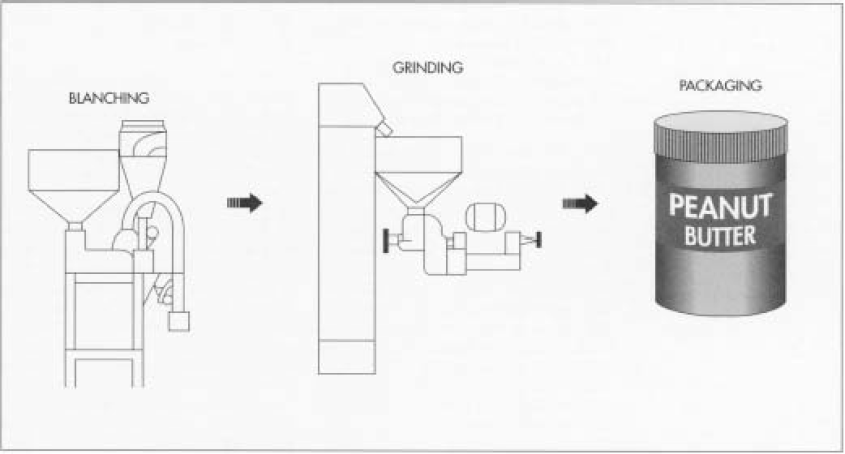
And after it is packaged, it still has to make its way through the supply chain, from manufacturer to distributor to grocery store, to shelf, to you, getting boxed and scanned and transported multiple times along the way.
We only participate in the last few steps of a peanut butter jar’s lifecycle. Here is the typical end-user process:
- Walk to the pantry
- Scoop into mouth
- Put spoon in dishwasher
If we took away our fancy technology and processing powers, how easy would it be to get our peanut butter fix? (And no, I don’t mean the modern version of DIY bootstrapping it, where you order pre-shelled, already blanched and roasted peanuts from Amazon, pour them in your $300 Vitamix, and smugly blend them on high-speed for three minutes. I mean OLD SCHOOL.)
Eating Peanut Butter WITHOUT Fancy Technology
Step 1: Let’s start by assuming you aren’t planting and growing the peanuts yourself, because I’m not a psycho.
Step 2: And let’s also assume that you don’t have to pick the peanuts yourself, because when I was in kindergarten, we took a field trip to a farm to pick peanuts, and once was enough.
Step 3: Get the peanuts. To not totally cheat, let’s say you have to walk to the store.
Step 4: Buy the peanuts. Apparently, it takes 720 peanuts to make 16 ounces of peanut butter. At 2 peanuts a pop, you would need 360 peanut pods.
Step 5: Walk home.
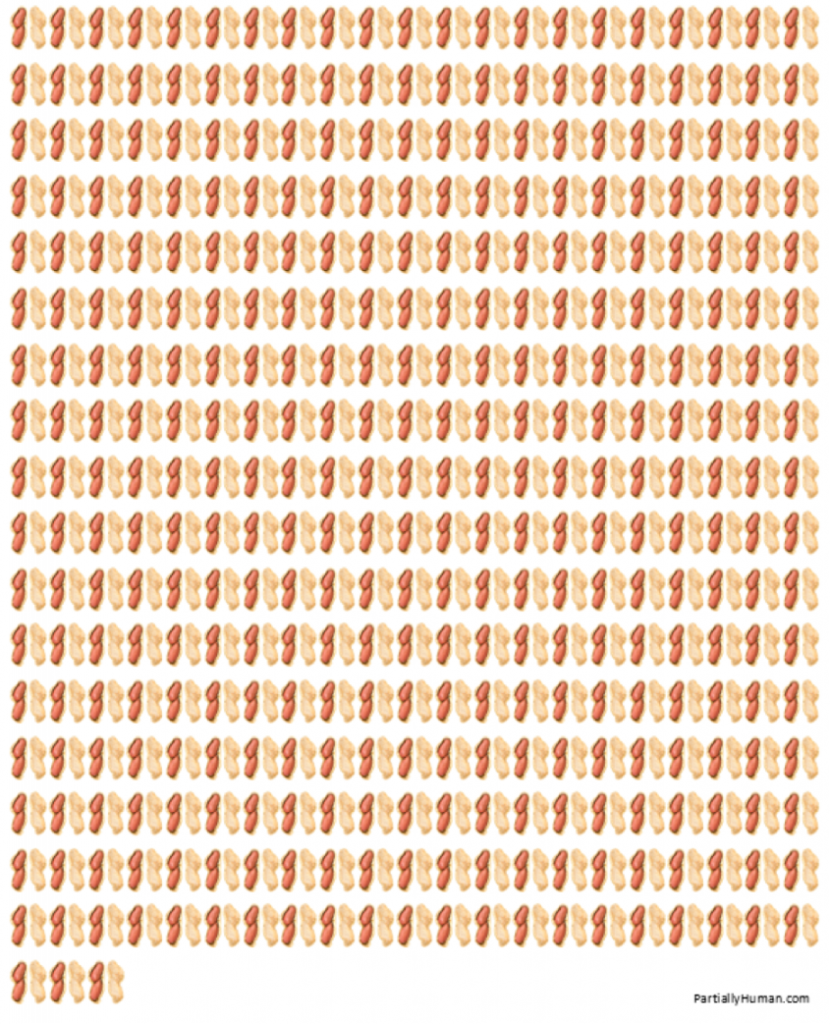
Step 6: Shell the peanuts. THREE HUNDRED AND SIXTY OF THEM. Have you eaten peanuts out of the shell before? It’s an awkward, messy, painstaking task.
For perspective, here is what 360 shelled peanuts looks like:
Step 7: Roast the peanuts. I’m not exactly sure how you would do that without a modern oven, but nuts roast fast, so I’m thinking you can do a few batches by holding a pan over a fire.
Step 8: Remove the skins. As you saw above, peanut butter manufacturers blanch them with air to do that, but you can just sort of rub them with a kitchen towel to do it yourself.
Step 9: Grind them up. WITHOUT a blender! Lots of smashing with a meat mallet or rolling pin.
Step 10: Scoop the whole mess into a jar.
Step 11: Eat. Scoop that peanutty goodness into your mouth.
Step 12: Clean up that big mess you made, you filthy animal.
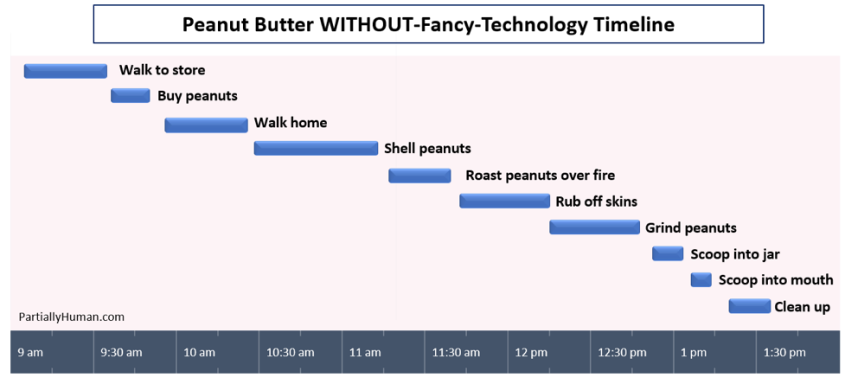
How much peanut butter do you think you would eat if you had to make it this way? And after all that effort, how mindlessly would you wolf it down? You can bet those sweet cheeks that I would eat less peanut butter if I had to do even half of those steps.
Now compare that again to our modern, convenient scenario:
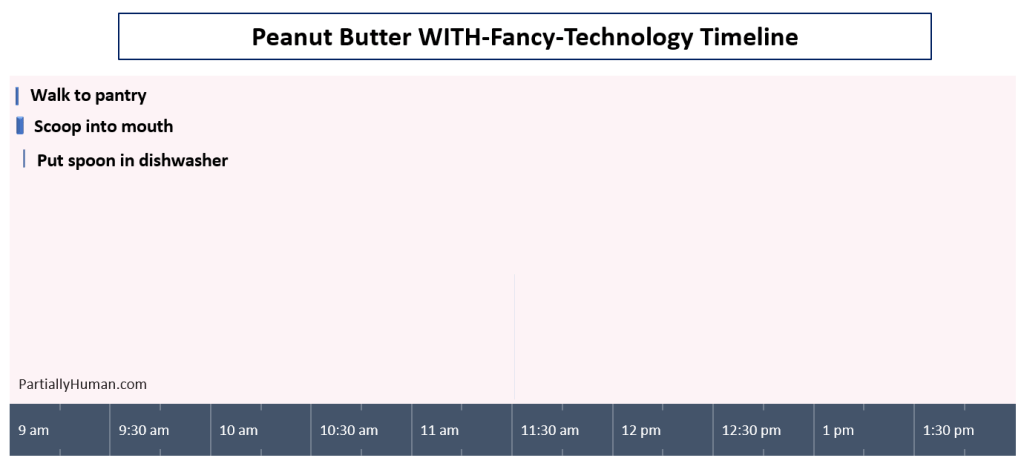
Without a question, the second timeline looks better to me. And modern peanut butter is cheap, yummy, and convenient to boot. The ultimate trifecta. But what’s the tradeoff for this magic?
Ultra-Processed Foods Can Pack in Calories like Nobody’s Business
The standard 16-ounce jar of peanut butter (with peanuts as the only ingredient) has 2,660 calories and 224 grams of fat, or 160 per ounce. Prior to food manufacturing you had very few opportunities to gorge yourself on calorie-dense food without first doing extensive preparations.
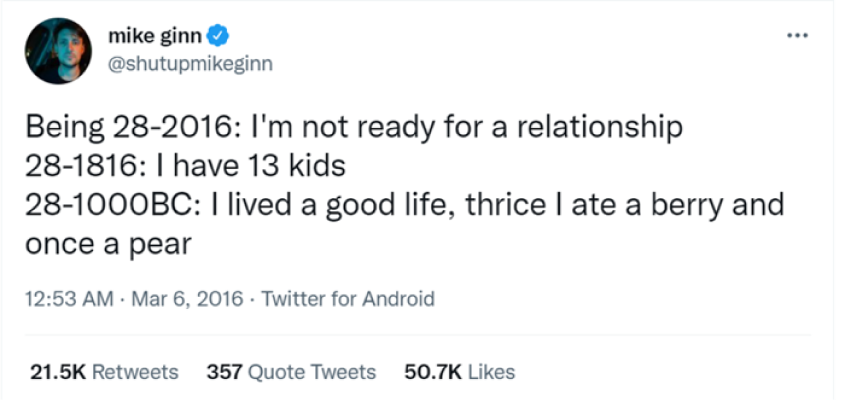
Before supermarkets, a few lucky ducks in Alaska got to feast on some whale blubber, clocking in at around 250 calories per ounce. We’ve been making oil, butter, and cheese for a long time (which obviously also require processing, but you could buy those easily), and at about 250, 200, and 115 calories per ounce respectively, those were your best opportunities to wolf down calorie-dense foods.
I know I just threw a lot of numbers at you, so here’s my point: overeating processed foods is ridiculously easy.
To put it in perspective, higher-calorie whole fruits and vegetables can have up to about 30 calories per ounce. In order to eat the same number of calories in a 16-ounce jar of peanut butter you would have to eat approximately: 23 medium sweet potatoes, or 53 cups of strawberries, or 88 cups of broccoli!

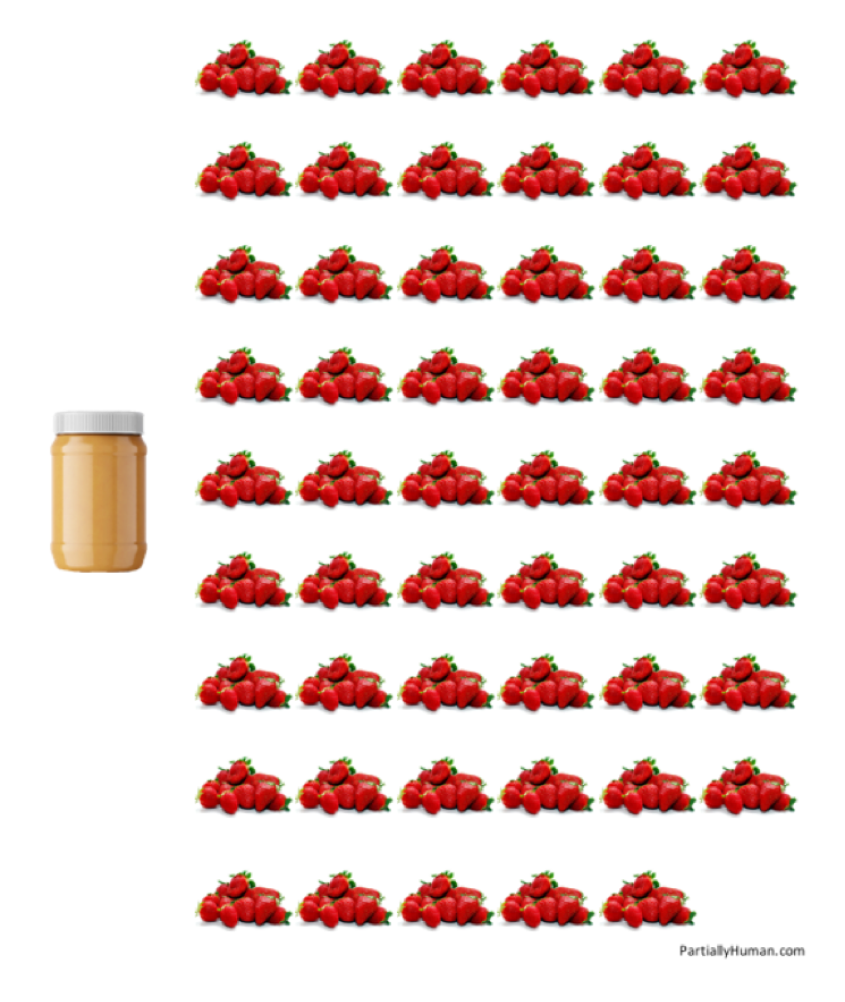
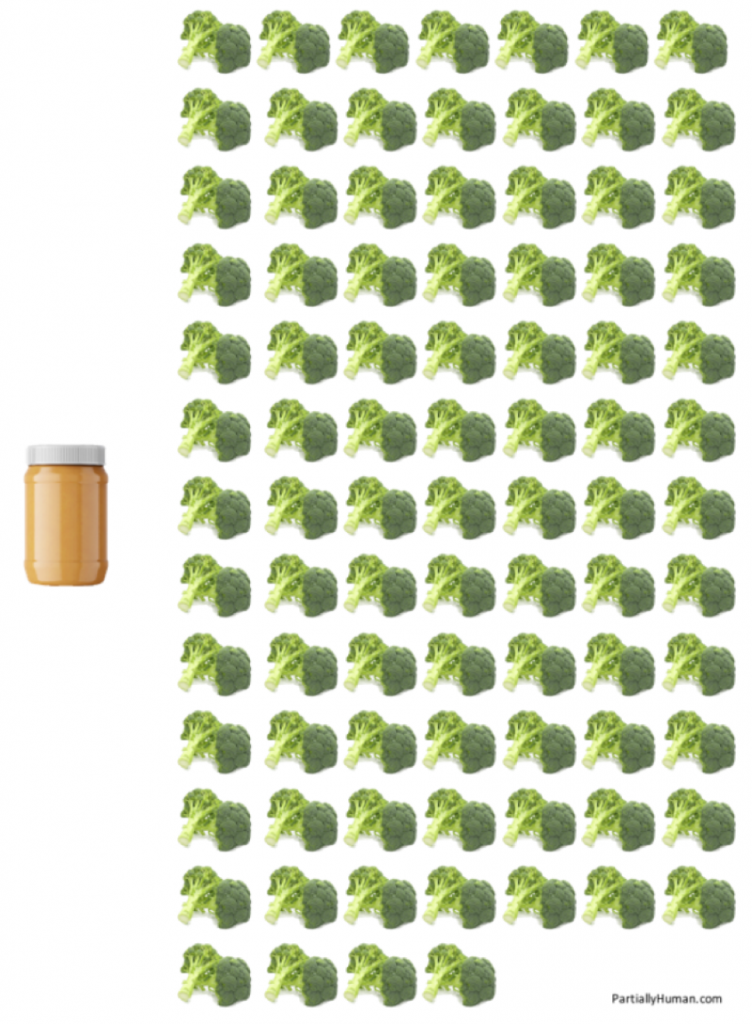
How long do you think it would take to eat that much broccoli?
How Long Does It Take to Eat Unprocessed Foods?
Even eating champions struggle to quickly consume large portions of vegetables – the chewing slows you down too much. Gideon Oji, a competitive eater who won a raw kale eating championship, managed to eat 25.5 16-ounce bowls of kale in 8 minutes, totaling about 1,100 calories of kale. That’s 1/3 the calories that Todd the peanut butter champ consumed in less than 1/10th of the time. Assuming his jaw doesn’t give out from exhaustion, it would take a world champion speed eater AT LEAST 22 minutes to eat enough kale to equal the calories in a jar of peanut butter. Remember, Todd DeFazio ate 3,075 calories and 259 grams of fat in under 1 minute with peanut butter.
Whatever the speed you eat peanut butter at, if your kale and peanut butter eating speeds stays at a similar ratio, then however much peanut butter you eat in almost a minute would require about 22 minutes of constant kale eating.
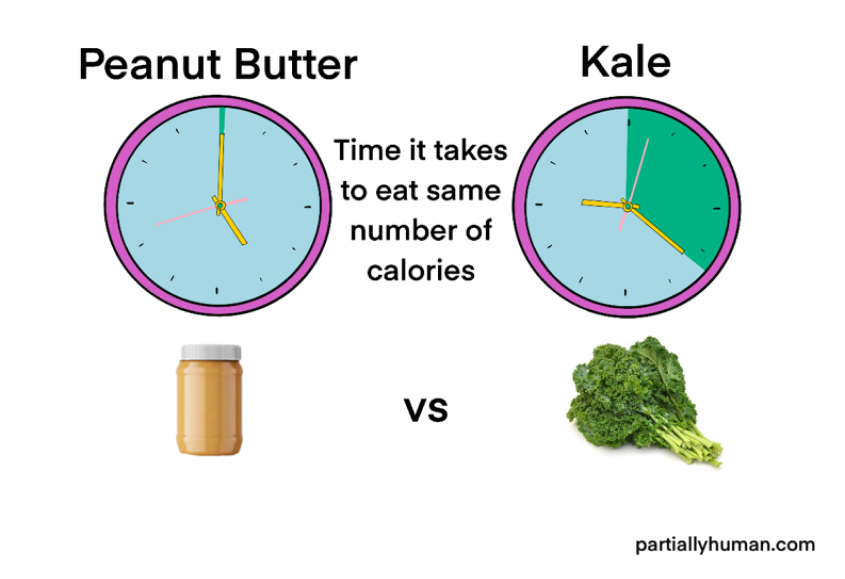
The fiber in plants and structure of raw foods requires too much chewing to mindlessly wolf down, making it very hard to overeat them.
Modern Processed Food is Irresistible
The foods that people struggle with overeating the most contain some combination of fat, salt, and sugar that have undergone some sort of processing that makes them WAY yummier than they would be on their own or in their natural states. And refined sugar was prohibitively expensive for most of human history, so struggling to control a sweet tooth was mostly a problem for royalty until the 1800s.

Here is an incredibly accurate and super scientific scale that demonstrates how food processing and salt/fat/sugar-combining increase the irresistibility of food:

So how does basic peanut butter compare to foods with that magic combo of ultra-processed and highly-palatable? Now one jar will only get you the equivalent of 5 cups of full-fat ice cream.
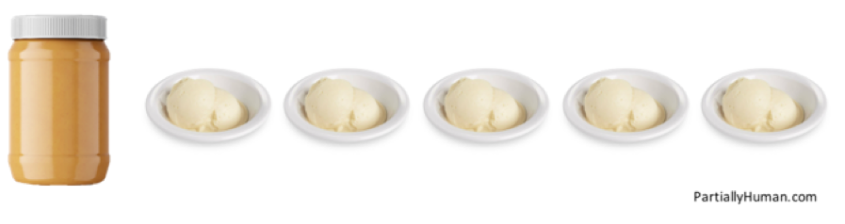
It’s not that difficult to eat a few cups of ice cream, because natural hunger cues only work with natural foods. But that’s only an issue if you are eating those foods frequently and mindlessly.
Bringing Awareness to Foods That Cause Us to Overeat
It’s so easy and normal to eat predominantly hyperpalatable processed foods these days that we don’t tend to give much thought to it. Stepping back to take stock of what we’re eating on a regular basis can be eye-opening. Learning to clearly differentiate between foods that are easy to overeat and those that are not is a key piece of the modern food environment puzzle.
For our experiment this week, we will explore the processed foods in our food environment and how they play a role (or not) in encouraging overeating.
And then next up, in part 2 of this series, we will shift our focus to the prevalence of processed food in our food environment and how that also contributes to inadvertent overeating.

Part 1 Experiment: Does food processing promote overeating?
There are two dimensions to something being overeat-able: calorie-density and yumminess.
Calorie density – While the calories listed on nutrition labels are not perfect measures of how many calories your body will absorb, and they also don’t speak to how healthy a food is, they are a useful metric when roughly considering portion sizing. The more calories a food packs in, the less you can eat before you have exceeded your body’s energy requirements. Some foods are almost impossible to eat, while others require careful portioning.
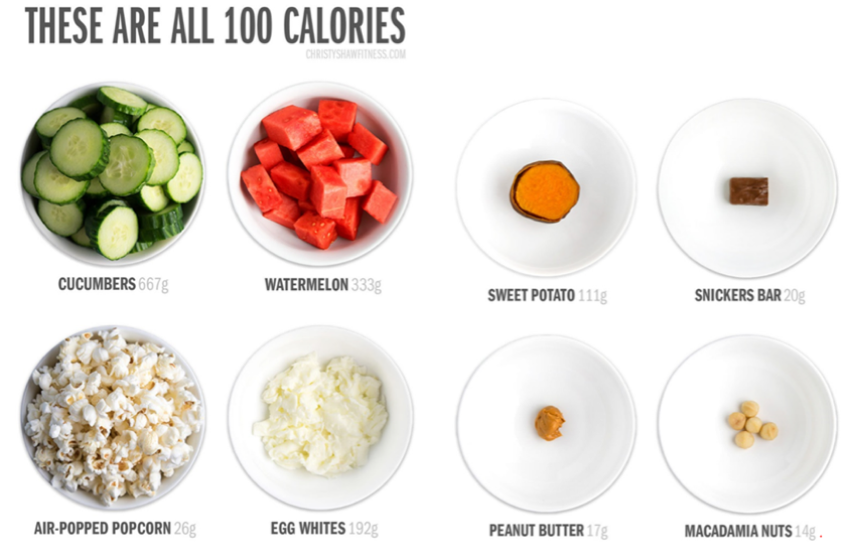
Yumminess – The more palatable something is, the more of it you want to eat. Hyper-palatable foods contain irresistible combinations of sugar, fat, salt, and carbohydrates not found in nature that tap into the brain’s reward system and make it hard for us to stop eating them.
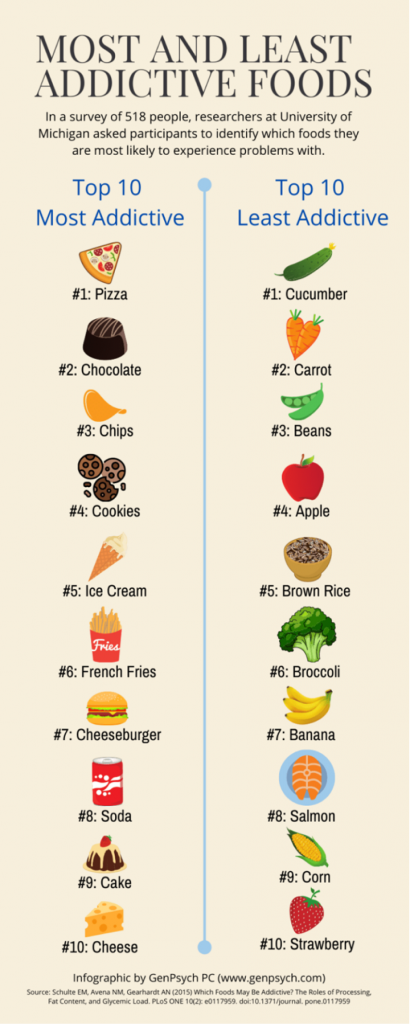
Step 1: PAY ATTENTION
How calorie-dense and yummy (i.e., overeat-able) are your foods?
Assessing Calorie Density
Here’s a neat and eye-opening way to take an inventory of your food based on calorie density.
The Food Line-Up Exercise: Calorie Density (courtesy of John Fawkes)
- Pull all your food and beverages out of your fridge and pantry.
- Make post-it notes for anything you regularly eat that you don’t have on hand (take-out, office donuts, coffee shop muffins, etc.) and add them to the food pile.
- Calculate the calories per gram for each food.
- Line up the foods in order from least calorie-dense to most calorie-dense. (You’ll have zero calorie foods like tea and sparkling water on one side and oil/butter on the other end at 9 calories per gram.)
- Take a picture and/or record the order of the food and calories per gram.

The foods on the low-calorie side are difficult to overeat. Those on the opposite end can punch you in the gut with calories in the blink of an eye, usually without even making you feel much fuller.
Assessing Yumminess
This part is more subjective and individual – you now need to rank your foods by how irresistible you find them.
The Yumminess Food Line-Up
Rearrange the foods by how delicious you think they are. The foods you crave and struggle to stop eating go at one end and foods you have to force yourself to eat go on the other. The signs that a food is hyperpalatable and designed to encourage you to overeat are:
- You crave it despite not being hungry.
- You often eat more of it than you originally intended.
- It’s hard to eat just a little bit.
- You keep eating it past when you are full.
Take a picture and/or create a new list in your spreadsheet with the yummy foods.
Step 2: GET CURIOUS
Do some analysis of the two food line-ups.
- When you rearranged the foods, did the yummiest foods stay toward the more calorie-dense end?
- Is your food environment predominantly comprised of less-processed, lower calories foods or more-processed, higher calorie foods?
- How generally aware are you of calorie-density? Are you more careful with portion sizes with things like oil, cheese, and peanut butter?
- How processed are the yummy foods? How many processing techniques do they check off? (Ordered roughly from most benign to more harmful)
-Canned
-Dehydrated
-Fermented/pickled
-Juiced
-Pasteurized
-Refined, pressed, ground, milled (think oils, flours, pasta, cereal)
-Added preservatives
-Added salt, sugar, fat
-Artificial ingredients
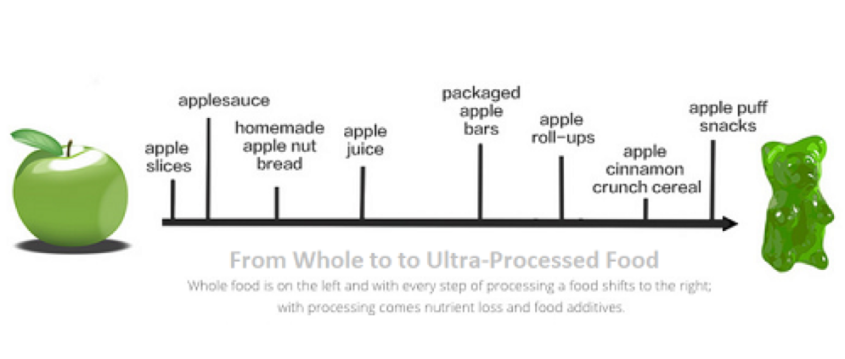
- Which foods contain that potent combination of calorie-density and irresistible yumminess?
- How easy or difficult is it to moderate portions of those foods? Does it require some thought and attention? What processing techniques or ingredient combinations make it more challenging to control portions?
- How easy or difficult is it for you to moderate portions of whole, intact, unprocessed foods with no added salt, sugar, or fat (i.e., fresh fruits and vegetables)?
Step 3: GET CREATIVE
Stopping to think about our food environment and eating patterns can yield important “aha” moments. You’ll likely find that there are foods higher in calorie density and processing that you don’t like as much as some less processed and/or lower calorie foods. You may also realize that some foods lend themselves to easy overeating if you aren’t careful.
Identify some easy tweaks you can make that would reduce the chances of inadvertent overeating. When it comes to calorie-dense and ultra-processed foods – portion control is king.
Brainstorm as many tweaks as you can! Get creative! Here’s my list.
Portion control ideas:
- Serve yourself using measuring cups, or pretend you have T-rex hands and scoop the food on your plate using only your index and middle fingers.
- Use tiny plates and bowls while pretending you have tiny arms like a T-rex.
- Eat whole, unprocessed foods (because dinosaurs can’t read packaging).
- Start meals with fiber-filled foods like salad or fruit that require lots of chewing, like the super cool herbivore Stegosaurus did.
- Eat off a plate instead of directly out of the container, but not like a dinosaur would with just your mouth, like a human that uses utensils (or maybe like a baby that throws some of its food on the floor).
- Buy foods that naturally take longer to eat and are more difficult to wolf down, like: nuts still in the shell, oranges that need to be peeled, whole lobsters, watermelon with seeds, foods that require a lot of chewing like raw broccoli, and pretend you’re a Brachiosaurus chewing on a tree like in Jurassic Park.
- Buy individual servings of cake, chips, candy, etc. instead of a whole cake or family-size bag of treats, then just be really sneaky so your family doesn’t know you didn’t get enough to share (eat it while pretending you are the kids from Jurassic Park hiding from the Raptors in the kitchen scene).
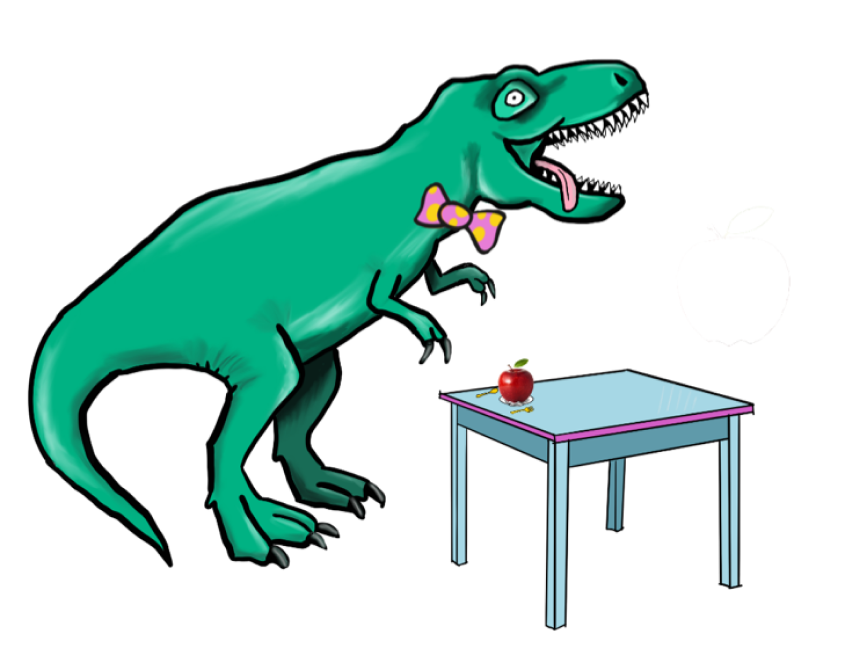
It’s fine to eat foods that are easily over-eatable, it just requires that we pay more attention to quantity. Then stacking the deck by loading up on foods that are hard to overeat, either because they are lower in calories or they don’t have addictive qualities, means we don’t have to think so hard or rely on willpower the rest of the time.
Step 4: TAKE ACTION
Choose a couple of ideas from your list, ideally things that are lower effort and higher impact, and implement them.
The two big stumbling blocks here tend to be:
- Remembering
- The odd (kind of icky) feeling of doing something different from what you’re used to.
For both of these, having a very specific plan helps. Think through precisely what you need to do to implement your idea and when you will do it. It helps to write it down and set reminders for yourself.
Step 5: GAIN INSIGHT
Experimenting with different ways of tweaking your food environment to limit inadvertent overeating will teach you a buttload about what factors influence how much you eat. So, let’s review what happened in our experiment.
How did it go?
- Did your experiment work the way you wanted it to?
- What went well?
- What could have gone better?
- Did you have any wins or signs of progress in the right direction?
- Were there any unintended consequences or unexpected obstacles?
What did you notice as you tweaked your environment? Some variables to assess:
- Frequency and intensity of cravings
- Relative healthiness of food choices
- Relative satisfaction with food choices
- Mood and emotional stability
- Desire to overeat
- Instances of overeating
If you’re happy with how things went, either keep on doing what you’re doing or look for ways to build on your success by adding more environmental tweaks. In Part 2 of this series, we will look at the sheer abundance of food in our environment and how that influences our eating, then we will experiment with tweaking other variables that contribute to what and how much we eat.
Don’t forget to share your experiment and results on the Partially Human Facebook page or comment below!

A big thank you for your article post. Really Great.