
How Great Ideas Become Nightmares
The one about how great ideas go off the rails
Why is it that great ideas get watered down and mangled, often to the point of becoming wholly unrecognizable, when they are adopted by large groups? History is littered with movements that sounded great, in theory, but panned out disastrously because the implementers strayed from (or misunderstood) the original principles—like when Jack Skellington tried to make Christmas with the help of Halloween Town in The Nightmare Before Christmas. His attempt to spread a great idea ended as an abomination. How does Christmas become a nightmare? And why do good ideas go bad?
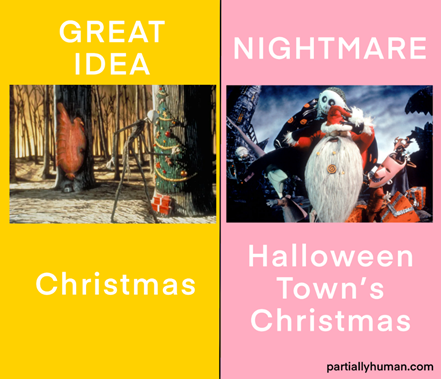
Today we’ll look at how well-meaning ideas get off track so we can anticipate the inevitable issues they’ll encounter as they spread.
The Spark


A great idea starts with seeing the world in a new way—a fresh perspective that unveils possibilities and potential. When Jack stumbles into Christmas Land, he immediately notices snow—something he has never seen before. He approaches the new experience with an open mind and curiosity—two potent ingredients that pave the way for an idea to take hold. Running around the town asking, “What’s this? What’s this?”, he’s enraptured by presents, electric lights on strings, and the lack of monsters under children’s beds.

Typically, those who dive headfirst into a new idea do so because they see its merits. People like Jack are captivated by possibilities—they love learning and growing and challenging themselves. They have a compelling vision they’re inspired to realize. They are trailblazers or, as we will discuss later, chefs. And since any big idea requires help from others, our hero must get his town onboard in order to create Christmas.
The Spread
Unfortunately (and predictably), when Jack spreads the word about Christmas to Halloween Town, it doesn’t go so well. He tries showing them some typical Christmas objects, such as presents, bows, and stockings. The townspeople get excited, but clearly miss the point—they assume that scary things are hidden in the presents, bows are made out of things that are gross, and a stocking probably has a rotten foot covered in gook in it.
Jack tells them, “Listen now, you don’t understand. That’s not the point of Christmas land.” But they still think Christmas is simply a new approach to Halloween, just featuring new ways to scare people. The townspeople are not approaching Christmas with a beginner’s mind—open to radically different ways of thinking. They bring their existing thoughts, beliefs, and culture to the endeavor of creating Christmas, not realizing that they are totally off base.
People who jump on a great idea as it spreads will have a mix of motives. Some will approach it similarly to Jack, with curiosity and openness. Some might join in because everyone else is doing it or because someone they admire is onboard. Agreement will vary. Understanding will vary. (I know…duh. Welcome to the internet, right?) How the idea ultimately plays out depends on enough people agreeing AND understanding.
The Agreement and Understanding Continuums
We all fall somewhere on Agreement and Understanding Continuums for every topic. It’s important to be able to tease out where people are on these continuums when trying to get a new idea off the ground: this helps predict whether an idea will be implemented effectively or fail completely.
Agreement Continuum
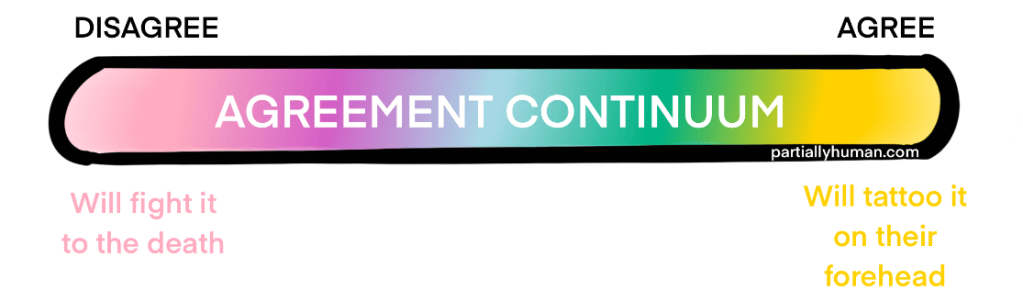
The implications of people not agreeing with an idea are obvious—they’ll either oppose, resist, avoid, or begrudgingly participate. None of those options are necessarily good or bad. We don’t want everyone on the planet mindlessly jumping on board with every new idea—some ideas suck. We need dissent and conflict to tease out the good ideas from the nonsense ones, and to refine promising ideas that have some flaws. Resistance is only a problem when people are fighting good ideas that have been rigorously tested and thoroughly vetted.
Here is where the townspeople are on the Agreement Continuum after their meeting with Jack.

We won’t focus much on the Agreement Continuum today, other than to highlight how dangerous it is when people pre-maturely agree to an idea they don’t fully understand.
Understanding Continuum
The Understanding Continuum is much trickier than the Agreement Continuum because, where you probably have a reasonable sense of how much you agree with something, it’s much harder to gauge how well you understand something. Scott Adams observed, “Being absolutely right and being spectacularly wrong feel exactly the same.” This is how great ideas truly go off the rails—people oversimplify, water down, or distort the foundational elements of an idea without even realizing it, like the people in Halloween Town did.
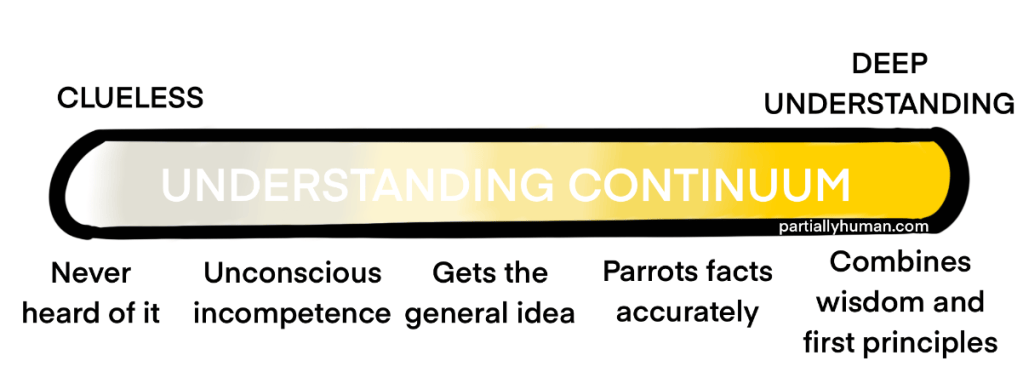
Despite Jack’s attempts to get the townspeople to understand Christmas, they continue to get it wrong. When the mayor enthusiastically declares, “Oh how HORRIBLE our Christmas will be!!!” Jack corrects him, “No, how JOLLY.” And the mayor, looking confused, hesitantly parrots, “How jolly our Christmas will be.” There is a major disconnect: Jack wants his Christmas to be filled with laughter and joy and warm feelings, like he experienced firsthand in Christmas Land, while the townspeople think of Christmas as merely an iteration on Halloween.
Jack tells the town point-blank that they don’t understand. Undeterred, the people excitedly commit to creating Christmas anyway. Here is where the town is on the Understanding Continuum.

Lack of understanding is insidious. It’s like an infection that spreads, weakening the idea as people’s minds morph it into a pale, corrupted version of itself. This adulterated version of the idea takes on a life of its own, contaminating the original idea in the process. The morphing that happens through lack of understanding is categorically different from what happens when an idea is modified due to people arguing against it—arguing against an idea using critical thinking sharpens and improves the ideas, whereas haphazardly adopting the hazy notion of an idea weakens it.
The Thing About Understanding…
As a kid, I knew every single word to every single Mariah Carey song. In her song I Am Free she sang:
Once I was a prisoner
Lost inside myself
With the world surrounding me
Wandering through the misery
But now I am free
Every time I listened to that song, I thought about how it was pretty crazy that Mariah Carey had been in jail, and I hoped my parents wouldn’t find out because then they might not let me listen to her music anymore.
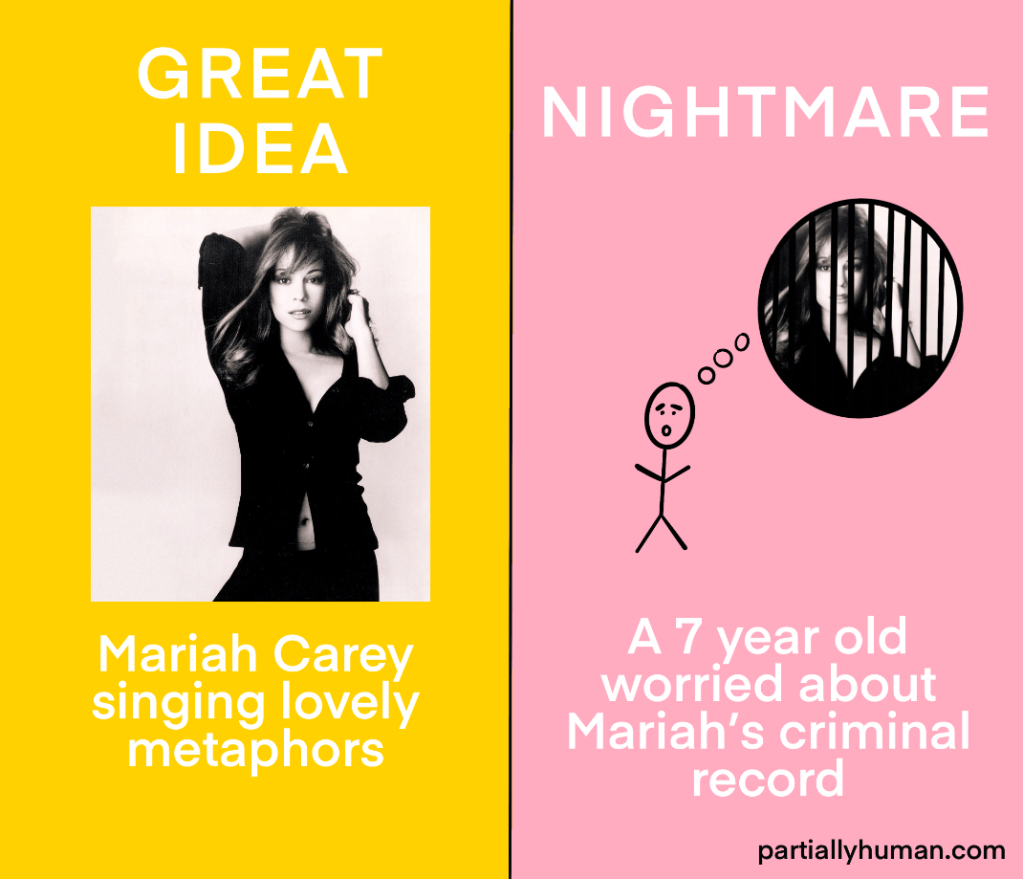
This is how well I understood Mariah Carey’s lyrics.

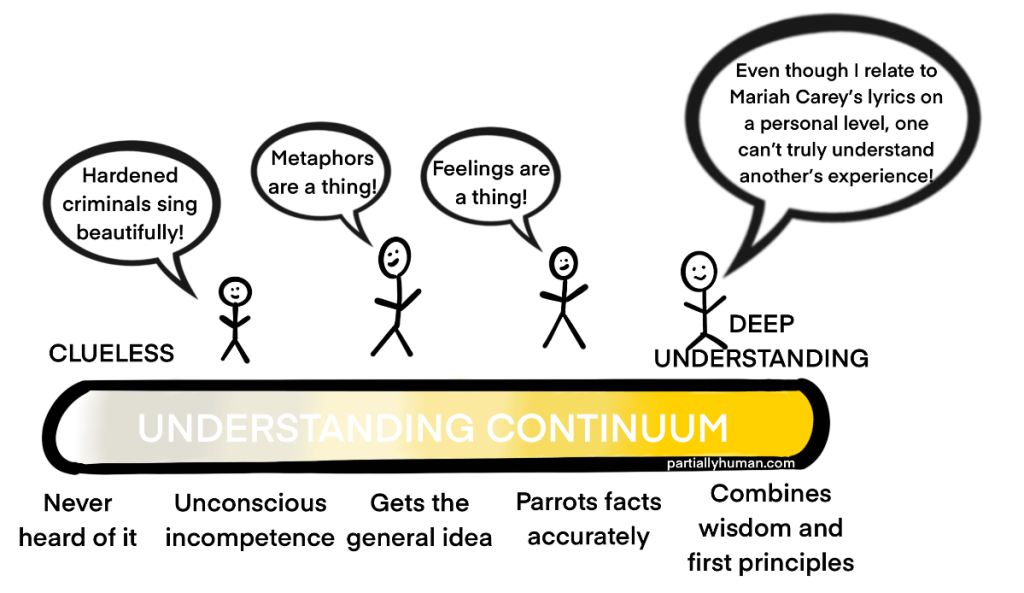
Did I know every word to every song? Yes. Did I think I understood those words? Yes. Did I actually understand? Not really. It wasn’t until I had more life experiences (and a better grasp on metaphors) that I understood what Mariah was singing about in those soulful ballads (or thought I did). As a kid I understood the literal English coming out of her mouth, missing the nuance and emotional complexity entirely. After experiencing romantic love, I understood many of the lyrics on a new level. But only recently, since I read her book where she talks about what was going on behind her songs, have I come to a closer understanding of what she actually meant. Heck, even now—who knows what I’m getting wrong about her lyrics? I’ve never been married to a much older, overly controlling music executive, or navigated being biracial in the 70s/80s, or experienced most of the things she has.
Here is my journey along the understanding continuum for Mariah Carey music.
Understanding someone else’s life experiences and art is uniquely challenging since we can’t directly experience other people’s thoughts and emotions. But when it comes to ideas, we are all able to understand the same fundamental principles because those aren’t based on an individual’s subjective experience. Great ideas are based on verifiable empirical data that anyone can examine and understand. So how do you know whether you are like 7-year-old me—worrying about Mariah Carey’s criminal record, or the townspeople—imagining monsters hiding in presents? And how can you move along the Understanding Continuum to grasp the true essence of concepts like Christmas?
Thinking Like a Chef
Upon returning from Christmas Land, Jack does the hard work of trying to understand Christmas—analyzing decorations, books, toys, and other Christmas paraphernalia in a lab—while continuously asking, “What does it mean? What does it mean?”.
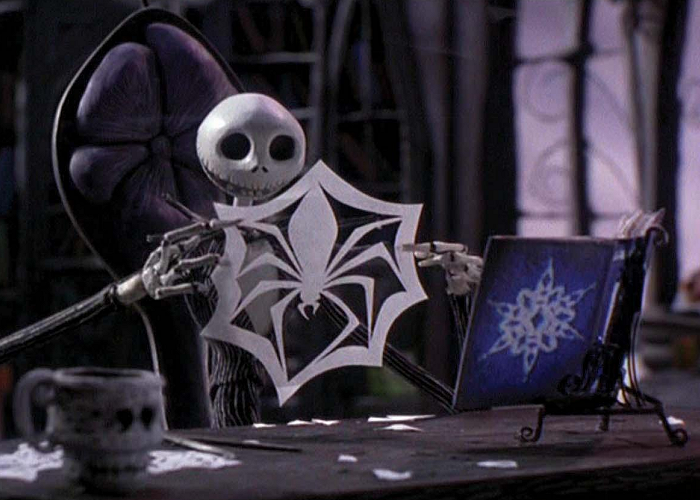
He strives to truly understand Christmas by digging and questioning. Jack approaches the idea of Christmas like a chef—attempting to grasp the first principles.
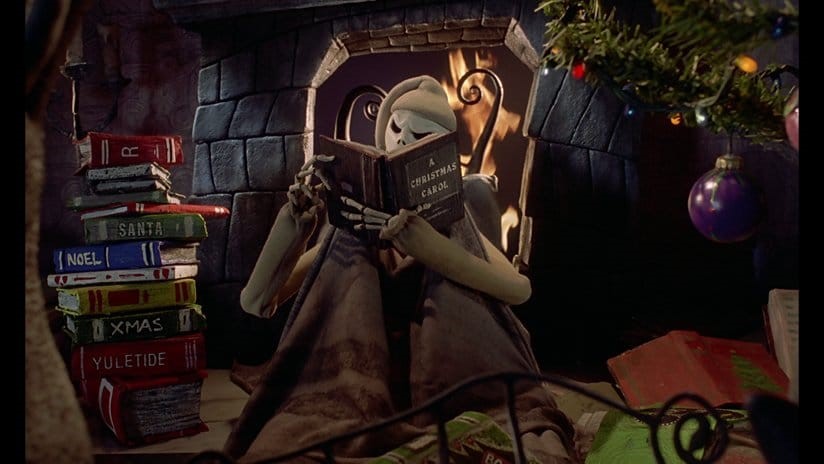
My favorite blogger, Tim Urban of Wait but Why, came up with the concept of the cook and a chef. Tim says a chef is someone who reasons from first principles (i.e., basic assumptions that can’t be deduced any further). A chef uses raw, edible ingredients to build a dish from the ground up. Unencumbered by conventions, they question every element of the dish (i.e., the idea), affirming what is absolutely true, what has been proven, and what is essential. They know the secret: that most things are made up by fancy monkeys, not immutable laws of nature. A chef is all the way to the right on our Understanding Continuum, after they’ve done a deep dive to grasp the fundamentals.

When you think from first principles you are able to independently assess the merits of an idea and use the raw ingredients to create something wonderful. You can take the essential elements and implement them effectively, taking into account the existing norms. Unfortunately, Jack didn’t make it all the way to first principles, or deep understanding, before carrying out his Christmas scheme. While clearly a true Halloween Chef, he remained a Christmas Cook.
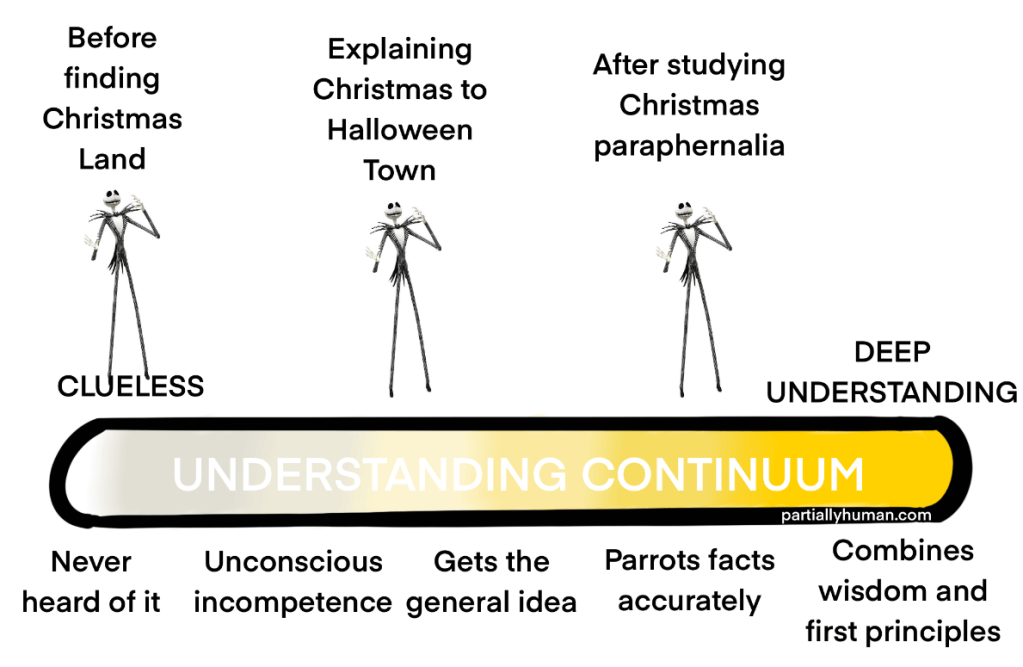
But at least he tried! This is very different from how the townspeople approached figuring out Christmas.
Thinking Like a Cook
A cook (for the purposes of this analogy, not an explanation of the restaurant industry) prefers to follow a recipe or tweak an existing dish. This type of thinker reasons by analogy, looking to see what other people are doing or what they have seen done in the past. When a cook encounters a new idea, they don’t deconstruct it and poke at it and question its basic assumptions; instead, they check it against common convention and their existing beliefs.
We all think like cooks much of the time because it is easier and faster. There is no need to deeply question every single convention. We floss and brush daily, eat vegetables, wear pants in public, dress up on Halloween, give people presents at Christmas, and adhere to myriad social norms and expectations because at some point someone told us to. Who has the time or energy to examine everything to the nth degree? And it doesn’t even matter if a norm makes sense in most cases—most cultural practices aren’t grounded in logic, they are useful insofar as they help strangers know what to expect from each other when they interact, giving us a shared group identity that paves the way for cooperation. Most cultural practices and beliefs are arbitrary. As long as they’re not hurting anyone, so be it. But when Halloween Town has a bunch of cooks modify their Halloween recipe into Christmas, people get hurt.
Cooking Up Nonsense
When a cook buys into an idea without doing the hard work of understanding the fundamental elements of it, they end up adopting the trappings of a movement, but not the thought process behind it. It’s much easier to adopt the outward practices and visual markers of an idea than it is to change your thoughts and beliefs. You see this frequently when people adhere to a specific diet and become obsessed with whether certain foods are “compliant” or, on the opposite end, find ways to bend every rule so far that the diet becomes unrecognizable.
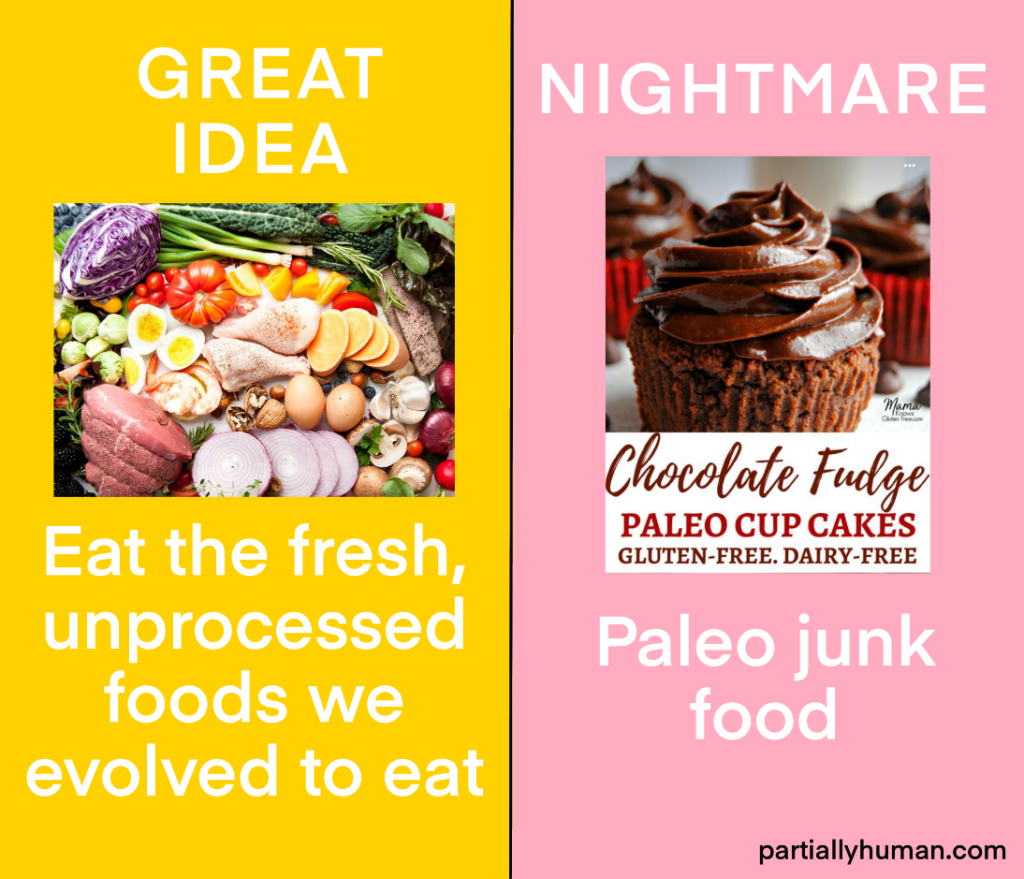
My favorite example of this is the Paleo diet. The founder of Paleo reasoned that eating a bunch of processed junk is a recipe for feeling like crap. His vision was simple: eat real foods our ancestors would recognize. He promoted a diet filled with fresh meat, fruits, and vegetables instead of our modern diet laden with sugar, industrial oils, artificial stuff, and ultra-processed ingredients. (Note: I’m not a Paleo adherent and I don’t think the diet was squarely reasoned from first principles, but it’s directionally correct and a useful case study.)
As Paleo became popular, you saw the inevitable rise of cooks adopting the idea and bastardizing it. The Paleo Cooks missed the forest for the trees, either maniacally focused on strict compliance—as if a teaspoon of sugar was akin to anthrax, or they bent the rules to their very breaking point—iterating on their existing junk food diet by creating dishes totally at odds with the entire premise of Paleo, like Paleo cupcakes. Paleo cupcakes!
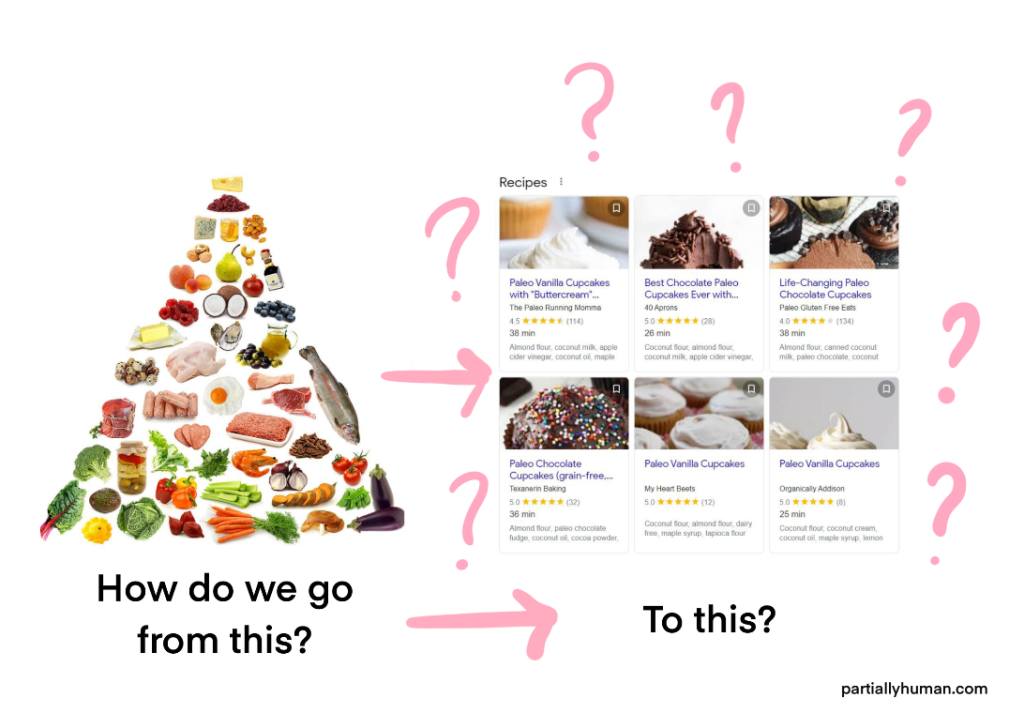
Both groups—the Paleo Compliancers and the Paleo Cupcakers—missed the point and focused on the letter of the law, instead of the spirit of it.
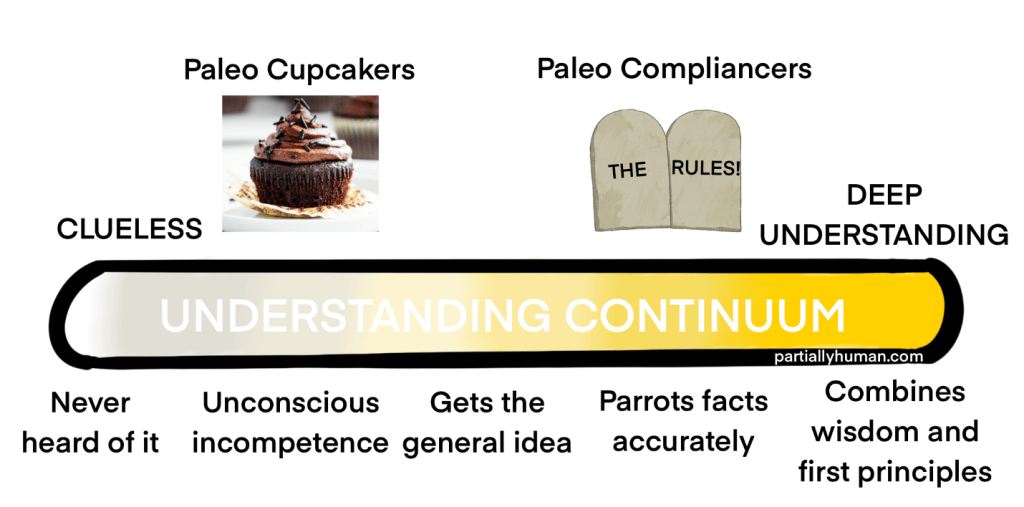
Compliancers and Cupcakers
Cupcakers
Halloween Town is full of Cupcakers—sticking to their familiar spooky recipes. As they prepare for Christmas, they sing an ominous-sounding song, Making Christmas, not at all reminiscent of a cheerful carol. They make scary toys, like ducks covered in bloody holes and hats made out of rats. They make gross decorations. They torment Santa. They modify every last detail about Christmas until it is essentially Halloween again.

Similarly, the Paleo Cupcakers bring their love of indulgent and highly processed foods to their new diet, force-fitting Paleo-ish ingredients into their existing recipes—essentially eating iterations of the exact same foods they used to eat under the guise of a diet literally designed to be the opposite of that. (Regular readers of this blog will recognize Chonk’s work at play here too.) Peter Drucker famously said, “Culture eats strategy for breakfast,” pointing out that new ideas get crushed by the inertia of existing cultural practices. So, if someone eats cupcakes for breakfast, that’s what they’ll continue to do, modifying the recipe just enough to be able to say they are in line with the new idea. Rather than overhaul their existing mindsets and practices, they’ll poke holes in the new doctrine until there is just enough space for them to shove in their old habits. This is the classic fate of any movement or ideology: people eschew the parts that are hard or icky and cherry-pick (or in the case of Paleo, cupcake pick) the fun and easy parts.
Compliancers
The Paleo Compliancers, on the other hand, latch on to rigid rules, using black-and-white thinking to squash the nuance out of the general principles. They struggle to apply the fundamental ideas in novel situations because they rely on strict guidance from above. Rather than focusing on the ostensible goal of good health, they make Paleo ideas into dogma and measure success by whether they are “doing it right.” Food choices become moral measures. This would be like executing Christmas to the letter—decorating perfectly, singing the classic carols, preparing traditional foods—while sucking all the spirit and fun and connection out of it. Obsessing about the petty details and measuring success via a rule book (i.e., tradition) can make any holiday into something your loved ones dread, thanks to you stressing people out with your tedious plans and myopic focus.

It’s normal to hunger for certainty—to just KNOW the TRUTH of things. Turning ideas into dogma gives us that delicious sense of safety we crave. Participating in groupthink and tribalism feels like being hugged by puppies while swimming in a pool of cinnamon rolls. People will always create a rule book that oversimplifies things—pinning down the dos and don’ts, then viewing success through that narrow lens. Why? “Because I say so!” “Because it’s always been that way!” “Because that’s how it’s done!” People want black-and-white text to point to that confirms their black-and-white thinking, edging out all that icky uncertainty, complexity, nuance, and relativity. This is what happens when you don’t bother (or don’t know how) to reason.
A Christmas Nightmare
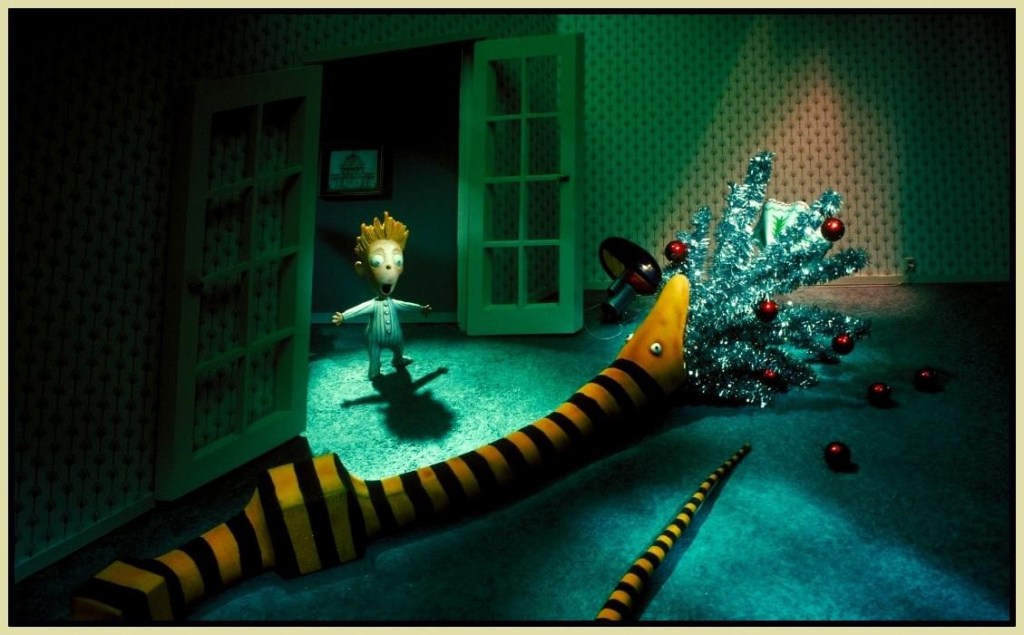
Christmas day is a disaster. Jack, dressed as Santa, carries out an abomination of the holiday where children are frightened and attacked by toys. Where Christmas trees and presents are eaten by snakes. Where decorations menacingly come to life. He utterly fails to recreate the special feeling that had inspired him in the first place. And as the news reports that “an imposter is shamelessly impersonating Santa Claus, mocking and mangling this joyous holiday,” Halloween Town claps and cheers, delighted by their handiwork.
Jack, however, is not delighted—crestfallen, the way I imagine many visionary leaders are as they watch their ideas crumble, he despairingly sings:
What have I done?
What have I done?
How could I be so blind?
All is lost, where was I?
Spoiled all, spoiled all
Everything’s gone all wrong
So how does a great idea get ruined? You get a bunch of people onboard who don’t viscerally understand the fundamental principles behind it because they failed to do the hard work of reasoning.
A Better Recipe: Thinking from First Principles
Implementing new ideas is hard. Really hard. There are inevitable and predictable limits to change, especially in large groups of fancy monkeys. And, the more important it is for people to understand and believe in the fundamental principles of an idea in order for it to work, the lower the odds of success as you scale it (e.g., Communism). Merely getting a bunch of people onboard does not a successful movement make, as we saw with Halloween Town.
My goal in writing about this isn’t to make you depressed or to discourage you from trying to spread good ideas. Instead, my hopes are twofold:
- You won’t be like the townspeople—inadvertently implementing nightmares because you’re stuck in old thought patterns—instead you’ll think things through to first principles. You’ll approach new endeavors with curiosity and an open mind, eager to understand and unafraid to ask questions.
- You won’t make the same mistake that Jack did—naively thinking that others will do a good job carrying out an idea that they didn’t arrive at through reason—rather, you’ll help others work through your thought process and ensure they understand the spirit, intent, and foundational elements of your idea. Instead of rushing to get people to agree with you, you’ll slow down and prioritize understanding.
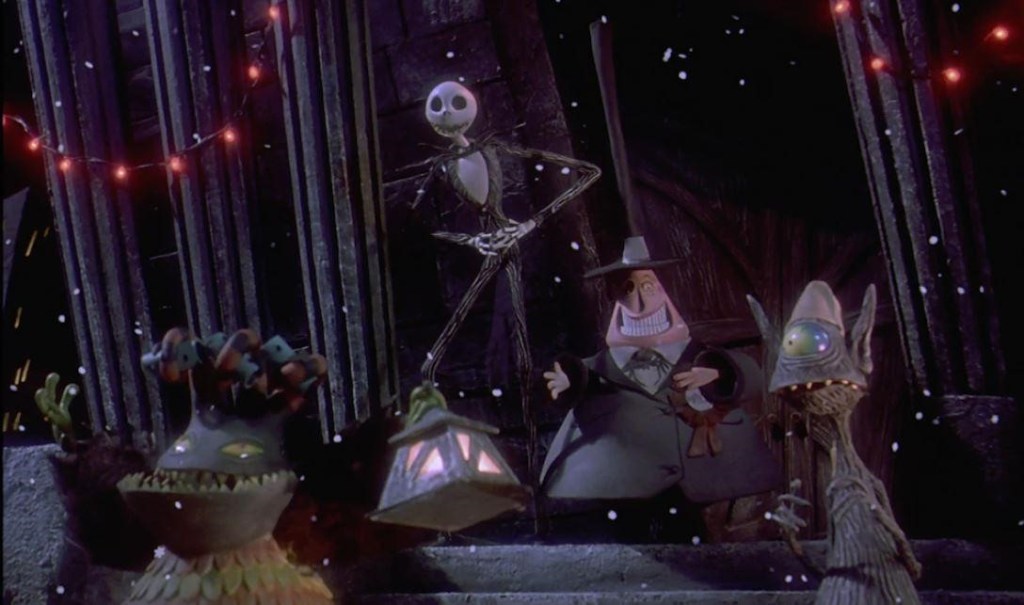
At the end of the movie, snow falls for the first time ever in Halloween Town. The townspeople excitedly sing—exactly as Jack did when he first encountered snow— “What is this? What is this? I haven’t got a clue. But it’s completely new.” They finally experienced the spark of curiosity and a taste of beginner’s mind. This firsthand experience shifted them out of their entrenched thought patterns, opening them to new possibilities.
Now it’s our turn.

Experiment: Thinking Like a Chef
STEP 1: PAY ATTENTION
How well do you understand the ideas you hold true?
What’s true?
How do you know things are true?
What unexamined beliefs do you hold?
What mindsets and practices do you adhere to simply because they are convention?
How often do you arrive at conclusions by reasoning through the available data instead of accepting information at face value?
It’s hard to unearth our faulty reasoning because our thoughts feel true—remember, being absolutely right and being spectacularly wrong feel exactly the same. So here’s a good starting point: most things are made up by fancy monkeys and every idea is—at best—a gross oversimplification of complex phenomenon. Very few things are absolutely, unequivocally, universally true. Even math, which most people hold to be totally true, is a flawed representation of reality—Google it. A bunch of fancy monkeys invented the rules for math, and those rules are imperfect—often failing to follow nature and align accurately with reality. So what else isn’t true?
STEP 2: GET CURIOUS
This is the fun part. QUESTION EVERYTHING!
Ask questions until you arrive at the most basic truths or elements of an idea:
- Why do I think this?
- Is it true?
- Can I absolutely know it’s true?
- How do I know it’s true?
- Turn the thought around. Is the opposite as true as or truer than the original thought? (Dig into Byron Katie’s The Work to see more about this. Her process is a simple way to loosen entrenched thought patterns.)
- What are some alternative explanations and perspective? Are any of those true or valid?
- What evidence supports this view? What evidence contradicts this view?
- Is the evidence true?
- How do I know that?
- Why is it true?
- Why?
- Why?
- Why?
This way of thinking is freeing, breaking you out of mindsets and practices that don’t serve you. Often you’ll find that most cultural practices—while arbitrary and nonsensical—are relatively harmless. Conventions and norms are convenient, necessary conduits for civilization. Customs like Christmas are full of silly, made-up traditions that bond groups and make life fun! We don’t need to overthink everything or expect total rationality. But unexamined beliefs bear responsibility for a significant share of our most intractable problems. Bad ideas are the monsters hiding under your bed, wreaking havoc on your dreams. Staying curious and open-minded keeps the nightmares at bay.
What ideas and beliefs do people hold that aren’t true? Please share your thoughts in the comments or on the Partially Human Facebook Page!

Thanks for sharing. I read many of your blog posts, cool, your blog is very good.