
Gen Z, Emojis, and Monkeys

The one about how Gen Z uses emojis in a way that is age appropriate but also makes me sad.
According to a slew of recent articles, Gen Z interprets emojis differently than older generations do. This is not surprising; each generation has their own communication idiosyncrasies, pop culture references, and slang words. But what struck me most about these articles was how Gen Z’s interpretation of emojis skews toward the negative—inferring sarcastic, ironic, and rude intentions from seemingly innocuous digital images. Are they just a bunch of buttholes? Or is something else going on?
Today’s post will look at why each generation interprets emojis differently, why we should have some empathy for Gen Z’s darker interpretations of things, and also stuff about monkeys.
How Different Generations Interpret Emojis


The irritating slant on most articles about emoji interpretations positions things as if Gen Z is in-the-know about correct emoji usage and the other generations are embarrassing themselves and showing themselves to be out-of-touch by using emojis differently.
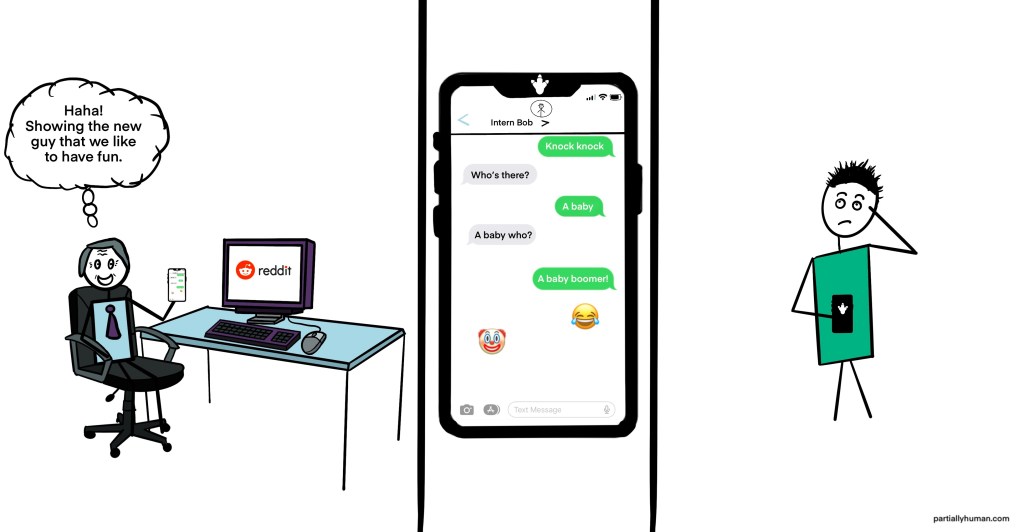
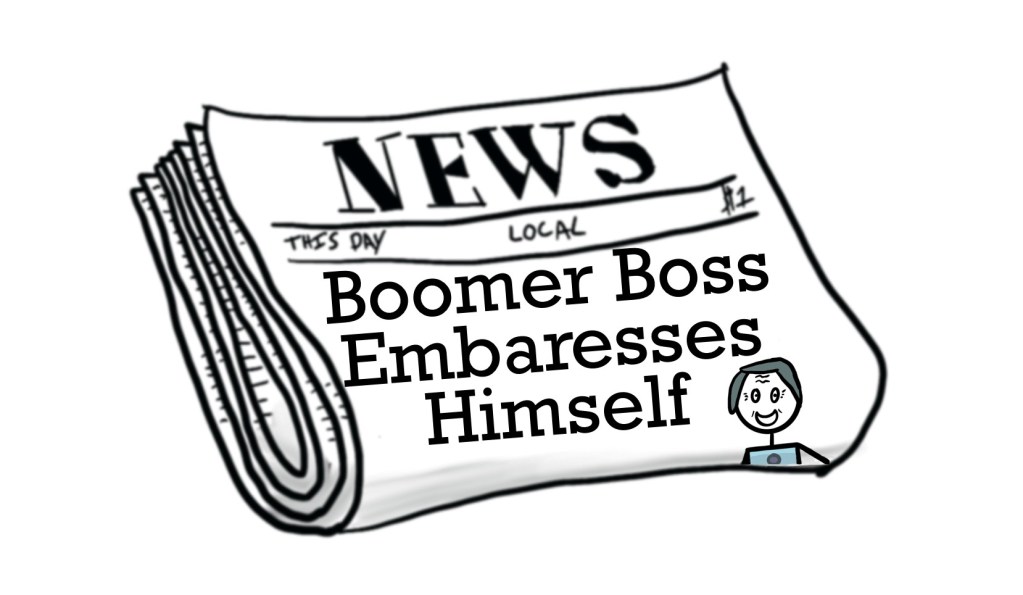
That is nonsense that needlessly pits us against each other over silly things—the epitome of the narcissism of minor differences. The meaning behind symbols, like words or emojis, is entirely made up by us, a bunch of fancy monkeys.
There is no objectively true, correct, absolute meaning behind a skull-and-crossbones or eggplant emoji—they mean what we collectively agree they mean.
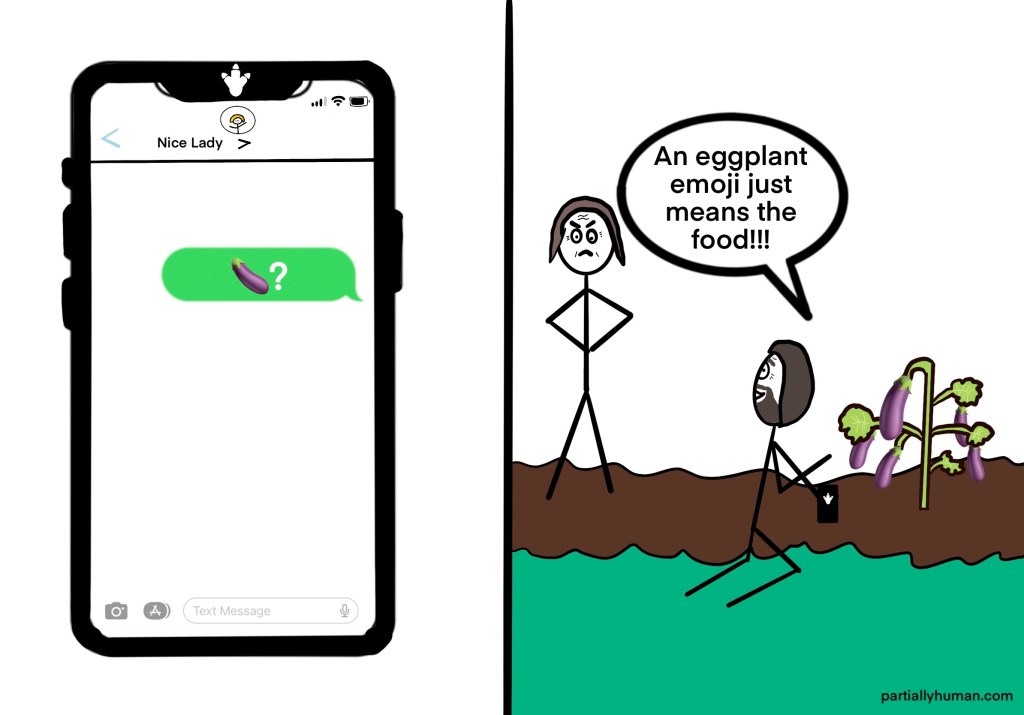
This is important to remember, because people argue as if their emoji interpretations are right. That view is inaccurate and unproductive.
Here’s what matters: when someone sends or receives an emoji, what message do they think is being communicated? We co-create meaning, and thus must continuously navigate the ever-shifting message intended by language.
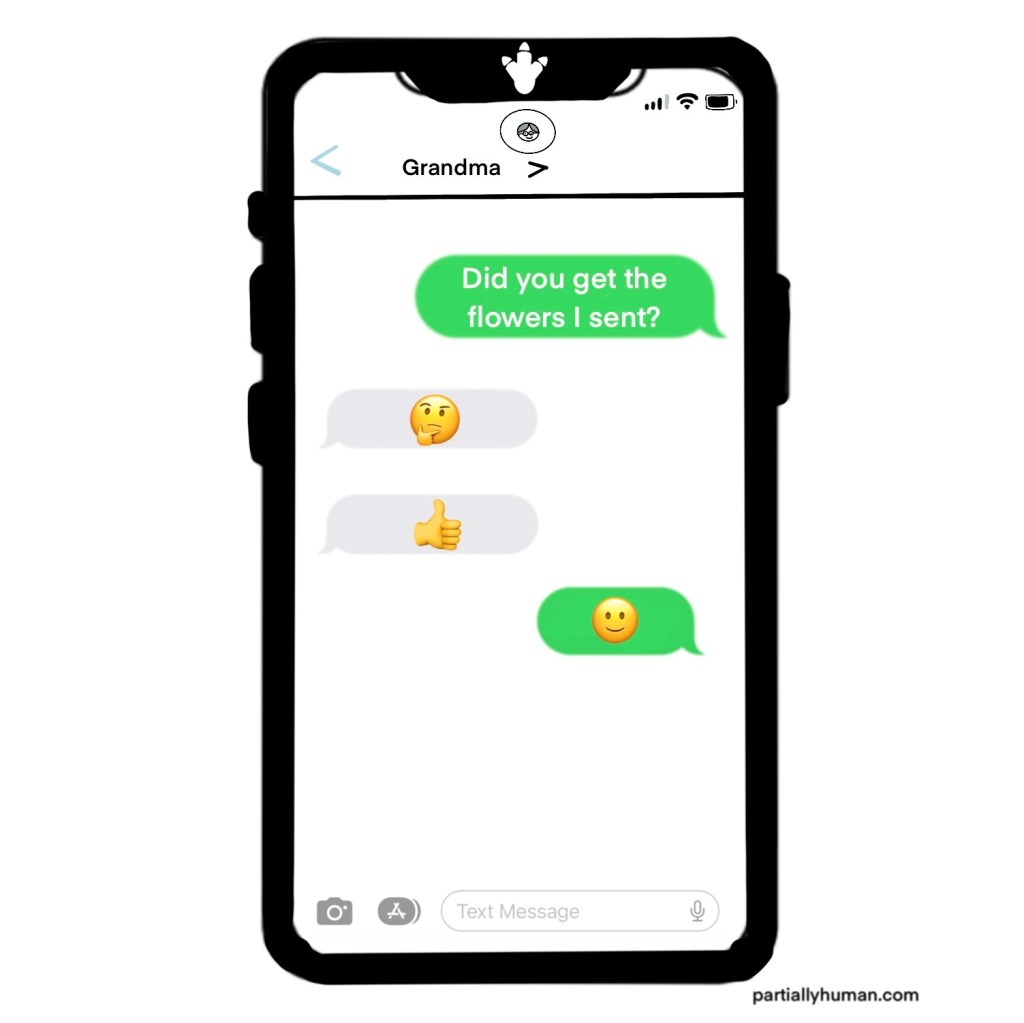
Quick test: what possible misinterpretations could there be in this exchange between a grandparent and grandchild?
Let’s find out what different generations think they’re saying with emojis. I’ve compiled examples of controversial emojis, where different age groups tend to interpret them to mean different things.
(FYI, in reading a bunch of articles about this topic, sometimes the distinction between millennials, Gen X, Baby Boomers, and beyond was unclear. Occasionally, millennials were noted as using certain emojis differently than Baby Boomers, but it appeared that overall the older generations mostly interpret emojis similarly, so I just lump them together, when applicable.)
Loudly Crying Face

- Gen Z might use this when laughing at something inappropriate or traumatic, like someone getting injured. It can also be used to express overly dramatic feelings.
- Millennials might use this for sadness or overwhelming happiness, depending on the context.
- Older generations use this to mean very sad.
Slight Smile Face

- For Gen Z, it can passive-aggressively be used to express awkwardness or discomfort, like a fake smile, or it can be used ironically.
- Older people view this as a pleasant, friendly expression.
Thinking Face
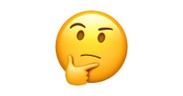
- Gen Z uses this to signal that they think an opinion is dumb.
- Older generations use it to indicate that they need to think about the question or information.
Crying Laughing Face

- Gen Z doesn’t use it, and thinks it is uncool and for older people. If they do use it, they use it ironically, to make fun of someone who would use it.
- Older generations use it to mean that something is funny.
Thumbs Up

- Gen Z sees this as rude, like a sarcastic or passive-aggressive “good job.”
- Older generations see it as straightforward “okay” or “I got it” or “I agree.”
Miscellaneous Emojis to Indicate Attractiveness
Gen Z has a wide variety of emojis that signal someone is hot. To name just a few:
- Pregnant woman

- Hourglass

- Fire (depending on context)

- Hot face

- Weary face

Millennials might use the fire emoji to signal hotness, but other than that, I struggled to find any emojis that older generations commonly use to indicate that someone is attractive. Usually, they would just use words to call someone good looking.
Review
Let’s review our earlier example of a grandchild asking their grandma whether they received flowers. Here’s how that exchange might have gone, given how different age groups interpret emojis.
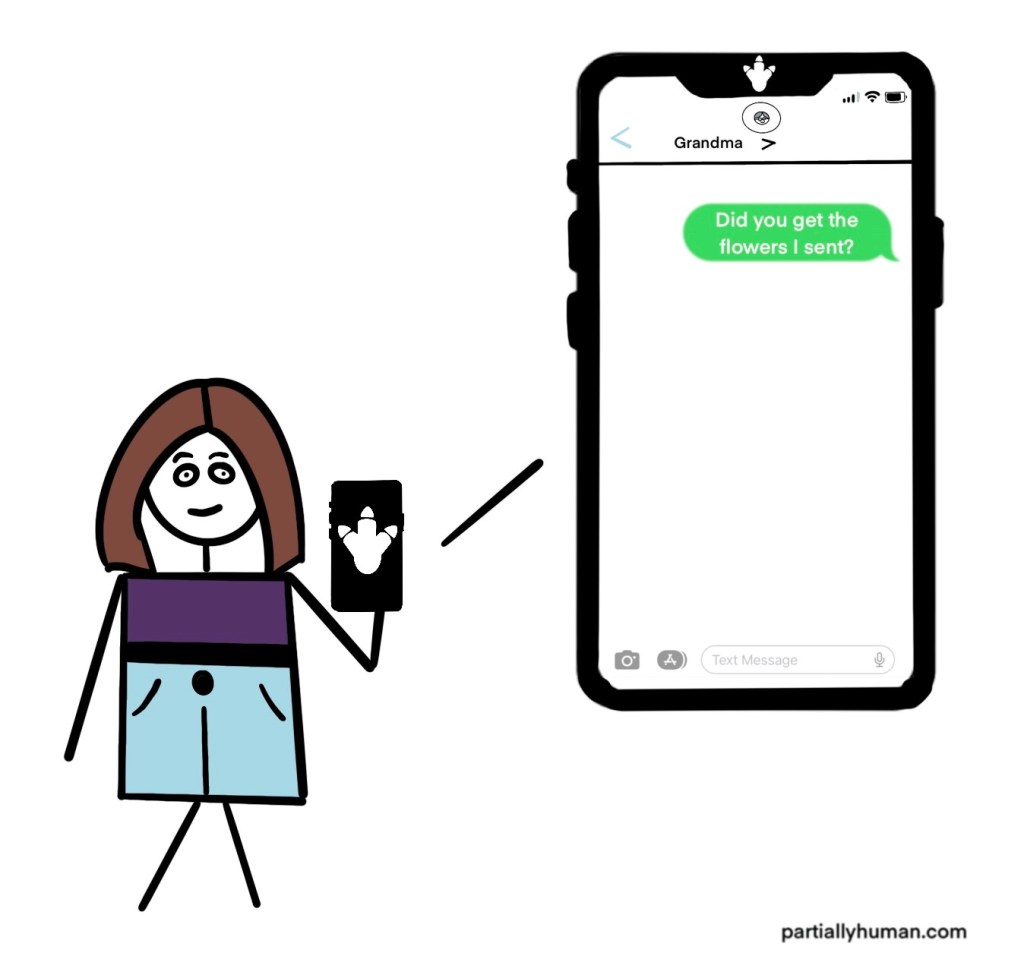

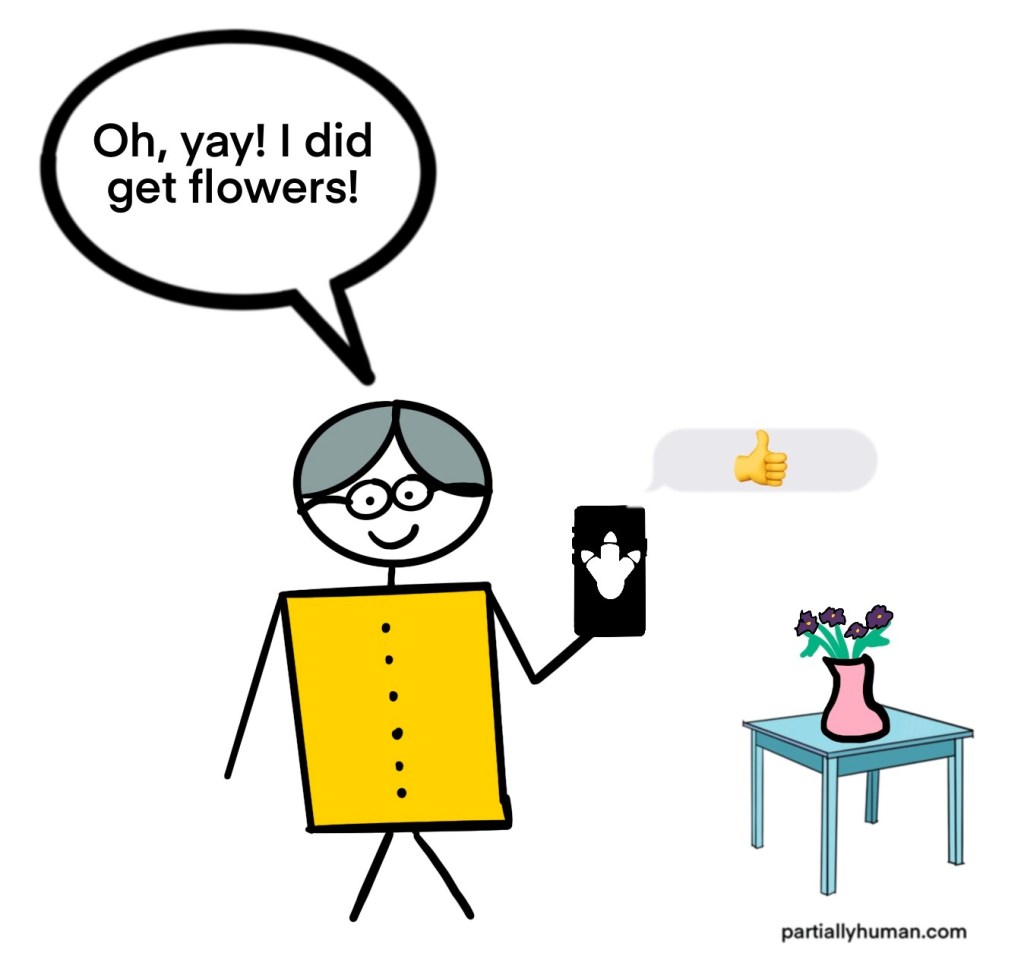
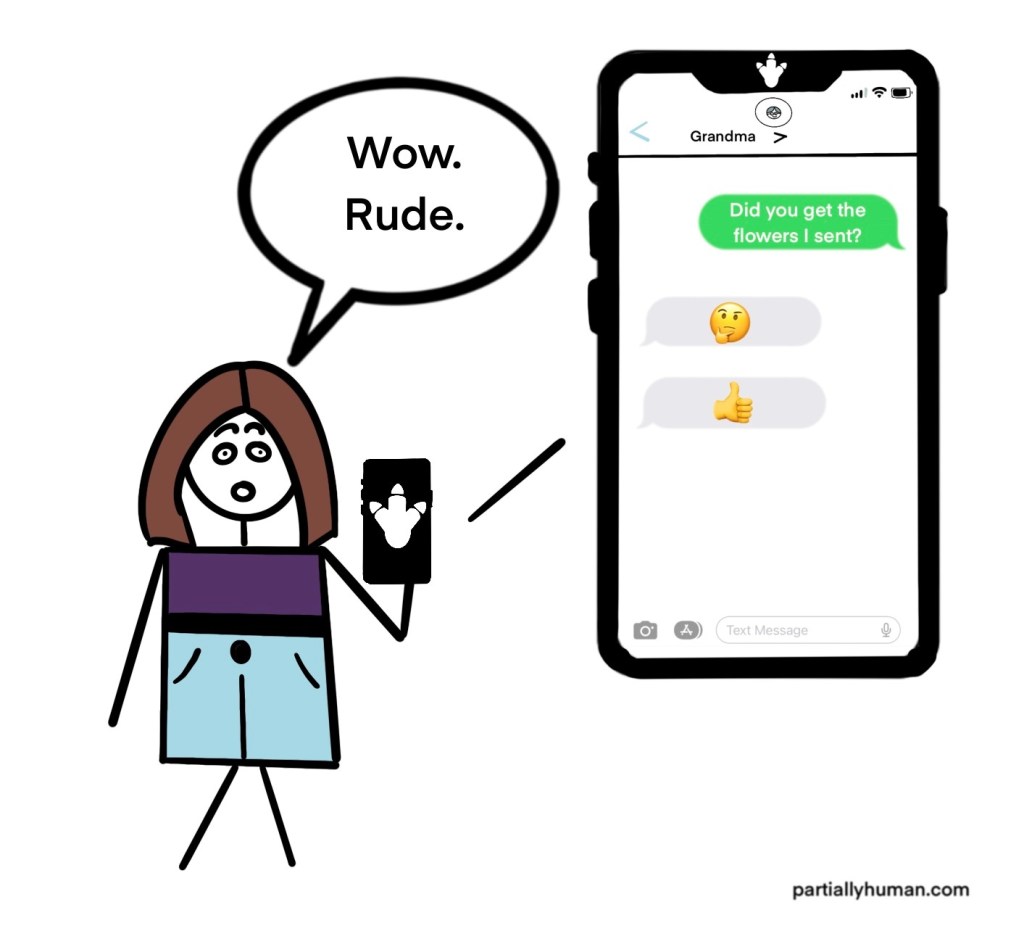

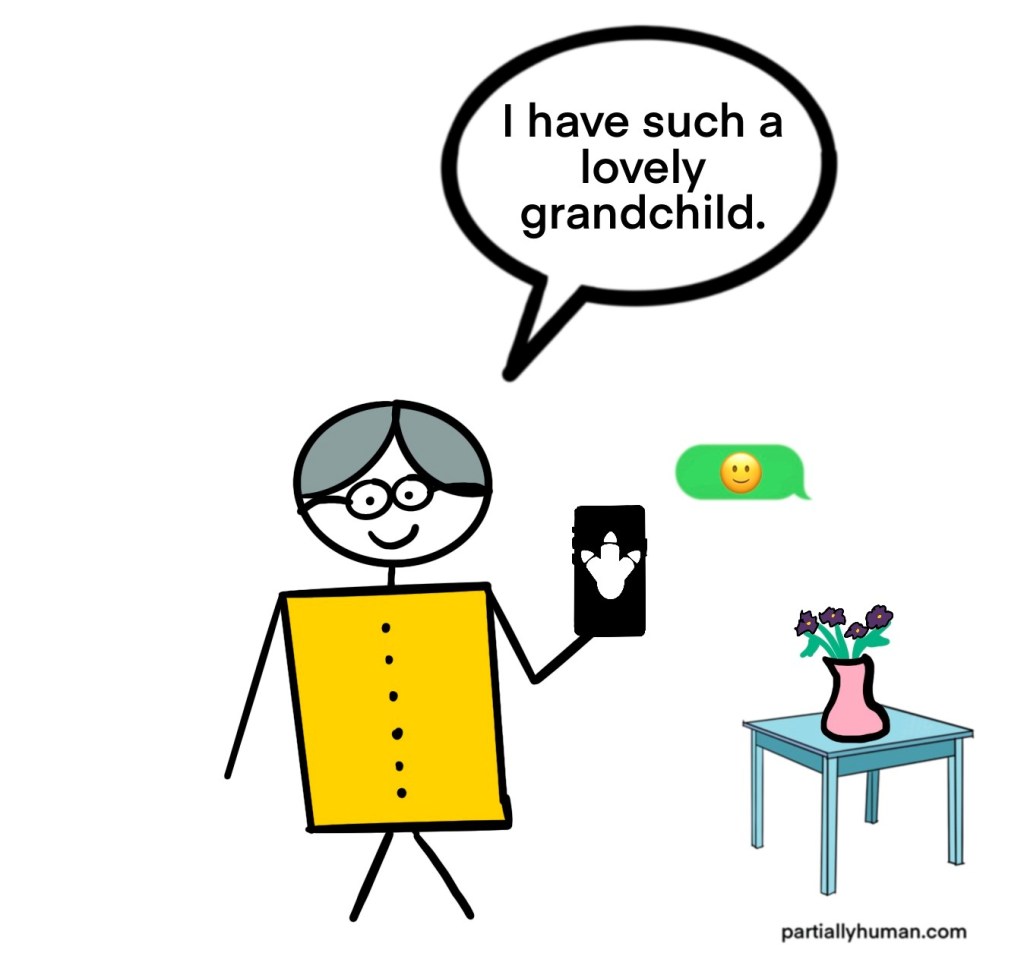
Opportunities for miscommunications abound, much like in one of my favorite Key and Peele sketches.
Thematic Differences
Did you notice any patterns emerge as you saw the differences between generational emoji usage?
One major difference that caught my eye is that Gen Z’s emojis are more likely to be sarcastic, ironic, or passive-aggressive—in other words, not nice. And this wasn’t just me cherry-picking emojis. I was unable to find a single emoji that Gen Z uses in a more wholesome way than other generations do. In fact, I left out dozens of examples of Gen Z taking seemingly sweet emojis, like the heart or the smiling with hearts face, and making them insulting. (More on why that is later.)
Another big difference is that interpreting Gen Z’s emojis tends to require more context and a broader cultural understanding. And then each subsequent generation’s emoji usage gets progressively more literal and straightforward. Let’s dive into why that is.
Why Do We Use Emojis Differently?
Some attribute the differences between how the generations use technology to the fact that they had these devices introduced to them at different points in life. But I don’t think that just because Gen Z had access to smartphones as infants explains why they use emojis the way they do. These different communication tactics clearly map on to how one’s communication abilities evolve over time.
Communication Evolves Throughout Your Life
There is a spectrum of how sophisticated our communication skills are. We all start out as babies, communicatively inept. And over several decades, we continue to improve in our ability to get our message across effectively. (To be clear, I’m not saying that all 80-year-olds are better communicators than all 20-year-olds. Just that most people tend to improve over time, resulting in a proportionally higher concentration of skilled communicators in older age groups.) The most advanced communicators can write thought-provoking books, give compelling speeches, deliver witty banter at parties, debate opponents intelligently, and convey their message clearly, directly, and persuasively. Think: Oprah, Tony Robbins, Neil DeGrasse Tyson, Brené Brown, Tim Urban, Marcus Aurelias, Mark Twain, Socrates.

(FYI, those on the right side are supposed to be Oprah and Socrates. But I’m sure already knew that based on how hyper realistic my drawings are.)
The Journey from Baby to Dog to Monkey
Human babies are born with communication skills less sophisticated than a toad and more sophisticated than a Pop-Tart. We can’t do much more than cry and make random noises, in hopes that our caregivers will correctly interpret our cryptic messages. By our toddler years, we can finally communicate about as well as a dog can. And then something fascinating happens in puberty, we make a great developmental leap forward, achieving the social sophistication of monkeys.

This probably sounds like I’m being rude, comparing teenagers to monkeys, but not at all! Monkeys have sophisticated social skills that enable them to form tribes, navigate complex hierarchies, and cooperate at scale. This is why, in our teen years, we become hyperaware of what others think of us. Our brains place enormous value on fitting in and being a desirable, capable member of the community. And our peer group, our tribe, sets the standard for what constitutes “desirable.” So our communication morphs to demonstrate that we are part of the in-group, to raise our social status, and to solidify our group bonds. This is a critical developmental milestone. It’s also a painful one. (More on that in a bit.)
(To be clear, I’m not saying teenagers and monkeys have the same intelligence. We surpass monkeys in our ability to reason and think abstractly at a very early age. It’s just that many skills and values we share with monkeys come sharply into focus in our teen years, heavily influencing our behavior.)
From Monkey to Fancy Monkey
And then, at some point in our 20s or 30s, we transition into being Fancy Monkeys, where our pre-frontal cortexes develop enough to reign in some of our more animalistic tendencies.

Around the time we become Fancy Monkeys, we settle into using words and phrases and emojis that we’re comfortable with, that we’ve been using for years, that other people also use and understand. We don’t pick up new slang as readily, and neither do our peers—so there isn’t much reward for doing so. And critically, what becomes of primary importance when communicating is that other people interpret what we are saying correctly. Language becomes less about signaling how cool or trendy we are.
Don’t get me wrong, adults of all ages are still monkeys—we are still petty at times, we want people to be impressed by us, and we have moments of impulsiveness and short-sightedness. I continue to be amazed at how often I read articles about adults attacking fast food workers and giant brawls breaking out at Waffle House. (I tried to add a video of Waffle House fights here but YouTube restricted it as adult content that you can only view on their platform. Sorry.)
We are animals! Not surprisingly, incidents like giant Waffle House fights usually involve alcohol, which impairs your pre-frontal cortex—the exact part of the brain that is not fully developed yet in people under 25. So alcohol brings out our more primal monkeys to play. That last evolved monkey never fully goes away, he’s just constrained more effectively.
It’s true, even as older, wiser, fancier monkeys, language continues to be a status symbol, signifying things like what groups we identify with (e.g., social class, political groups, internet groups dedicated to discussing doggos) and how smart we are. But as we become fancier versions of monkeys; we use our pre-frontal cortex more often, we become more objective, more compassionate, more understanding, and less impulsive. And as we mature emotionally, our thinking becomes less black and white, we become more comfortable expressing our emotions, we’re less afraid to be vulnerable, we don’t fixate on blaming others, we become better at setting healthy boundaries, and our self-esteem becomes less fragile. Each of the changes corresponds to changes in how we communicate. I’m just speculating here, but I don’t think Oprah uses emojis like this:

Sophisticated Communication
As we mature, our speech—and emojis—morph toward conveying messages using language that is:
- Clear
- Direct
- Respectful
- Empathetic
- Kind
- Honest
And as we get older, our responsibilities demand more of us. As we build our career, develop fulfilling relationships, raise a family, and try to live a good life, the communication skills listed above are necessary. Sarcasm and passive-aggressive jabs won’t take you far in the workplace or in your marriage.
Some might take my message to mean that Gen Z are the ones using emojis inappropriately and that Millennials are indeed not using emojis “wrong.” That’s missing the point. The point is that what Gen Z is doing is developmentally appropriate. And, ideally, we would have some empathy for what they are going through, because it’s pretty sucky to be that age—currently ages 11 to 26—and mired in monkey culture.
The Miserable Monkey Years
Being a monkey is hard. Monkeys are clearly some of the unhappiest animals on earth. Their lives are filled with drama and anxiety and insecurity and bullying and violence—just like humans between middle school and college-age, AKA our monkey years. During this time, our monkey-programming turns on in full force.

Our values change in our monkey years—in important ways—that eventually make us productive, functional members of society. We start caring about status (which correlates to our ability to add value to the tribe), about being perceived as sexy by potential mates (which correlates to our ability to reproduce), and about belonging (which correlates to us being able to cooperate with others) —all things that play a role in success (but not happiness). We live out those values in crude, primitive ways in our early years. It’s a painful progression through an unkind jungle. Mean Girls did a great job capturing exactly what it’s like.
Being a teen/young adult is hard. The self-consciousness alone is reason enough to feel for our younger monkey brethren! It’s such a confusing and frustrating time, when we are just past the threshold of puberty but not yet established(ish) adults. During that time, to achieve status, we prove our mettle by doing risky things, like pouring hot sauce up our butts. To make ourselves attractive, we obsess about wearing the trendiest clothes and posting flattering pictures. To bond with our tribe, we create arbitrary cultural artifacts, like dances or slang words, to denote in-group vs. out-group credentials. And the only way to keep up is a lot of monkey-see monkey-do.
And there’s so much confusion. And insecurity. And existential angst. And we just want to fit in. And that’s hard to do. (Read about when I was a closeted Barney Lover here.) And we want to matter. And we aren’t sure whether we do. And we want to be good, worthy members of society. But it takes a long time to develop the knowledge, skills, and abilities necessary to contribute meaningfully—and we’re impatient. (This is why stories like Harry Potter and Stranger Things are popular—we love the idea that we can change the world despite having zero training or experience.)
The monkey years are a painful, awkward, stressful developmental stage. And one way this manifests is in a power struggle with older generations.
Climbing the Monkey Status Hierarchy
As teens become aware of society’s status hierarchies, they begin to care about where they fall on those totem poles. And they quickly realize that they are at the bottom of the heap, in most cases. If you look at most conventional measures of success—competence, resources, power, influence—younger people have less of those things. That sucks. It hurts the ego. It’s psychologically painful for us primates to be at the bottom of the pack.
But learning how to skillfully navigate hierarchies is critical to effectively functioning as a human. And our monkey years are when we are thrown into the deep end to learn how to swim through complex social structures.
Imagine being 12 years old and realizing you don’t have the attractiveness of a Playboy Bunny, you don’t have the wealth of a Silicon Valley tycoon, you don’t have the expertise of a doctor, you don’t have the fan base of an actor, and you don’t even have the authority of a janitor. And at 12 (give or take a couple years), your monkey-tendency to compare yourself to others starts kicking in at full force. You are comparing yourself to everyone all the time to assess how you stack up. And you rarely come out on top! Basically, you can only feel superior to elementary schoolers, the handful of “weird kids” in your class, and super dysfunctional people on reality shows.
How do you grapple with this set of circumstances? What are your options?
A. You could stop comparing yourself to other people. (Lol—good luck with that one!)
B. You could do the painstaking work to develop yourself over the course of many years, and deal with feeling like a pile of poop in the moments when you compare yourself in the meantime.
C. You could redefine success to instantly become an impressive, noteworthy group member.
Option C looks pretty good, huh? So rather than try to exclusively play by the (also arbitrary, made-up) rules set by people with the upper hand, we form our own in-groups with our own rules. We form coalitions with our peers. This makes us feel powerful and gives us a sense of belonging. Those outside the group, like older generations, begin to feel like they are Other—they don’t understand us; they don’t appreciate our newfound culture; the way they do things is lame.
So we make new social standards.
And just like that—ta da!—we’re winning. We’re cool. We’re valuable. We’re worthy. Success now means wearing the right hat and knowing the latest TikTok craze and being good at yo-yoing and using emojis a certain way.
Creating our generation’s own rules, culture, and measuring stick is our training ground for operating in groups successfully AND a shortcut to rising up the ranks faster. It’s a win-win situation for young people. It’s a reasonable and rational reaction to their circumstances. It makes total sense. Why not let young people feel a sense of purpose and gain a little self-esteem from mastering things that adults would consider useless?
And yet, older adults tend to feel tremendous resistance toward younger people making their own rules. Each generation grumbles about the one following it, complaining about what’s wrong with kids these days.
There Is Nothing Wrong with Gen Z
It’s silly how adults bemoan the natural and predictable behavior of younger people. While it’s frustrating to watch someone with less knowledge and experience make mistakes, I don’t think in this circumstance they are making mistakes. They are progressing nicely along, developing increasingly sophisticated social and communication skills. It just APPEARS that they are regressing, to older people who aren’t taking in the bigger picture.
If you feel curmudgeonly toward the generation(s) behind you, you’re in good company. People have been complaining about younger generations for thousands of years. But this viewpoint is ironically the same flavor of delusion, the same absence of wisdom that the younger folks you deride are acting out.
Imagine you are the wisest, most knowledgeable, most experienced person alive. You would see the inevitable nature of how humans behave as they come of age. You would see how they couldn’t be any way other than how they are. They can’t skip over the awkward years, where they fumble around to establish an identity and forge bonds with the tribe beyond their family. To resist that truth is to be just as naïve and myopic as we accuse them of being as they obsess about wearing the right jeans and knowing what music is cool.
I love how the writer Robert M. Gay put it in the January 1917 issue of The Atlantic Monthly:
“Foolishness, radicalism, morbidity are marks of promising youth, the obvious signs of inward ferment. The melancholy pose, the affectation of pessimism and cynicism, the sentimentality, the conviction of genius, that many of us deplore or deride in certain young people, may be as natural to their age and disposition as the sense of immortality of which Hazlitt writes so feelingly in one of his essays. We should rejoice to find them. They are among the indications of spiritual growth.”
It’s normal though to be uncomfortable when someone has a different culture. It can make you insecure about how to act around them. It threatens your sense that you’re doing things “right.” It can lead to misunderstandings. And each generation develops their own culture, so there’s this inevitable friction. It seems though that one of the fiercest conflicts between the fresh crop of people coming of age and those approaching middle age is this: defining what’s cool.
On Being Cool
I think I’ve zeroed in on what the real issue is with this whole emoji thing, and it all traces back to coolness. Look, Gen Z is cooler than everyone. This is a fact. Remember the thematic differences between how Gen Z uses emojis versus older people? Gen Z more heavily uses emojis to:
- Signal that they are up-to-date on the latest trends and culture
- Be ironic, sarcastic, and passive-aggressive
- Judge how hot someone or something is
By definition, these things are cool. Per the dictionary, cool means: showing no friendliness toward a person or enthusiasm for an idea or project and/or fashionably attractive or impressive. Young people are drawn to these qualities like monkeys to bananas. For rational reasons, at that stage of development, it feels good to be cool.
And it doesn’t feel good to be told you’re no longer cool—as happens to every generation eventually, when their successors redefine what’s cool.
My fellow Millennials are grappling with their/our fall from coolness. I’m personally glad that we are not cool anymore. I’ll admit, I initially balked when I saw articles about how Gen Z thinks we are “cringe,” wearing our skinny jeans and using the word doggo. But then I remembered what it means to be cool, per Brené Brown:
“Cool is the need to be perceived as completely in control, completely certain, risking no emotional exposure at all. It’s the straightjacket of, ‘I’ve got everything managed.’ It’s emotional stoicism, not emotional exposure.”
Being cool is the currency of the land for teenagers, and it comes at a great price—your earnestness, your vulnerability, and your ability to be your authentic self. Coolness hinders your ability to connect meaningfully with your fellow human beings. Here’s what it looks like to be cool.
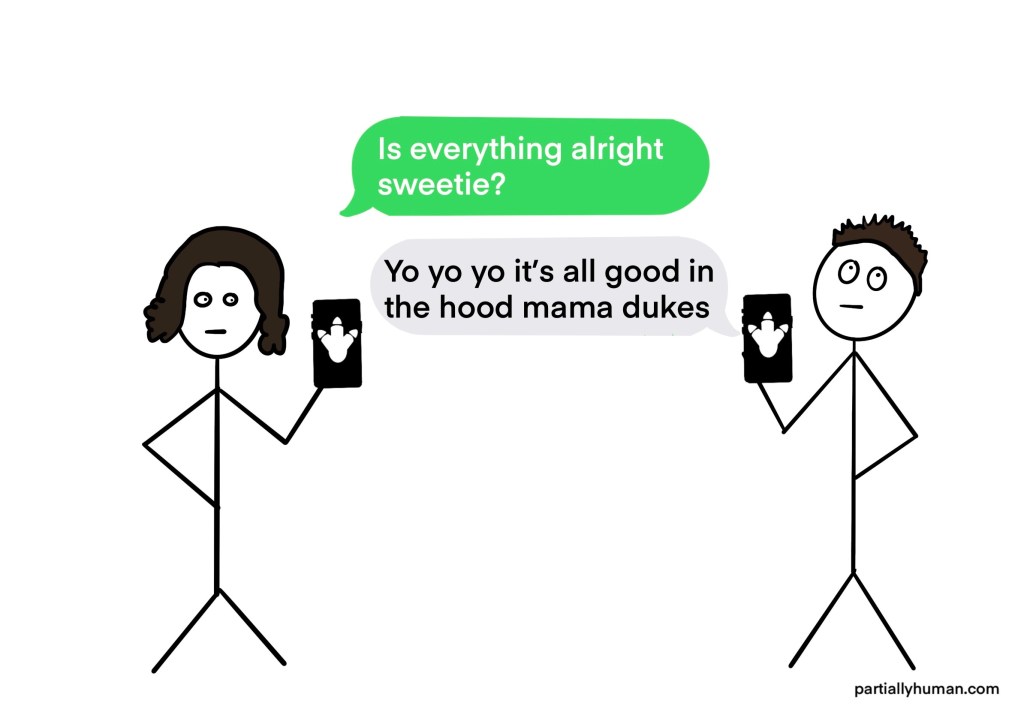
Here’s what it looks like to not be cool.
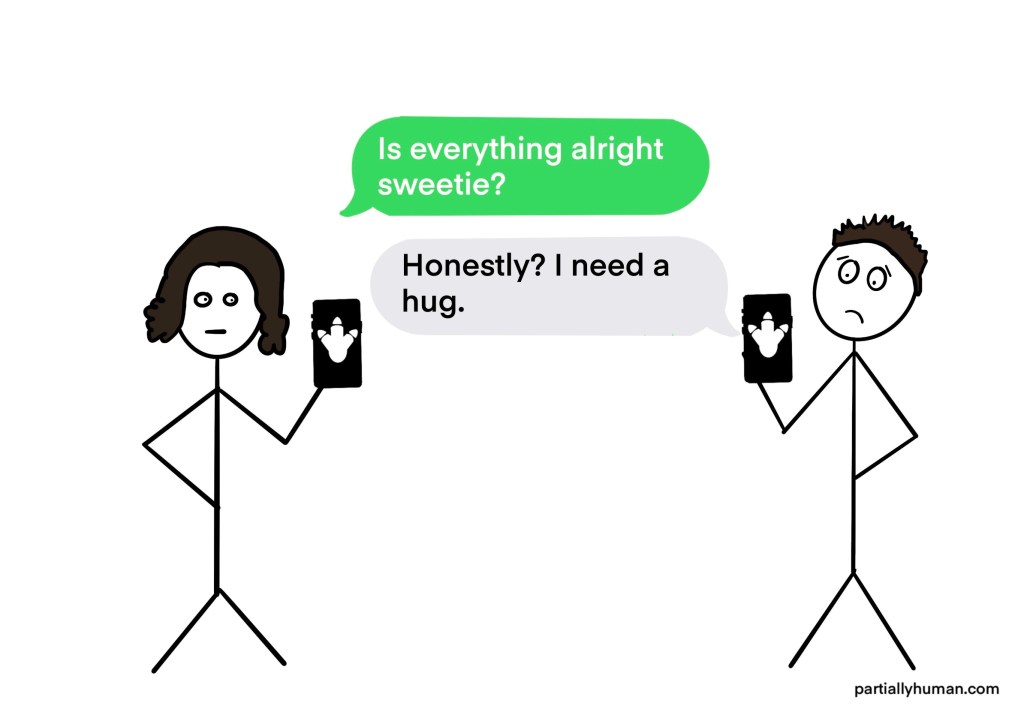
Older generations, rejoice in your uncoolness! You are getting a much better deal—clear and direct communication, empathy, and kindness. We should have compassion for the poor Gen Zers who are still swimming in a pool of snarkiness. Extend a little extra kindness their way (but not a thumbs up or slightly smiling emoji). And remember that eventually they’ll join us in the dorky side of the pool, scoffing at the next generation’s trends.
But There Might Be Something Wrong with Gen Z
I would be doing a disservice to the topic of generational differences if I didn’t bring up some data that indicates that there may indeed be a verifiable difference between Gen Z and the older generations: their mental health. Anxiety, depression, and suicidal thoughts have proliferated for them. There are lots of factors contributing to this, but I do think it’s interesting to think about how this impacts their emoji use and how emoji use also impacts their mental health.
When I was in high school, a boy on my school bus told me I have a big forehead. (Oddly, I don’t. So that was a weird insult.) When I got home, I cried (despite the lack of said big forehead). And as the memory of the incident faded, the emotional sting did too. If he had texted me a rude emoji about my forehead, I could have kept looking at it to refresh the emotional reaction. I could have relived him telling me that over and over.
So the damage teens are doing to each other when they type out their snarky, passive-aggressive comments is more severe and longer lasting than when you might hear something rude muttered in passing. That’s definitely one dynamic that makes their monkey years extra miserable. And another one is, that if a group is suffering from worse mental health—for whatever reason—then that is going to bleed into the broader group dynamics. You know the old saying “hurt people hurt people.” It’s true. Another saying, “attitudes are contagious.” Also true. People’s moods play out online in destructive ways that fuel the mentally toxic fire of monkey culture.
So in my opinion, Gen Z has things worse. They never get to escape the jungle. They go home, to a place that should be safe, and they are still virtually surrounded by their peers. And it used to be that during weekends and summer breaks, you were only exposed to your friends and family. Now there’s no respite from the drama of the broader world. You can read daily, or even hourly, updates from some guy from your bus rating girls’ foreheads.
A Note of Encouragement to Gen Z
Dear Gen Z,
Right now, you are surrounded by the most concentrated monkey behavior you will ever experience, doing your best to survive. It gets better. When you are in your 30s and 40s and beyond, your peers will be more earnest and vulnerable with you. People will reward clear and direct communication. Your relationships will thrive in the context of kindness and mutual support. You won’t have to be on the lookout for sarcasm or hidden meanings (as often). Your clothes and taste in music and pop culture knowledge won’t matter as much. Your self-esteem will be tied to more substantive things like whether you’re living your values and contributing meaningfully to your community.
And while you will always encounter people who act like buttholes, their snide remarks won’t sting so much. You’ll even feel sort of bad for them, because you’ll know their inner monkey is calling the shots and making them miserable.
So hang in there. Enjoy being cool. Bond with your tribe. Just know not to take it all so seriously.
And be open to the possibility that older people are earnestly sending you good-natured texts. Rather than asking us to stop using the thumbs up or the slightly smiling face, could you view them in the positive spirit intended? Would you rather live in a world where dozens of emojis have rude subtexts, or one where they have positive, supportive connotations?
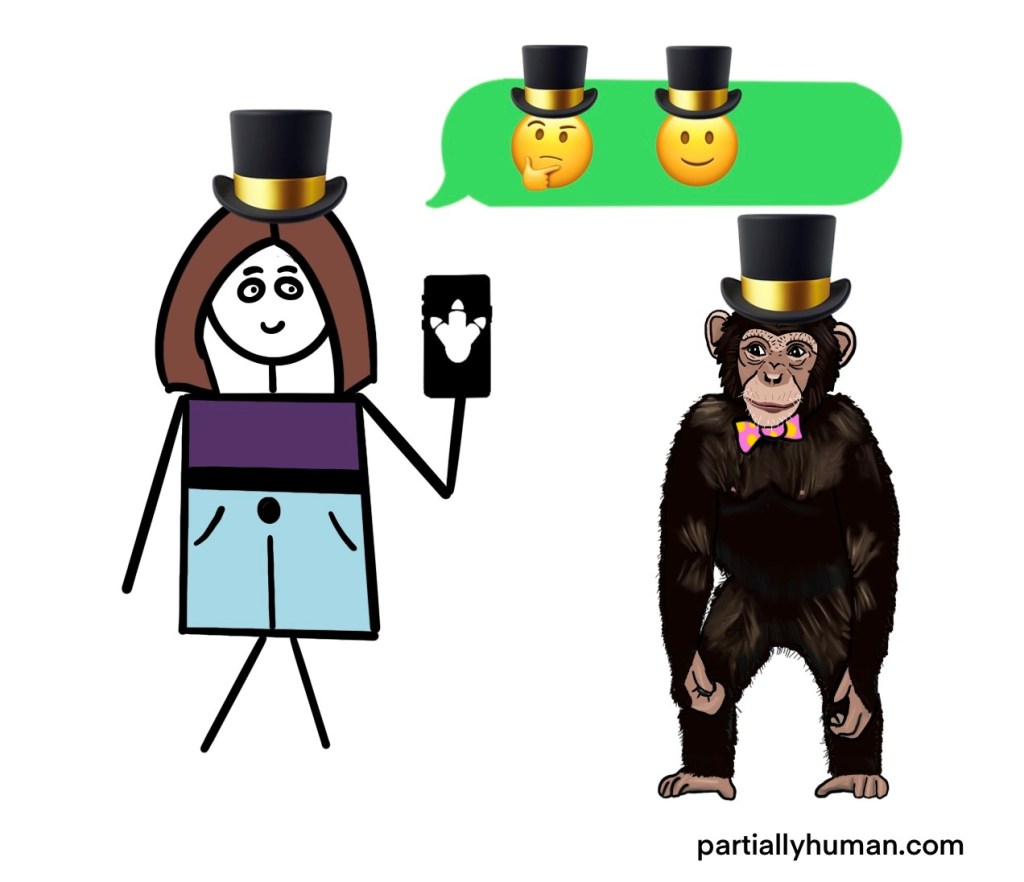
EXPERIMENT: Using Emojis like a Fancy Monkey

Your major take-away from this post should be that we sometimes use emojis to mean different things, causing miscommunications. So what do we do about that? As with any area where there is high miscommunication potential, we have to have a heightened awareness that disconnects are probable during intergenerational texting. And as such, explicitly communicating our intention and verifying with people what they mean is crucial. It’s the same as when talking to someone from a different country; there’s a heightened need to overcommunicate. And even then, things will get lost in translation, so we have to assume positive intent and give each other grace.
To that end, how can you send and receive emojis more effectively?
STEP 1: PAY ATTENTION
- What emojis do you send and receive regularly?
- Are you texting with people from different generations, who are potentially interpreting emojis differently?
- Are there people sending you emojis that you view to be unkind or ill-willed?
STEP 2: GET CURIOUS
- Does anyone think you’re being rude or passive aggressive with your emojis?
- Is it possible your emojis are being interpreted differently than intended?
- Are you certain you understand the meaning and intention behind the emojis people send you?
STEP 3: GET CREATIVE
- How can you ensure that your messages are received as intended?
- How can you verify that you understand the intention behind the texts/emojis you receive?
- How can you use emojis differently with different people to communicate more effectively?
- How can you adjust your interpretation of an emoji’s meaning, based on who is sending it to you?
STEP 4: TAKE ACTION
- Get out there and have conversations with the people in your life about these things.
- Find out what they think different emojis mean.
- Share your interpretations.
- Come to a consensus on what things mean so that there are fewer misunderstandings.
Good luck!

Comments