
Are You Guilty of Thought Crimes?
The one about grappling with unvirtuous thoughts.
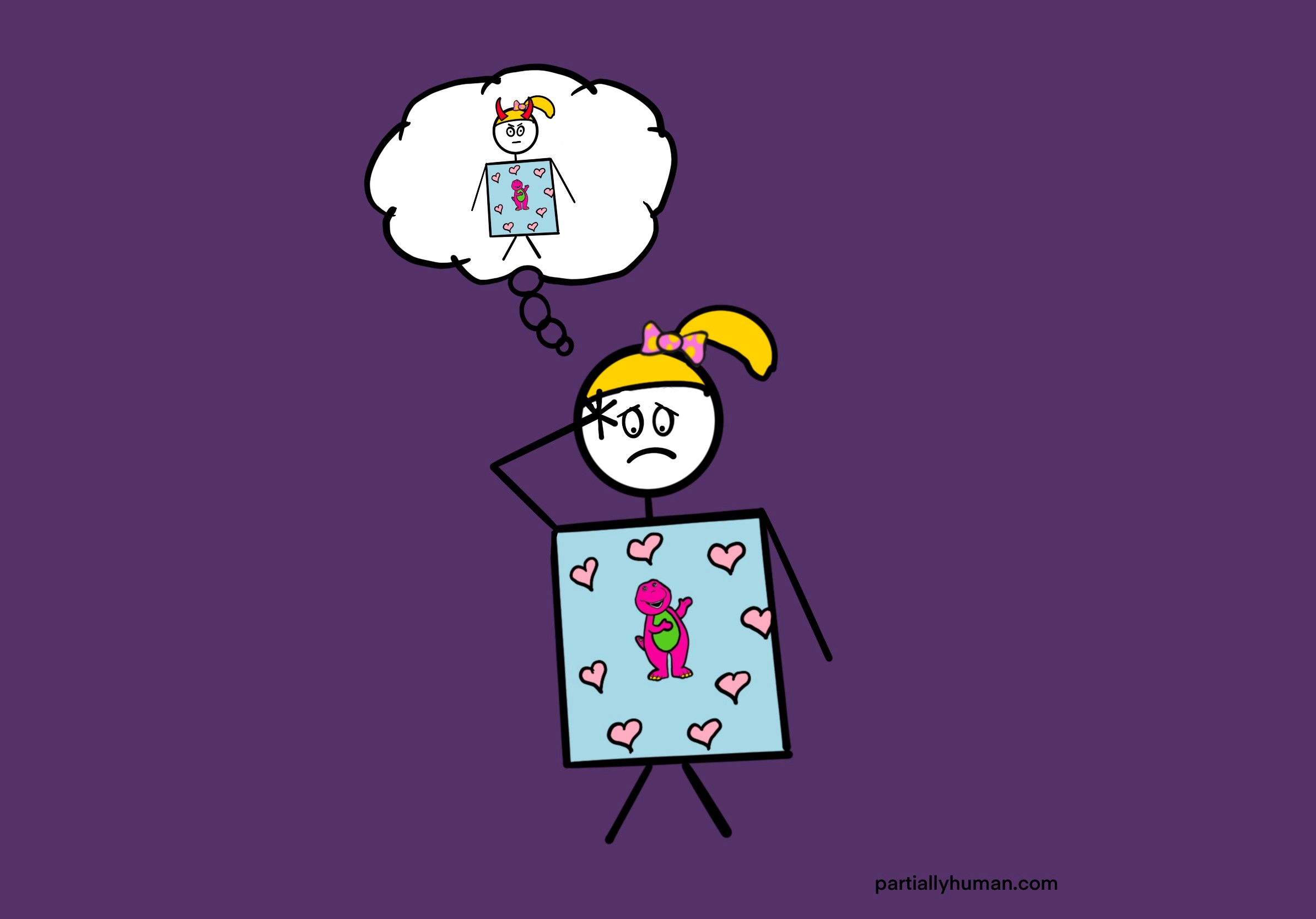
When I was in kindergarten, I couldn’t wait to go to school on my birthday. I had been anticipating this day for weeks, the day when special birthday privileges like walking at the front of the line, choosing the book at story time, and wearing a birthday sticker would be bestowed upon me. When the day finally arrived, I wore my favorite dress, made sure my mom was extra careful doing my hair, and I showed up ready to be the star of the show.

Shortly after arriving at school, it came to light that another girl, Jessica, had had her birthday over the weekend, and was sad to have missed out on the special birthday privileges granted to the lucky ones with weekday birthdays. To this day I don’t know what possessed me, but I reluctantly offered to share my birthday privileges with Jessica.
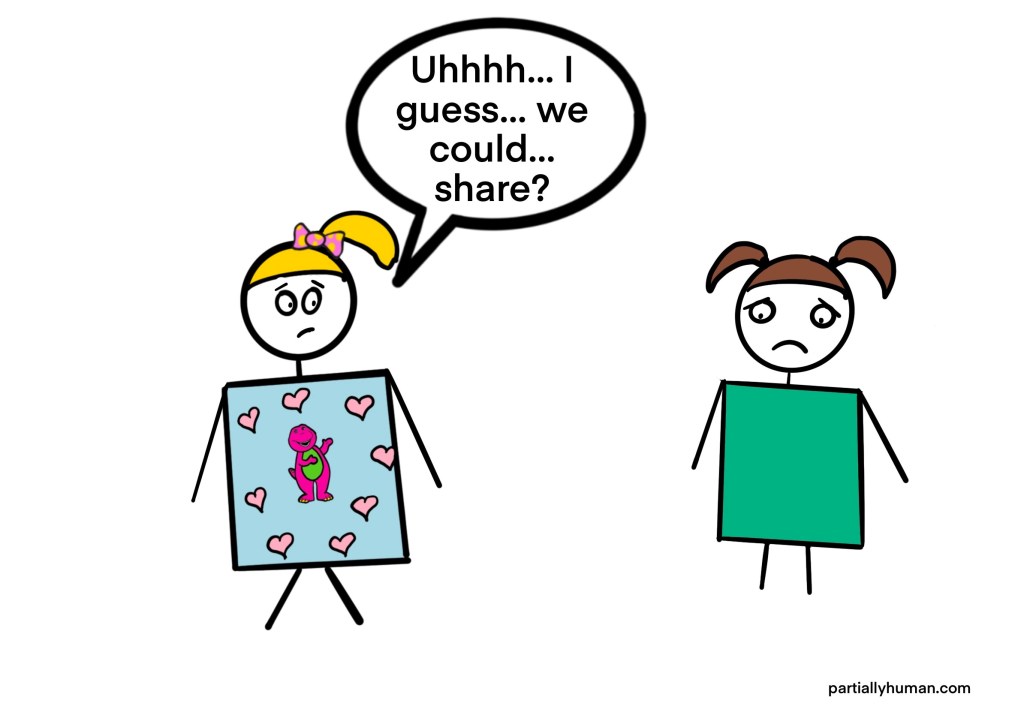
I regretted it the second the words left my mouth.
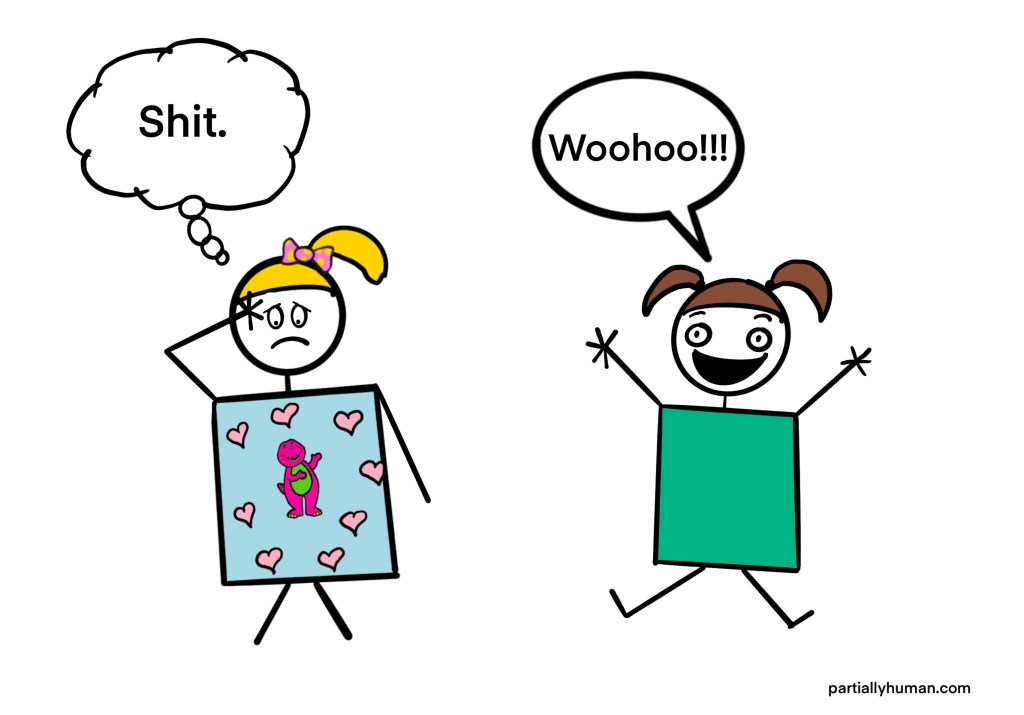
But it was too late. What was done was done. So we shared. And I resented every single second.
Good or Bad?


A question for you, reader: Was I a good person or a bad person that day?
On the one hand, I shared something I prized with someone else.

And on the other hand, I would have been thrilled if Jessica had abruptly burst into flames.
So, is doing a good deed enough to be a good person? Or do your thoughts have to be virtuous too? Was I guilty of a thought crime?
I regularly put my thoughts on trial, generally only judging myself favorably if my motives are pure. Which means, the good things I do don’t count if my heart isn’t fully in it. If I feel inconvenienced by my dog’s needs, then I’m lazy. If I don’t like spending so much money on Christmas presents, then I’m stingy. If I don’t feel like giving someone a ride, then I’m selfish. I do all the things—despite how I feel—but they don’t count, because it’s—apparently—my thoughts and feelings that constitute who I really am, not my actions.
Is that fair? Does ambivalence cancel out good deeds?
I hope not.
Are You Only as Good as Your Thoughts?
I have good reason to be hopeful that my thought crimes don’t cancel out my actions, because one key lesson cognitive science teaches is this: you are not your thoughts. This means that just because you have a thought, that thought doesn’t mean something about you. Most thoughts are generated in this random(ish), haphazard manner where your brain is spitting out something it thinks might be relevant in the moment. It’s like it’s doing this permanently ongoing, sloppy Google search and clicking on links of varying quality in hopes of feeding you something useful.
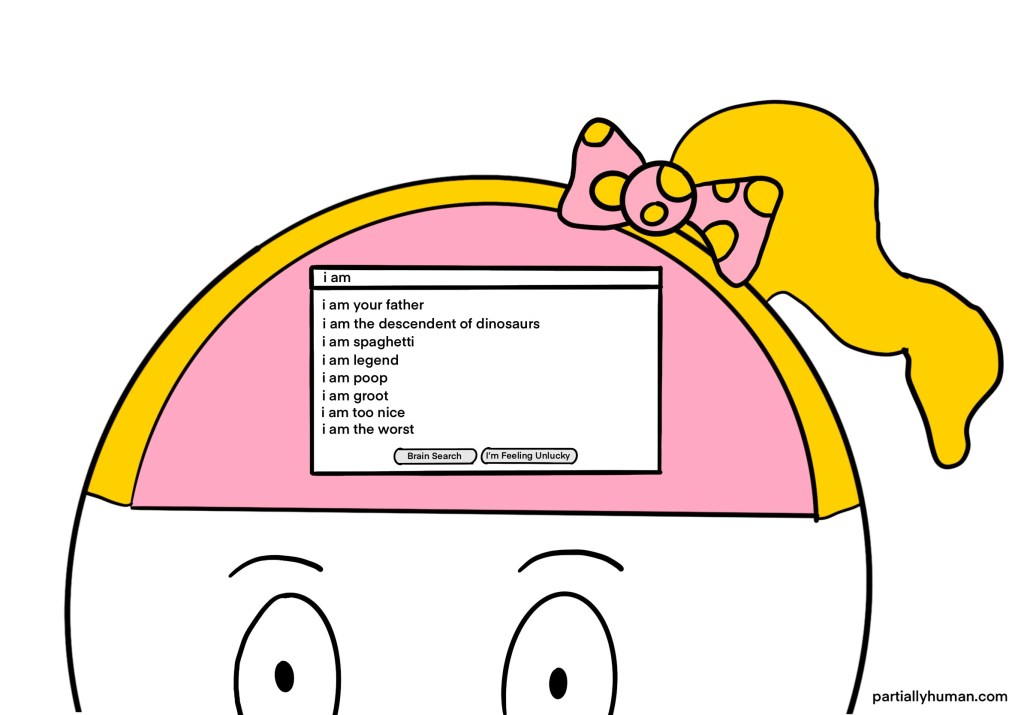
When you notice all the silly, weird, nonsensical thoughts flitting through your brain, and how you easily discard most of them, you can see how powerful it is to not identify with your thoughts.
For instance, I might think, “I should get rid of my entire wardrobe and start from scratch, buying new clothes that all coordinate with each other. And then it would be so easy to get dressed. And I would look amazing all the time. And people would be like – wow, she is so put together. And…” My brain is off and running with that thought. There are various ways I could digest this thought pattern.
What I personally would do, with this particular train of thought, would be to write it off as some silly, impracticable fantasy that doesn’t actually make any sense. I know I wouldn’t really want to get rid of all my clothes—I like a lot of them! And I wouldn’t want to spend money on a whole new wardrobe. So my brain was testing out an idea, it didn’t fit with my broader values and practical considerations, and the idea was discarded, without me thinking there is some deeper meaning about the type of person I am for thinking those things. There’s no attachment to the thoughts; it feels morally neutral.
Alternatively, my ego could get attached, and get a boost from the new-wardrobe-thoughts. I could think about how I’m such a savvy person, so efficient with my time, so fashionable, and so smart to think about approaching fashion this way. I could think these thoughts say something good about me—proof that I’m wonderful.
Or I could go the other direction. I could be horrified at how vain and materialistic I am. I could think that I fell hook, line, and sinker for the commercialistic values of a capitalist society. I could think about how greedy and financially irresponsible I am for wanting to replace perfectly good clothes with all new stuff when I know good and well I should be saving more for retirement. I could think that these thoughts are a true reflection of how shallow I am. I could equate these thoughts with my moral fiber—proof that I’m trash, deserving of a guilty verdict.
We’ve all experienced all three scenarios—realizing our thoughts lack substance, being impressed by them, and questioning our fundamental character because of them.
The urge to equate having unvirtuous thoughts with being an unvirtuous person, and vice versa, is strong. We care deeply about motives—ours and others—wanting them to be impeccably wholesome. As if humans could be as one dimensional as Teletubbies.

It’s a ludicrous standard to hold ourselves to—perfectly kind, decent thoughts. Our brains simply aren’t designed with those specifications.
Realistically Assessing Thoughts
So how do we reckon with the messy reality that we have a jumble of mixed motives? And that an inexorable part of being human involves petty impulses? Well, just that. Acknowledge and accept that reality. Trying to suppress the thoughts is counterproductive. Instead, seeing the broader pattern of how everyone grapples with these competing urges and desires depersonalizes it. Meaning, ambivalence is to be expected and it doesn’t say anything about you that you have unvirtuous thoughts, beyond that you are human. (Tip: Thoughts about what a bad person you are for having bad thoughts are JUST MORE THOUGHTS.)
Your thoughts will naturally cycle through many different sentiments in response to a situation, that doesn’t mean they are true, it doesn’t mean that you believe them, and it doesn’t mean anything about you as a person. Even if you find an untoward thought tantalizing, that just sheds light on a normal desire wired somewhere in the brain.
On my 6th birthday, I wasn’t good or bad. I was just a fancy monkey wearing a dress, a complicated being with competing motivations, someone who did something kind and also had unkind thoughts. There’s no need to issue an oversimplified, binary verdict. And there’s no need to ascribe the thoughts or deeds (kind or unkind) to mean something about me; I was a product of my environment, nature, and conditioning.
Probably not the uplifting “it’s your actions that count” messaging some might hope for. But if it’s your actions that count, then that means toddlers are the worst people on the planet.
And that can’t be right, because we all know that Jessica is the worst person on the planet.
Kidding!!!
EXPERIMENT: GRANTING THOUGHT CRIMES AMNESTY
STEP 1: PAY ATTENTION
- Do you ever feel guilty for having unvirtuous thoughts and feelings?
- Do you think you’re a bad person when you have impure motives, desires, and impulses?
- Do you ever feel like you should feel differently than you do?
STEP 2: GET CURIOUS
- When you have these “bad” thoughts, are there also other thoughts with different viewpoints?
- What makes some thoughts feel like a truer representation of you than others?
STEP 3: GET CREATIVE
- How can you disentangle your identity from these unsavory thoughts (without trying to repress them)?
- How can you observe the thoughts with less judgment?
- How can you move away from issuing moral evaluations for thought crimes?
The brain is a tricky bastard. And it takes intentional effort and time to habitually have compassionate responses to icky thoughts. So hang in there!

Oh gosh, if you only knew where my thoughts take me :). Thanks for this article, it was awesome. And I’m sure you made Jessica’s day, and she still remembers how it changed her life and made her a better person.